
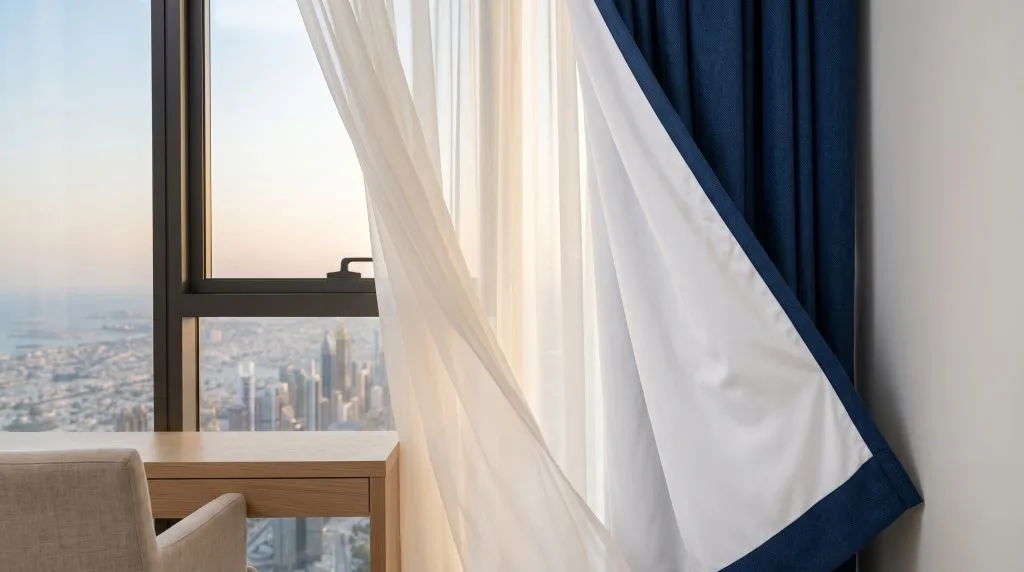
Choosing window treatments becomes significantly easier once you understand the distinct roles of sheer chiffon and curtain lining. While often considered alternatives, they solve completely different aesthetic and environmental challenges.
A sheer chiffon curtain is an exposed, lightweight decorative layer designed to soften glare, maintain natural daylight, and add fluid movement. A curtain lining is an engineered backing placed behind decorative face fabric to enhance privacy, block UV rays, insulate against solar heat, and protect premium textiles.
Quick Takeaways
- Sheer Chiffon: Ideal for daylit living areas, glare diffusion, and daytime privacy screening.
- Curtain Lining: Essential for night-time privacy, room darkening (dimout/blackout), acoustic damping, and thermal insulation.
- The Ideal Setup: An independent double-track system with sheer chiffon closest to the glass and a lined blackout drape on the room-facing track.
Sheer Chiffon vs. Curtain Lining: Comparison at a Glance
| Feature / Property | Sheer Chiffon Curtain | Curtain Lining |
|---|---|---|
| Primary Function | Diffuses harsh daylight and softens window framing | Enhances opacity, body, thermal barrier, and UV protection |
| Visual Placement | Visible, front-facing translucent layer | Concealed backing sewn or hung behind the face fabric |
| Light Transmission | High transmission; eliminates direct glare | Filters, dims, or blocks light completely (0%–100%) |
| Night-Time Privacy | None (silhouettes visible when indoor lights are on) | Complete (blocks shadows and exterior viewing) |
| Fabric Weight & Drape | Airy, delicate, lightweight, and fluid | Substantial, structured, and stabilizing |
| Typical Installation | Independent track closest to the window glazing | Sewn to main drapery or hung on a secondary rear track |
| Best Suited For | Living rooms, dining spaces, and daytime screening | Bedrooms, nurseries, media rooms, and sun-exposed glass |
What Is a Sheer Chiffon Curtain?
In window design, “sheer” describes the transparent quality of the textile, while “chiffon” refers to a balanced, finely woven fabric character. Chiffon sheers offer a refined matte finish and fluid drape without the stiff synthetic hand often associated with basic voiles or organzas.
Modern sheer curtains can also be crafted from open-weave linens, batiste, or performance polyesters. The primary advantages of sheer chiffon include:
- Diffusing Harsh Daylight: Softens intense midday sunlight into a gentle, ambient glow.
- Preserving Outdoor Views: Retains your outdoor skyline and landscape perspective during daytime hours.
- Interior UV Moderation: Helps buffer flooring, rugs, and upholstery from direct sun exposure.
- Architectural Softness: Visually balances stark window frames and expansive glass openings.
The Reality of Sheer Curtain Privacy
Sheers provide effective daytime privacy because exterior sunlight is significantly brighter than indoor light. However, this dynamic reverses after dark: when interior lights are switched on, illuminated silhouettes and interior movements become visible from the outside. For ground-floor rooms, bedrooms, and high-density residential towers, pair sheers with an opaque secondary curtain.
What Is Curtain Lining and Why Is It Essential?
Curtain lining is a functional backing textile attached to or installed behind a decorative face fabric. It provides critical protective and performance advantages:
- UV & Sun Protection: Prevents decorative textiles (such as silk, linen, velvet, and jacquard) from solar discoloration and fibre degradation.
- Thermal Insulation: Adds an insulating air barrier against the glass, helping reduce solar heat gain and easing air-conditioning load.
- Enhanced Stack & Fall: Adds the necessary weight and structure for deep, uniform pleats (e.g., Wave fold or Pinch pleats).
- Uniform Exterior Appearance: Provides a cohesive neutral street-side look regardless of individual room fabric choices.
Common Curtain Lining Options
1. Standard Sateen Lining
An uncoated cotton or poly-cotton sateen that adds body, protects face fabric, and offers moderate light filtration without complete darkness.
Recommended for: Formal living rooms, majlis areas, and decorative draperies that require a structured, tailored fall.
2. Dimout Lining
Constructed with an integrated dense black yarn core to block 80%–95% of incoming light while keeping the drape soft and supple.
Recommended for: Living spaces, home offices, and guest bedrooms needing strong glare reduction without clinical blackout.
3. 100% Blackout Lining
Finished with a composite coated backing that blocks 100% of light passing through the textile weave. Available in neutral white, ivory, and grey face backings.
Recommended for: Primary bedrooms, children’s nurseries, media rooms, and luxury hotel guest suites.
4. Thermal Interlining
A padded fleece or flannel layer placed between the decorative face fabric and the rear lining. Interlining maximizes sound dampening, thermal insulation, and bespoke fullness.
Recommended for: Floor-to-ceiling glass, west-facing elevations, and heavy formal drapery projects.
Room-by-Room Window Treatment Guide
- Living & Dining Rooms: Install floor-to-ceiling sheer chiffon to maximize daytime illumination. Pair with a lined or dimout main curtain for evening entertaining and privacy.
- Bedrooms & Nurseries: Combine a sheer layer for morning light with a 100% blackout-lined curtain. Ensure generous track overlap at the edges to eliminate light leaks.
- Majlis & Formal Reception: Use structured standard or dimout lining behind velvet or jacquard drapery to give the fabric weight, complemented by textured sheer curtains.
- Home Offices: Choose dimout-lined drapery or performance sheers to eliminate computer screen glare while retaining an open feel.
The Optimal Setup: Independent Double-Track Layering
For bright climates, a two-layer double-track system provides complete control across changing light conditions:
- Outer Track (Glass-Side): Keep sheer chiffon closed during bright daylight hours to soften sunlight and preserve privacy.
- Inner Track (Room-Side): Close the lined main curtain in the evening for full privacy, light blocking, and acoustic comfort.
Design Note
Never stitch heavy blackout lining directly to a sheer fabric. This compromises the translucency and fluid movement of the chiffon. Run both curtains on separate tracks with adequate space (typically 10–12 cm clearance between tracks).
5 Checks Before Ordering
- Assess Solar Exposure: East-facing glazing requires morning light control; west-facing windows require thermal or coated lining to reduce afternoon heat.
- Verify Track Pocket Depth: Dual-track systems require 18–22 cm of ceiling recess depth to operate smoothly without fabric friction.
- Account for Edge Light Leaks: Extend blackout tracks 15–20 cm beyond the window opening to prevent light halos along the perimeter.
- Verify Hardware Capacity: Heavy interlined curtains require heavy-duty architectural tracks or motorized systems with solid ceiling anchoring.
- Check Climate Suitability: For detailed guidance on yarn durability, humidity resistance, and weave types, read our guide on How to Choose the Best Fabrics for the UAE Climate.
Frequently Asked Questions
Which curtain layer should be closest to the window?
In standard double-track installations, the sheer curtain sits closest to the glass, while the lined main curtain hangs toward the room interior. This allows the sheer to filter incoming sunlight while keeping the heavier decorative drape neatly stacked at the sides during the day.
Is chiffon the same as a sheer curtain?
Chiffon is a specific lightweight, finely woven fabric construction known for its smooth hand feel and fluid drape. “Sheer” is the broad category describing all translucent fabrics, including chiffon, voile, organza, and open-weave linens.
What is the difference between dimout and blackout lining?
Dimout lining blocks 85%–95% of light through high-density weave construction while maintaining soft drape. Blackout lining features an applied composite backing that prevents 100% of light penetration through the fabric.
Is blackout lining always black?
No. The term refers to light-blocking performance rather than color. Premium blackout linings are produced in neutral white, ivory, or stone finishes that face the glass to reflect exterior heat.
Looking for Custom Window Treatments?
Explore AMALI’s custom curtains and drapery collections or contact our design team for personalized guidance on track dimensions, lining specifications, and textile selection for your space.