
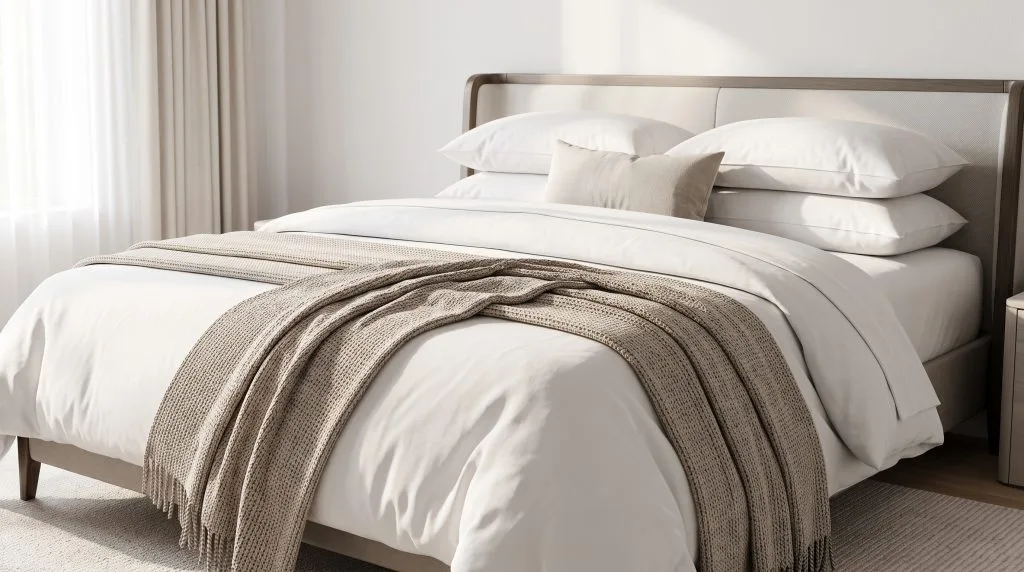
We spend a third of our lives in bed, yet most people buy sheets and blankets based purely on colour or marketing buzzwords. A well-made bed is more than an aesthetic focal point—it is a functional sleep system that directly regulates your body temperature, impacts your sleep cycle, and defines your daily recovery.
From debunking thread-count myths to settling the debate over top sheets and weighted blankets, this comprehensive guide explains everything you need to know about choosing, sizing, and layering your bedding for hotel-quality sleep.
Quick Takeaways
- Fabric Matters Most: Choose cotton percale for a crisp, cooling feel; choose sateen for silky smoothness; choose linen for maximum breathability.
- The Thread Count Myth: A 400-thread-count sheet made of long-staple cotton will always feel softer and outlast a cheap 1000-thread-count synthetic blend.
- The Luxury Layering Formula: A complete bed uses a fitted sheet, an optional flat sheet, a primary duvet, and a textured throw or coverlet at the foot.
- Mattress Depth is Crucial: Standard fitted sheets will slip off modern pillow-top mattresses. Always measure your mattress depth and buy “deep-pocket” sheets if it exceeds 30 cm.
How to Layer a Bed Like a Luxury Hotel
Luxury hotels use a specific formula to make beds look inviting and feel incredibly comfortable. Understanding the anatomy of a layered bed makes it simple to tailor warmth and aesthetics to your own room.
- The Foundation (Mattress Protector): A breathable, fitted barrier that shields the mattress from moisture, dust mites, and daily wear without altering comfort.
- The Base (Fitted Sheet): Features elasticated corners to hug the mattress tightly, providing a smooth, wrinkle-free sleeping surface.
- The Buffer (Flat Sheet / Top Sheet): Placed between the sleeper and the duvet. It creates a hygienic barrier, drastically reducing how often heavy outer covers need washing.
- The Core (Duvet / Comforter): The primary insulating layer, consisting of a breathable insert (down, feather, or hypoallergenic microfiber) enclosed in a washable cover.
- The Accent (Quilt / Coverlet): A lightweight, decorative woven blanket placed over the bed for intermediate warmth during transitional seasons.
- The Finish (Throw Blanket / Runner): A textured textile folded across the foot of the bed. It protects the duvet from foot traffic and provides quick spot-warmth for afternoon naps.
Home Bedding vs. Hotel Bedding: What is the Difference?
While home bedding is all about personal preference, hotel bedding is a calculated balance of luxury, durability, and industrial laundering. At home, you might choose relaxed linen or colorful bamboo sheets. Hotels, however, almost exclusively use optic white bedding because it can be bleached, communicates absolute cleanliness, and creates a “halo effect” that makes the whole room feel refreshed.
If you are trying to replicate a hotel experience at home—or if you are sourcing for a hospitality project—here is the exact breakdown of how bedding quality scales by star rating:
| Setting / Rating | Fabric & Composition | Layering Strategy | Pillows & Inserts |
|---|---|---|---|
| Home (Personalized) | Any (Linen, Bamboo, Sateen, Percale); colours & prints | Highly varied; often just a fitted sheet and a duvet | Tailored to the individual sleeper’s neck/spine needs |
| 3-Star Hotel (Practical) | Poly-Cotton Blends (e.g., 60% cotton / 40% polyester) | Fitted sheet + flat sheet + synthetic blanket (easily washed) | Standard synthetic microfiber fill; usually 2 pillows per bed |
| 4-Star Hotel (Premium) | 100% Cotton (typically crisp percale, 250–300 thread count) | Triple-sheeting or a medium-weight duvet inside a cotton cover | High-grade down alternative; 4 standard pillows |
| 5-Star Hotel (Luxury) | 100% Long-Staple Cotton (Sateen or fine Percale, 300–400+ TC) | Plush mattress topper, fitted sheet, flat sheet, ultra-fluffy duvet, decorative throw | Goose down and premium feather (often with a “pillow menu” for guests) |
How to Replicate the 5-Star Hotel Feel at Home
To upgrade your home bedroom to 5-star luxury status, you don’t need a 1,000-thread-count sheet. Instead, focus on the foundation. 5-star hotels utilize thick, cloud-like mattress toppers (often featherbeds or high-density memory foam) beneath the fitted sheet. Pair this with crisp white, 300-thread-count, single-ply cotton percale sheets, an oversized duvet insert (buy a King insert for a Queen bed for extra fluff), and four high-quality pillows.
The Top Sheet Debate: Cultural Differences in Bedding
Do you actually need a top sheet? This is one of the most hotly debated topics in bedding, and the answer largely depends on where you live and your cultural background:
- The European Approach (Duvet Only): Common across Northern Europe, Scandinavia, and increasingly popular among minimalists. This method pairs a fitted sheet directly with a duvet inside a washable cover. It makes making the bed incredibly fast and avoids tangled fabric at your feet.
- The American & Hotel Approach (Sheet + Blanket): Uses a flat sheet tucked tightly beneath a blanket or duvet. Hotels prefer this because washing a flat sheet daily is far more economical and hygienic than washing a bulky duvet cover.
- Warm Climates (Middle East, Asia, Tropics): In hot climates, different materials and layers are used. Historically, silk and bamboo have been favoured in Asia for their cooling properties, while in the UAE and Middle East, a breathable cotton flat sheet often serves as the only blanket during hot summer nights.
Bed Sheet Fabric Comparison: Percale, Sateen, or Linen?
The yarn composition, weave structure, and thread density dictate how your sheets will perform. Here is how to choose the right fabric for your sleep style.
| Fabric / Weave | Hand Feel & Texture | Thermoregulation | Best Suited For |
|---|---|---|---|
| Cotton Percale | Crisp, lightweight, matte finish (classic hotel feel) | High; grid weave allows maximum airflow | Hot sleepers, summer nights, humid climates |
| Cotton Sateen | Silky, smooth, subtle sheen, and heavy drape | Moderate; denser weave retains slight warmth | Cold sleepers, air-conditioned rooms, luxury suites |
| Pure Linen | Textured, relaxed, softens beautifully over time | Exceptional; wicks moisture instantly | Casual interiors, warm climates, night sweats |
| Bamboo (Lyocell) | Ultra-smooth, fluid, friction-free surface | High; naturally hypoallergenic and cool to the touch | Sensitive skin, hair protection, eco-conscious buyers |
| Microfiber / Poly-blend | Soft, highly wrinkle-resistant, lightweight | Low; tends to trap body heat and moisture | Guest rooms, budget setups, cold winter climates |
Beware the Thread Count Myth
Many consumers believe higher thread count equals better quality. This is false. A 400-thread-count sheet woven from single-ply, long-staple Egyptian cotton will feel infinitely softer, breathe better, and last longer than a 1,000-thread-count sheet made by twisting cheap, multi-ply synthetic threads together.
Sleep Science: How Bedding Affects Your Health
Can Your Bedding Improve Deep Sleep?
Yes. Clinical sleep research shows that deep, restorative sleep (Slow-Wave Sleep) requires your core body temperature to drop by 1°C to 1.5°C. Synthetic, non-breathable blankets trap sweat and radiant heat. This elevates your skin’s microclimate, causing restlessness and nocturnal awakenings. Natural fibres (cotton, linen, bamboo) stabilize this microclimate by wicking moisture away.
Why Do Weighted Blankets Work?
Weighted blankets utilize Deep Touch Pressure (DTP). By applying gentle, evenly distributed weight across the body (ideally 7%–12% of the sleeper’s body weight), they stimulate the parasympathetic nervous system. This physical pressure promotes the release of serotonin and melatonin while suppressing cortisol (the stress hormone), effectively calming anxiety and reducing the time it takes to fall asleep.
What is the best mattress for people with sleep apnea?
For individuals with sleep apnea, spinal alignment and airway positioning are critical. The best choice is typically a medium-firm memory foam or natural latex mattress that prevents the hips from sinking too deeply, which can misalign the neck. Additionally, pairing the mattress with an adjustable bed base—allowing the sleeper to elevate their head by 10 to 20 degrees—can significantly reduce airway obstruction and snoring.
Bedding Sizing & Fit: Avoiding Common Mistakes
Can you use Full sheets on a Queen bed?
No. A standard Full (Double) mattress measures 137 × 190 cm, while a Queen mattress measures 152 × 203 cm. A Full fitted sheet lacks the fabric to stretch over a Queen mattress and will either tear at the seams or constantly pop off the corners. Flat sheets and duvets designed for Full beds will also look too small, leaving the sides of a Queen mattress awkwardly exposed.
What to do if your bed sheet is too small (or keeps popping off)
If your fitted sheets constantly slip off the corners in the middle of the night, check the following:
- Mattress Pocket Depth: Modern pillow-top mattresses range from 30 cm to 45 cm deep. Standard sheets (25 cm depth) will not fit. Always specify extra-deep pocket sheets.
- Heat Shrinkage: 100% natural cotton and linen can shrink 3%–5% if washed in boiling water or dried on high heat. Stick to lukewarm washes and low-tumble drying.
- Quick Fix: If you love a set of sheets that are slightly too small, use elastic sheet clips (suspender straps) underneath the mattress corners to lock them in place.
Bedding Care & Hygiene Standards
Because bedding remains in direct contact with your skin and respiratory system for hours every night, strict hygiene protects against allergens and prolongs fabric life.
- Can bed bugs live on blankets? Yes. Bed bugs frequently harbor in the folds, seams, and hems of sheets and duvets. If you suspect an infestation, wash all bedding in hot water (minimum 60°C) and tumble dry on high heat for at least 30 minutes to eliminate pests and eggs.
- Wash Frequency: Launder sheets and pillowcases weekly. Wash mattress protectors and duvet inserts every 2 to 3 months.
- How many pillows should you have? A luxury bed configuration typically includes 2 to 4 functional sleeping pillows (a mix of firm support and soft contouring) and 2 decorative accent cushions. Avoid overloading the bed with throw pillows that end up on the floor every night.
Upgrade Your Sleep Sanctuary
Ready to build the perfect bed? Explore AMALI’s premium bedding collections, featuring breathable percale, long-staple sateen, and tailored accessories, or read our guide on How to Choose the Best Fabrics for the UAE Climate.