
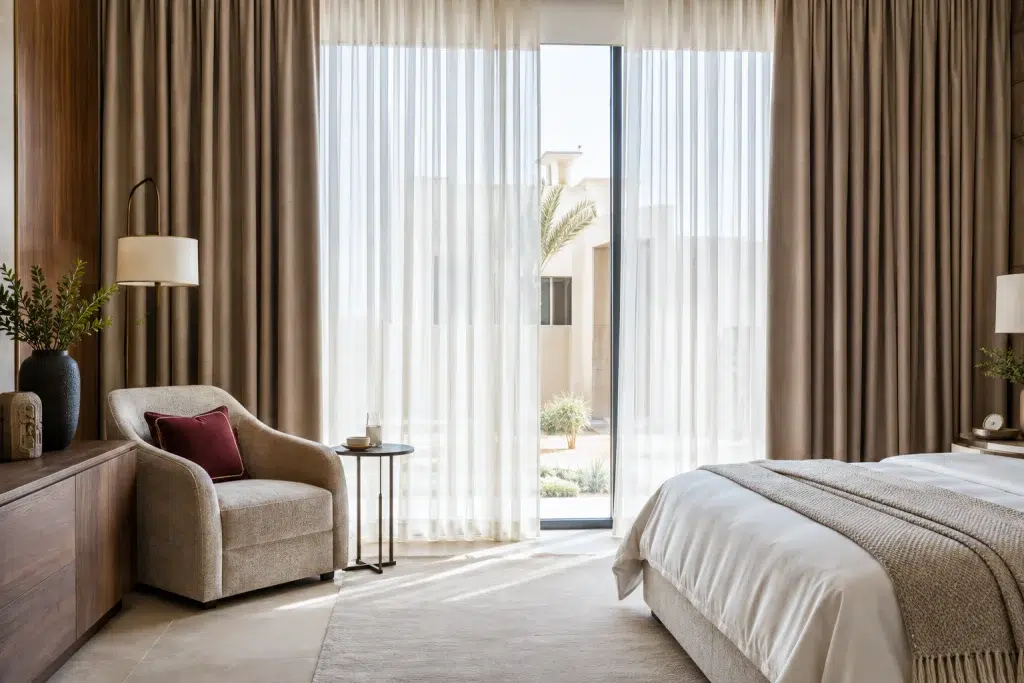
Choosing fabric for a home or commercial interior in the UAE is not simply a question of colour and texture. Strong sunlight, prolonged summer heat, coastal humidity, dust and continuous air conditioning all affect how a textile looks, feels and performs over time.
There is no single fabric that is best for every UAE interior. A material that feels comfortable as bedding may not provide the structure required for curtains. A velvet that creates depth in a formal majlis may be less suitable for a sun-exposed family room. The better approach is to match the fibre, weave, weight, finish and construction to the room.
This guide explains what to consider before choosing fabrics for curtains, upholstery and bedding—and how to create interiors that remain refined, practical and comfortable throughout the year.
Quick Answer
- Polyester and performance-oriented blends can be practical choices for curtains and frequently used upholstery when their construction and care requirements suit the application.
- Layered sheers with separate blackout or lined curtains provide flexible daylight, privacy and light control.
- Bedding comfort depends on fibre, weave, weight, finish, room temperature and personal preference; breathable constructions should be assessed by feel and use.
- Specify every textile by room, exposure, expected use and maintenance needs—not by fibre name alone.
What the UAE climate asks of interior fabrics
The UAE has a hot desert climate, but indoor textile performance is shaped by more than temperature alone. Coastal areas can also experience very high humidity, while windows exposed to strong afternoon sun receive intense heat and light. Inside, air conditioning creates a much cooler and drier environment for long periods.
These conditions create five practical priorities:
- Sunlight control: Direct sun can cause glare, raise the temperature near windows and gradually affect colours and fibres.
- Comfort: Bedding and other textiles used close to the skin should feel comfortable in a cooled room without becoming unnecessarily heavy.
- Dimensional stability: Curtains and upholstery should retain their shape through regular use and appropriate cleaning.
- Maintenance: Dust and daily use make cleanability especially important in busy homes, hotels and commercial spaces.
- Suitability for purpose: Light filtering, privacy, blackout, softness and abrasion resistance are different requirements and may need different constructions.
The right choice therefore depends on the complete textile specification—not only the name of the fibre.
Start with performance, then choose the appearance
Before comparing linen, cotton, polyester, velvet or jacquard, define what the fabric must do.
Ask these questions:
- Is the room exposed to direct morning or afternoon sunlight?
- Is complete blackout required, or only privacy and glare reduction?
- Will children, guests or hotel occupants use the textile frequently?
- Does the fabric need regular washing, occasional professional cleaning or simple vacuuming?
- Will it be used in a bedroom, living area, majlis, hotel room or commercial project?
- Is the desired effect airy and relaxed, tailored and architectural, or rich and decorative?
Once these priorities are clear, the visual decision becomes easier—and the finished interior is more likely to perform as expected.
Best curtain fabrics for UAE interiors
Curtains play a particularly important role in a hot, bright climate. They influence privacy, glare, daylight, visual softness and the amount of solar heat felt near a window. Research on window coverings in cooling-dominated climates also supports their role in reducing unwanted solar gain when they are selected and used appropriately.
Polyester and performance blends
Well-constructed polyester fabrics are a practical choice for many UAE curtains. They can provide consistent drape, good shape retention and relatively straightforward care. Their versatility also allows them to be produced as sheers, textured plains, jacquards and dense blackout constructions.
Polyester is especially useful when the priority is:
- dependable everyday performance;
- a neat, uniform fall;
- colour and texture options across multiple rooms;
- practical maintenance in homes or hospitality projects.
Quality still varies. Check the fabric weight, density, finish and recommended care rather than choosing by fibre content alone.
Bonded blackout and lined curtains
Bedrooms, media rooms and strongly exposed windows often benefit from blackout construction. A dense bonded blackout fabric can reduce incoming light and increase privacy, while a separate lining can add body and help protect the decorative face fabric.
It is important to distinguish blackout from thermal performance. Blackout describes light control; it does not automatically provide a certified level of insulation. The result also depends on curtain dimensions, side gaps, mounting position, lining and how fully the curtains cover the window.
AMALI Note
Blackout describes light control. It is not automatically a certified thermal rating; glazing, orientation, curtain dimensions, lining, installation and gaps also influence the result at a window.
For better coverage, allow generous width and ensure the finished curtain extends beyond the glazing where practical. Even an excellent fabric cannot block light entering through large gaps at the top, sides or centre.
Sheer fabrics
Sheers soften bright daylight and provide a graceful daytime layer without making the room feel closed. They work particularly well in living rooms, dining spaces and hotel interiors when paired with a second privacy or blackout layer.
A layered arrangement offers more control:
- sheer curtains for filtered daylight;
- blackout or lined curtains for privacy and stronger light control;
- independent tracks so each layer can be adjusted as conditions change.
This is often more flexible than asking one fabric to perform every function.
Velvet and decorative fabrics
Velvet introduces depth, softness and a sense of luxury, making it well suited to formal living rooms, majlis interiors, suites and hospitality spaces. Because pile fabrics respond visibly to light and handling, the direction of the pile and the way panels are cut should remain consistent.
For highly sun-exposed windows, use an appropriate lining and review the supplier’s care and lightfastness guidance. Rich colours and delicate surfaces deserve particular consideration before installation in direct, prolonged sunlight.
| Application | Suitable construction | Main advantage | Check before choosing |
|---|---|---|---|
| Sun-exposed curtains | Dense curtains with an appropriate lining or blackout construction | Stronger light control and protection for the decorative face | Window coverage, side gaps, care and available lightfastness guidance |
| Layered living-room curtains | Sheer layer with separate lined or blackout curtains | Flexible daylight, privacy and glare control | Independent tracks, fullness and room exposure |
| Everyday upholstery | Tightly woven textured or performance-oriented fabric | Stable surface suited to regular use | Abrasion information, cleaning method and intended traffic |
| Formal upholstery | Upholstery-grade velvet, jacquard or textured plain | Depth and decorative character | Usage level, pile direction, care and technical suitability |
| Bedding | Percale, sateen, linen or a suitable easy-care blend | Choice of feel, weight and maintenance | Weave, finish, care and personal comfort at normal room temperature |
Best upholstery fabrics for UAE homes and projects
Upholstery must cope with friction, body contact, dust and repeated cleaning. In this application, durability and maintainability usually matter more than whether a fibre is described as natural or synthetic.
Tightly woven textured fabrics
Dense textured fabrics and performance-oriented polyester constructions are strong candidates for sofas, dining chairs and frequently used seating. A tight weave helps create a stable surface, while subtle texture can conceal minor signs of everyday use better than an extremely smooth, flat finish.
For active family rooms, prioritise:
- a firm, stable weave;
- an appropriate abrasion specification;
- colours that suit the level of use;
- clear cleaning instructions;
- testable stain or performance finishes where required.
Jacquard
Jacquard describes a woven construction rather than a single fibre. Its pattern is formed within the fabric, allowing it to create visual richness without relying only on surface printing. It can work beautifully for statement chairs, cushions, headboards, majlis seating and decorative panels.
Review each jacquard individually. A decorative design intended for cushions may not have the abrasion performance required for a heavily used sofa.
Velvet for upholstery
Upholstery velvet can produce a refined, enveloping appearance in air-conditioned interiors. Select a grade intended for upholstery, not a lightweight decorative velvet, and confirm cleaning instructions before use.
In high-traffic or commercial settings, request relevant technical information such as composition, abrasion performance, colourfastness and fire-retardant certification where the project requires it. Do not assume that a residential decorative fabric automatically meets hospitality or regulatory specifications.
Project Note
Commercial and hospitality fabrics should be assessed against the project brief. Request project-specific technical documentation where composition, abrasion, colourfastness, cleaning or fire-performance evidence is applicable.
Best bedding fabrics for comfortable sleep
Bedding is different from curtains and upholstery because it remains close to the body for many hours. Comfort depends on fibre, yarn, weave, weight, finish, room temperature and personal preference.
Cotton percale
Cotton percale is often chosen for a crisp, clean hand feel. Its balanced, breathable character can suit people who prefer lighter-feeling bed linen in a climate where bedrooms are regularly air-conditioned.
Cotton sateen
Sateen has a smoother surface and more visible lustre. It can feel softer and more enveloping than percale, making it attractive for a polished hotel-style bed. Those who prefer a very light, crisp sleeping surface may favour percale instead.
Linen
Linen has a relaxed texture and can feel comfortable in warm conditions. Its natural creasing is part of its character, so it is best for interiors where an easy, understated appearance is welcome rather than a perfectly pressed finish.
Polyester and blended bedding
Polyester and blended constructions can offer easy care, shape retention and practical durability. Comfort, however, depends heavily on the weave, weight and finish. Check the actual hand feel and specification rather than assuming that every blend will feel the same.
For any bedding fabric, choose the construction that feels comfortable at the bedroom’s normal air-conditioning setting—not only in the showroom.
Does colour matter in strong sunlight?
Colour affects both atmosphere and maintenance. Pale neutrals can make bright rooms feel calm and open, while deeper tones add definition and intimacy. Strong sunlight may affect colours differently over time, particularly when a textile remains in one fixed position near a window.
For demanding exposures:
- request lightfastness information when available;
- use lining to protect decorative curtain fabrics;
- avoid assuming that a dark colour automatically provides better heat control;
- consider how the outward-facing surface, glass specification and full window treatment work together;
- follow the supplier’s cleaning guidance to avoid uneven fading or surface damage.
The most effective result comes from treating the fabric, lining, track, window and room orientation as one system.
A practical room-by-room selection guide
Bedroom
Choose blackout or lined curtains for darkness and privacy, then select bedding according to preferred feel and the normal sleeping temperature. Layering a sheer behind the main curtain provides useful daytime flexibility.
Living room
Use sheers to soften daylight and add a second curtain layer where privacy or stronger glare control is required. For upholstery, choose a stable weave with care instructions suited to the household.
Majlis or formal reception room
Velvet, jacquard and richly textured plains can create depth and ceremony. Balance decorative impact with sunlight exposure, cleaning requirements and the frequency of use.
Children’s room
Prioritise washable or easy-care constructions, secure installation, comfortable bedding and good light control. Avoid selecting delicate surfaces purely for appearance.
Hotel or commercial interior
Begin with the project specification. Confirm width, composition, weight, colourfastness, abrasion performance, cleaning method and any required fire-retardant documentation. Approve physical samples under the actual project lighting before final ordering.
Common mistakes to avoid
Choosing only by fibre name
Two fabrics with the same fibre content can behave very differently because of differences in yarn, weave, density, weight and finish.
Treating blackout as a complete heat solution
Blackout improves light control, but room comfort also depends on glazing, orientation, installation gaps and the overall window system.
Ignoring the care label
A fabric is not practical if its approved cleaning method does not suit the way the room is used.
Approving colour from a screen alone
Screens, showroom lighting and daylight can all change how a colour appears. Review a physical sample in the intended room whenever possible.
Using decorative fabric for heavy-duty seating
Appearance does not prove upholstery durability. Match the technical specification to the expected traffic.
Before You Choose
Before confirming any textile for a UAE interior, verify:
- the room and intended application;
- direction and duration of sunlight;
- required privacy and light control;
- fibre composition, weave and weight;
- lining or layering requirements;
- cleaning and maintenance method;
- abrasion, lightfastness or fire-retardant documentation where relevant;
- the appearance of a physical sample in the actual space;
- measurements and installation details.
The best fabric is not simply the lightest, heaviest, most natural or most luxurious option. It is the one whose construction, performance and appearance are properly matched to the room.
Choose with confidence
For UAE interiors, thoughtful specification creates a better result than choosing by appearance alone. Curtains should respond to light and privacy needs. Upholstery should match the expected level of use. Bedding should suit personal comfort and the room’s normal temperature.
AMALI offers curtains, bedding and furnishing fabrics for refined homes, hospitality spaces and professional interior projects across the UAE. Explore the Fabric collection or speak with our team to compare textures, performance requirements and samples for your space.