
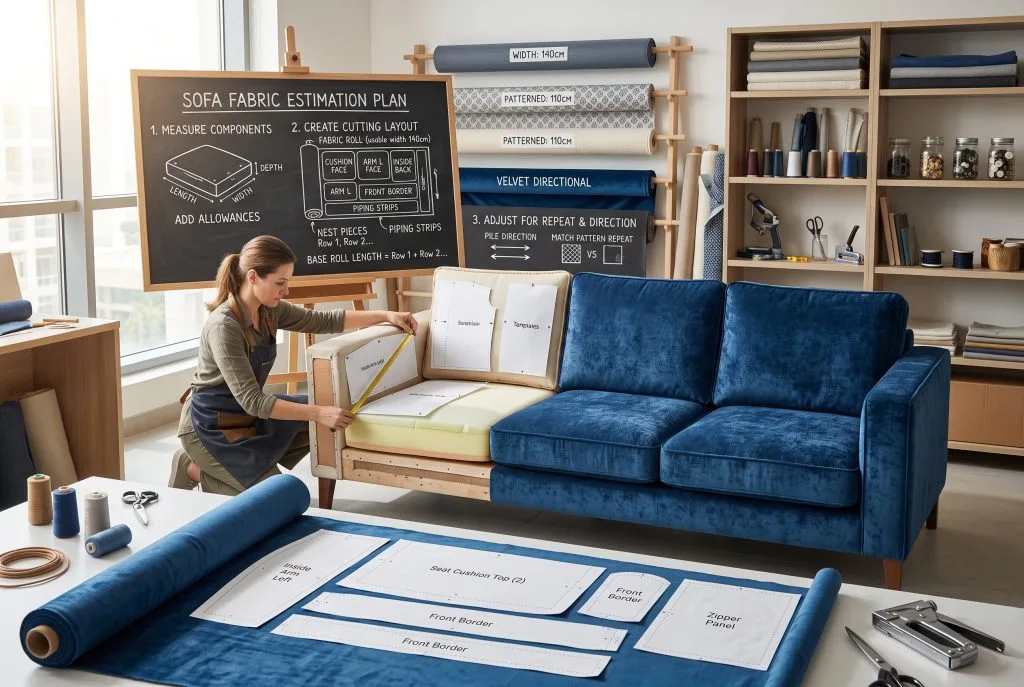
A typical two-seater sofa may need approximately 10–12 metres of plain upholstery fabric, while a typical three-seater may need around 12–16 metres when the usable fabric width is approximately 140–150 cm. Those figures are useful for early budgeting, but they are not final ordering quantities.
Sofas with loose cushions, wide arms, deep buttoning, skirts, piping, directional velvet or a large matched pattern can use considerably more. Two sofas with the same overall width may therefore require different amounts of fabric.
The dependable method is to measure every upholstered component, add the correct making allowances, arrange the pieces across the usable roll width and adjust the layout for pattern direction and repeat. This guide explains that process in centimetres and linear metres.

The quick answer
| Furniture type | Starting estimate | Important qualification |
|---|---|---|
| Armchair | Approximately 5–7 m | Style, loose cushions, wings and arm shape can change the total. |
| Two-seater sofa | Approximately 10–12 m | For preliminary budgeting only; complex frames and matching require more. |
| Three-seater sofa | Approximately 12–16 m | Large cushions, broad arms, skirts and tufting can increase consumption. |
| Sectional or modular sofa | Measure by module | Overall seat count is not enough for a reliable estimate. |
These ranges assume a relatively straightforward construction and a non-directional plain fabric. They should not be used to purchase cut fabric without checking the actual sofa and fabric specification.
Why there is no single sofa-fabric formula
A sofa is not one rectangular surface. It is a collection of shaped pieces: seat platforms, inside and outside backs, inside and outside arms, front borders, cushion faces, boxing strips, piping and sometimes skirts or upholstered feet.
The fabric is purchased as a continuous length at a fixed roll width. The real calculation is therefore a cutting-layout problem. The upholsterer must determine how many prepared pieces fit side by side across that width and how much roll length each row consumes.
Multiplying the sofa’s overall width by its height, or estimating only the visible surface area, ignores hidden turn-under material, seams, shaped sections and inefficient spaces between pattern pieces. It can significantly underestimate the order.
What does one linear metre of fabric mean?
Fabric is normally sold by length. One linear metre is a piece 100 cm long across the full supplied roll width. If the fabric is 140 cm wide, one linear metre measures 100 × 140 cm before unusable selvedges or other limitations are considered.
A linear metre is not the same as a square metre. Ten linear metres of 140 cm-wide fabric provide a different available cutting area from ten linear metres of 110 cm-wide fabric. Width must always accompany the length estimate.

Information needed before calculating
- Clear photographs of the front, back, both sides and cushions.
- Overall width, depth and height of the sofa.
- Dimensions of every removable seat, back and arm cushion.
- Whether outside backs and sides will use the main fabric.
- Presence of piping, skirts, tufting, channels or decorative panels.
- Actual usable fabric width—not merely the nominal roll width.
- Vertical and horizontal pattern repeat.
- Pattern direction, pile or nap and whether railroading is permitted.
- Required seam, wrapping, stapling and matching allowances.
- Any defects, roll limitations or reserve required for later repair.
If the fabric has not yet been selected, the final quantity cannot be confirmed. Width, repeat and direction belong to the textile, not the sofa.

Measure the sofa component by component
Measure finished seams and upholstered boundaries rather than only the furniture’s maximum external dimensions. Record length and width for each distinct face, then note how far the fabric must wrap beyond the visible edge for stitching, tensioning or attachment.
Seat and back cushions
A boxed cushion commonly needs a top, bottom and boxing strip. Zipper panels, pattern centring and piping may add further pieces. Measure the cushion itself from seam to seam and let the maker add the allowance required by the chosen construction.
Inside seat and inside back
Remove loose cushions before measuring the deck and inner frame. Include the sections that disappear beneath cushions or into seams; these hidden areas still consume material.
Inside and outside arms
Rolled, flared, padded and pleated arms require different shapes. Measure each face separately and record whether the left and right pieces must be mirrored or pattern-matched.
Outside back, outside sides and front border
Do not exclude the back merely because the sofa currently sits against a wall. Confirm whether the final sofa must be fully upholstered on every side. Front rails, kick pleats and lower borders can also contain several separate sections.

The professional cutting-plan method
- Create a piece schedule. List every required fabric component and its quantity.
- Add making allowances. Increase each finished measurement for seams, stapling, wrapping, tensioning and the workroom’s method.
- Confirm usable width. Exclude selvedges or areas that cannot appear on the finished work.
- Lock the direction. Mark the top of every piece when the design, weave, sheen or pile has a required orientation.
- Nest pieces across the width. Arrange compatible pieces side by side without rotating directional pieces incorrectly.
- Adjust matched rows to the repeat. Allow enough length to place motifs consistently across adjacent or prominent sections.
- Add all row lengths. The total planned roll length becomes the base linear-metre requirement.
- Add a justified reserve. Cover documented cutting risk, defects, repairs or project requirements without using an arbitrary percentage blindly.
The core relationship is:
Fabric required in linear metres = total length of all planned cutting rows ÷ 100
This formula is useful only after the pieces have been placed correctly across the usable width. It does not replace the cutting plan.

Worked example: why fabric width changes the answer
Consider three identical seat cushions. For this simplified example, each cushion needs one top and one bottom piece measuring 64 × 64 cm after the maker’s allowances. That creates six pieces. Boxing, zips and piping are deliberately excluded so the width effect remains clear.
| Usable fabric width | Pieces per row | Rows required | Base roll length |
|---|---|---|---|
| 140 cm | 2 | 3 | 3 × 64 cm = 192 cm, or 1.92 m |
| 120 cm | 1 | 6 | 6 × 64 cm = 384 cm, or 3.84 m |
The same six pieces consume twice as much length in the narrower layout because two 64 cm pieces no longer fit side by side. A complete sofa calculation applies this logic to every component and then adds the remaining cushion parts, frame sections and required allowances.

How pattern repeat affects fabric consumption
A patterned fabric must often begin each prominent piece at a compatible point in the design. That can prevent pieces from being placed immediately one after another and creates additional length between cuts.
For a simple illustration, suppose one prepared panel needs 112 cm of length and the vertical repeat is 32 cm. The next complete repeat that can contain the panel is:
112 ÷ 32 = 3.5 repeats; round up to 4 repeats.
4 × 32 cm = 128 cm of repeat-aligned length.
That one aligned length uses 16 cm more than the prepared panel measurement. The total increase is not found by applying one universal percentage to the whole sofa. It depends on how many pieces need matching, where motifs are centred, whether adjacent cushions continue the design and how pieces fit across the width.

Direction, nap and railroading
Plain-looking fabrics can still have a visual direction. Velvet and other pile fabrics may appear lighter or darker when reversed. Chenille, brushed surfaces, stripes and woven textures may also need every component to run the same way.
Railroading means using the fabric width along the horizontal length of the furniture instead of in the conventional vertical orientation. It can reduce seams on long backs or benches, but only when the supplier confirms that the fabric is suitable to be used that way. Turning an unapproved fabric can change appearance, pattern direction or performance.

Sofa features that increase the metre requirement
| Feature | Why it uses more fabric |
|---|---|
| Loose seat or back cushions | Each cushion needs several faces, boxing and often zipper or piping components. |
| Wide, rolled or pleated arms | Larger shaped pieces and folds consume more width and length. |
| Deep buttoning or tufting | Extra material is required to form depth, folds and anchored sections. |
| Channels or fluting | Repeated shaped panels need additional seams and alignment. |
| Piping from the main fabric | Long strips must be cut in the required direction, sometimes on the bias. |
| Skirt or valance | The full lower perimeter and any pleats require separate lengths. |
| Large matched motif | Pieces must start at selected design points, reducing nesting efficiency. |
| Directional pile or pattern | Pieces cannot be rotated freely to fill unused spaces. |
| Oversized or modular frame | More upholstered faces and long components must be included. |

Can the old sofa covers be used to calculate fabric?
Existing covers can provide valuable templates when they are carefully removed and labelled. They reveal hidden margins, seam locations and shapes that external measurements cannot show.
However, an old cover may have stretched, shrunk or been altered during an earlier repair. A professional should compare it with the frame, assess whether the new textile behaves differently and prepare a fresh layout using the new fabric’s usable width and direction.
Should you add extra fabric?
Some reserve is often sensible, but “add 10%” is not a dependable rule for every sofa. A large repeat may require more than a percentage suggests, while a well-planned plain layout may need only a modest cutting allowance.
The reserve should reflect pattern matching, pile direction, roll defects, cutting complexity, workroom practice and whether matching material should be retained for a future repair. When an exact dye lot or production batch matters, it is safer to approve the full requirement before ordering than to assume identical material will remain available later.
Common calculation mistakes
- Ordering from a generic two-seater or three-seater chart alone.
- Using overall sofa dimensions instead of measuring every component.
- Confusing nominal roll width with usable width.
- Calculating square metres instead of a linear cutting layout.
- Forgetting cushion bottoms, boxing strips, outside backs or lower borders.
- Ignoring vertical and horizontal pattern repeat.
- Rotating directional or piled pieces merely to save fabric.
- Leaving piping, skirts and tufting until after the order.
- Buying the minimum estimate and expecting a later batch to match.
What to send when requesting a fabric estimate
Sofa type: three-seater with three loose seat cushions and three loose back cushions.
Overall size: width × depth × height in centimetres.
Upholstery scope: all visible faces, including outside back.
Details: self-piping, no skirt, no tufting.
Fabric: product code and colourway.
Fabric data: usable width, repeat and direction if known.
Attachments: front, back, side and cushion photographs.
Please confirm the calculated metres, matching allowance and recommended reserve before the fabric is cut.
When enquiring about AMALI furnishing fabrics, provide the sofa measurements, photographs, selected fabric reference and project requirements. The fabric specification and final workroom layout should be confirmed before quantity is treated as an order figure.

Final ordering checklist
- The exact sofa and upholstery scope have been documented.
- Every frame face, cushion and decorative component is included.
- The current usable fabric width is confirmed.
- Vertical and horizontal repeats are recorded.
- Pattern, pile and top direction are marked.
- Railroading suitability is confirmed rather than assumed.
- Seam, attachment and matching allowances follow the maker’s method.
- The final cutting plan has been checked by the person making the sofa.
- The order quantity and any repair reserve will come from the same approved batch where required.

Frequently asked questions
How much fabric is needed for a two-seater sofa?
Approximately 10–12 metres of plain fabric around 140–150 cm wide can be used as an early estimate for a typical two-seater. The final amount depends on the frame, cushions, usable width, pattern, direction and upholstery details.
How much fabric is needed for a three-seater sofa?
A preliminary range is approximately 12–16 metres for a typical design using plain fabric around 140–150 cm wide. A large, tufted, skirted or heavily cushioned sofa may need more.
Is 15 metres enough for a three-seater sofa?
It may fall within a common starting range, but the number cannot be approved without the sofa and fabric details. A cutting plan must show that every component, allowance and match fits within the available length.
Does wider fabric always reduce the metres needed?
Wider usable fabric can allow more pieces per row and reduce required length, but not in every layout. Pattern direction, repeat, piece size and defects can limit the benefit.
How much extra is needed for a patterned sofa fabric?
There is no reliable universal percentage. The exact increase depends on vertical and horizontal repeat, motif placement, the number of matched components and cutting layout.
Does piping require additional fabric?
Yes, when the piping is made from the main upholstery fabric. Its consumption depends on the total cord length, strip width, required cutting direction and whether strips are cut straight or on the bias.
Can I calculate fabric using only a sofa photograph?
A photograph helps identify style and components, but it does not provide reliable scale, hidden allowances or exact cushion dimensions. Measurements and the selected fabric specification are still required.
Who should confirm the final quantity?
The upholsterer or workroom responsible for cutting and making should approve the final quantity. They know the construction method, allowances, matching plan and how the chosen fabric will be laid out.

The final answer
For early planning, allow approximately 10–12 metres for a typical two-seater and 12–16 metres for a typical three-seater in plain fabric about 140–150 cm wide. Treat those figures as a starting point, not a purchase instruction.
The correct order quantity comes from the sofa’s complete piece schedule, the fabric’s usable width, direction and repeat, and a checked cutting plan. Confirm that plan before cutting so every visible section can be completed consistently from the approved material.
