
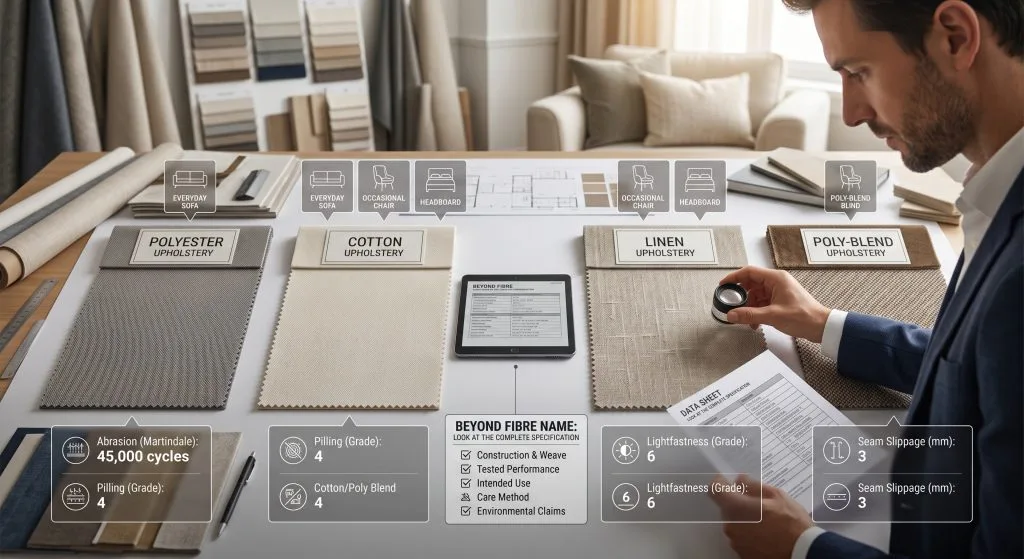
Choosing upholstery by fibre name alone sounds simple: polyester for practicality, cotton for comfort, linen for natural texture, or a blend for balance. In reality, those labels describe only part of the fabric.
A tightly woven polyester upholstery and a loosely constructed polyester fabric will not perform alike. Two linens can differ in yarn thickness, backing, finish and intended use. A blend may combine useful characteristics—or simply combine fibres without solving the demands of the room.
This guide compares polyester, cotton, linen and blended upholstery clearly, then shows how to choose using the complete specification rather than a familiar fibre name.

Which upholstery fibre is better? The quick answer
No fibre is universally best. The right choice depends on the furniture, frequency of use, appearance expected, exposure to sunlight and spills, maintenance plan and verified performance of the exact fabric.
- Polyester-rich upholstery is often considered when dimensional stability, practical maintenance and a broad design range matter.
- Cotton-rich upholstery can offer a familiar natural handle, clear colour and a comfortable matt appearance.
- Linen-rich upholstery is valued for dry texture, natural variation and a relaxed, refined character.
- Blended upholstery can balance appearance, handle and performance, but the blend ratio does not replace product-specific testing.
For a heavily used sofa, start with declared upholstery suitability, construction and test data. For an occasional chair, headboard or formal sitting room, texture and visual character may carry more weight. Fibre is one decision input—not the final verdict.

Why fibre content does not tell the whole story
Fibre affects absorbency, feel, lustre, response to moisture and other behaviours. Yet upholstery is a complete textile system. Yarn type, twist, weave or knit, density, pile, backing, coating, dyeing, finishing and furniture construction all influence how it looks and wears.
The same fibre can produce very different fabrics
Polyester can form a smooth plain weave, textured chenille or raised velvet pile. Cotton can appear as canvas, jacquard, velvet or a soft mixed yarn. Linen can be crisp and structured or softened and irregular. Construction often changes the customer’s experience as much as composition does.
Weight is not a durability score
A heavy sample may feel reassuring, but weight alone does not confirm abrasion resistance, seam performance, pilling, snagging or suitability for a particular seat. Likewise, a lighter fabric is not automatically weak. Evaluate the exact product against the application.

Polyester, cotton, linen and blends compared
| Option | Common reasons to consider it | Points requiring careful checking | Often considered for |
|---|---|---|---|
| Polyester-rich | Design variety, stability and potentially practical maintenance. | Pilling, oil-based soil, heat sensitivity, finish claims and verified lightfastness. | Everyday residential seating when the exact article is suitably rated. |
| Cotton-rich | Natural handle, matt colour and familiar comfort. | Absorbency, staining, shrinkage, creasing, fading and care method. | Residential furniture where natural feel and character are priorities. |
| Linen-rich | Dry texture, slubs and relaxed natural variation. | Creasing, movement, seam behaviour, abrasion, moisture response and customer expectations. | Occasional or selected daily-use pieces when specification supports it. |
| Blended | Potential balance of handle, appearance, stability and performance. | Actual fibre percentages, which fibre is on the face, construction, finish and complete test data. | Many residential and professional uses, depending on the exact blend and fabric. |
These are selection tendencies, not guarantees. A product’s technical sheet and representative sample take priority over the general column in any comparison table.

Polyester upholstery: benefits and limitations
Polyester is widely used in furnishing textiles because it can be engineered into many yarn shapes, textures, colours and constructions. It may be used alone or blended with natural or regenerated fibres.
Potential advantages
- Can provide good dimensional stability in an appropriately constructed upholstery.
- Supports a wide range of textures, from matt woven surfaces to chenille and velvet.
- May absorb less water than some natural fibres, although complete stain and cleaning behaviour depends on construction and finish.
- Can be specified for demanding use when supported by relevant test evidence.
Possible limitations
- Some constructions can pill or develop surface fuzz through friction.
- Oily marks may require a product-appropriate cleaning response.
- Heat can affect synthetic fibres, finishes or backing, so direct ironing and improvised heat treatment are inappropriate.
- The word “polyester” does not prove easy cleaning, stain resistance, colourfastness or contract performance.
Polyester-rich upholstery is often a practical shortlist option for everyday furniture, but only after its pilling, abrasion, colourfastness, care and intended-use information have been reviewed.

Cotton upholstery: benefits and limitations
Cotton can produce a soft or firm handle depending on the yarn and weave. It is frequently chosen for its natural touch, matt surface and ability to carry both clear solid colours and detailed patterns.
Potential advantages
- Comfortable, familiar contact surface with a natural-fibre character.
- Available in varied constructions, including canvas, twill, jacquard and velvet.
- Can deliver a restrained matt appearance that works across contemporary and traditional interiors.
- May develop a relaxed, lived-in appearance that some customers value.
Possible limitations
- Absorbency can allow spills to penetrate unless the complete fabric has an appropriate construction or verified finish.
- Shrinkage or dimensional change can occur under unsuitable cleaning conditions.i will share blog post with you and you will make realistic HD 8k detailed featured image which defines whole concept in one image with the resolutions of 1536 by 1024. ok
- Creasing, fading and surface wear vary with yarn, weave, colour and use.
- Natural fibre content does not mean the complete textile is untreated, biodegradable, organic or environmentally preferable.
Cotton-rich upholstery can suit both relaxed family rooms and formal settings, provided the care demands and tested performance match the installation.

Linen upholstery: benefits and limitations
Linen is made from flax fibre and is valued in interiors for its dry touch, irregular yarn character and restrained lustre. Slubs and subtle variation may be intentional features rather than defects.
Potential advantages
- Distinctive natural texture that can make plain colour feel visually complex.
- Dry, crisp or softened handle depending on finishing and blend.
- A relaxed appearance well suited to layered neutral schemes.
- Can be used successfully for upholstery when the specific construction is designed and tested for it.
Possible limitations
- Creasing and movement may be more visible and should be accepted as part of the intended look.
- Open or irregular constructions can snag, distort or show seam stress if poorly matched to the furniture.
- Moisture and cleaning can affect texture, dimensions or finish.
- A fabric described as “linen-look” may contain little or no flax, so composition must be checked.
For a crisp, permanently uniform sofa, linen’s natural movement may not meet expectations. For a customer who welcomes texture and gentle patina, an upholstery-rated linen or linen blend can be highly appropriate.

Blended upholstery: why fibres are combined
Blending allows textile designers to combine characteristics within the yarn or fabric. Polyester may be added to support stability or wear; cotton may contribute handle and mattness; linen may provide texture; viscose may add softness or lustre. The result depends on where and how each fibre is used.
A blend is not simply an average
A 60% polyester and 40% cotton fabric is not guaranteed to behave exactly halfway between two pure-fibre fabrics. The fibres may be blended within one yarn, placed in different warp and weft systems, or used separately in pile and ground. The face exposed to wear may not reflect the overall percentages evenly.
Why blends can be useful
A well-designed blend can retain a natural-looking texture while moderating some movement, increase design flexibility, or help a fabric meet a performance and price brief. Those outcomes must be confirmed from the finished product rather than assumed from the recipe.

Natural does not automatically mean better
“Natural” describes fibre origin, not automatic comfort, durability, health, sustainability or suitability. Cotton and linen production, processing, dyeing, finishing, transport, use and end-of-life conditions all affect the complete material story. Synthetic content also varies by source, production route, recycled claim and traceability.
Do not present one composition as environmentally superior without documented evidence and a defined basis for comparison. Where a certification or recycled-content claim matters, review the current certificate, product scope, chain-of-custody information and validity.
Which option is most durable?
No responsible answer can be given from fibre content alone. Durability includes more than surface abrasion: pilling, snagging, seam slippage, yarn breakage, loss of pile, colour change, staining and damage from unsuitable cleaning can all shorten useful service.
Review the supplier’s declared end use and relevant test results for the exact article. Test methods should be current and interpreted in context. An exceptionally high abrasion number is not proof that a fabric will last longer in every home or project.
Which option is easiest to clean?
Cleanability depends on fibre, dye, weave, finish, backing and the contaminant. Polyester’s relatively low water absorbency does not make every polyester stain-proof. Cotton’s absorbency does not mean every cotton upholstery is impractical. A verified finish or approved cleaning method can materially change the result.
| Question | Why it matters |
|---|---|
| What substances are likely? | Water-based drinks, oil, cosmetics, ink and dye transfer require different responses. |
| What cleaning method is approved? | Water, solvent, extraction or professional-only care cannot be substituted freely. |
| Is a finish present? | Its function, limitations and maintenance must be documented for the exact product. |
| Can covers be removed? | A zip does not automatically mean the fabric can be machine washed. |
| Has the complete furniture been considered? | Foam, filling, adhesive, backing, trims and frame can restrict cleaning. |

How sunlight affects the decision in UAE interiors
Large windows and intense UAE daylight can expose upholstery to significant light. Fibre type influences dyeing options, but colourfastness belongs to the finished fabric and colourway. A dark cotton, pale linen blend and solution-dyed synthetic cannot be compared fairly from fibre names alone.
Check the applicable lightfastness result and manage direct exposure through furniture placement and suitable window treatments. These measures reduce risk but do not make indoor upholstery fade-proof. The guide to fabrics for the UAE climate provides wider room-by-room considerations.

Best upholstery choice by room and use
Daily family sofa
Prioritise verified upholstery suitability, pilling, seam performance, realistic cleaning and appearance retention. A tested polyester-rich or carefully designed blend may enter the shortlist, but a suitable cotton or linen blend should not be excluded merely because it contains natural fibre.
Formal sitting room or majlis
Texture, colour depth and pattern may take greater priority when use is controlled. Cotton-rich, linen-rich and blended fabrics can all work, provided the chosen textile supports the seat construction and expected maintenance.
Dining chairs
Consider frequent contact, crumbs, food spills, seat-edge abrasion and cleaning access. Do not accept a generic stain-resistance promise; ask what is tested, what care is permitted and whether pattern or texture will trap visible debris.
Headboards and bedroom seating
Abrasion may be lower than on a family sofa, but hair products, skin oils and cleaning access still matter. Softer cotton-rich, linen-rich or blended textures can be appropriate when the care instructions suit the use.
Hospitality and commercial furniture
Composition is secondary to the full project brief. Confirm application-specific abrasion, pilling, physical properties, colourfastness, cleaning, flame performance and other consultant requirements using current documentation for the exact product.

Children, pets and real household behaviour
A home with young children, cats or dogs needs a fabric selected for actual exposures rather than a fibre stereotype. Claws can catch an open weave regardless of composition. Pet hair may be more visible on a contrasting colour. Oils, food and art materials test the approved cleaning method rather than the marketing label.
Inspect weave tightness, loops, floats, pile and texture. Confirm whether the surface pills, whether the colour shows lint, and how promptly common spills must be treated. No textile should be called child-proof, pet-proof or claw-proof without precise supporting evidence.

How to compare upholstery samples properly
- Record the exact identity. Note supplier, collection, design, colourway and batch reference where available.
- Read the full composition. Confirm percentages and whether face, pile, ground or backing are stated separately.
- Check intended use. “Furnishing fabric” does not always mean seating upholstery.
- Inspect the construction. Look for loose yarns, long floats, open areas, pile direction and backing.
- Handle it as installed. Curve the sample over an arm or cushion form and observe how it stretches, creases and catches light.
- View it in the room. Check morning, afternoon and artificial light beside actual finishes.
- Review performance and care. Match the test evidence and approved maintenance to the real use.
- Approve the correct material. Clarify whether the swatch represents colour only or the production batch being supplied.

Common mistakes when comparing fibre content
- Assuming 100% polyester is automatically durable and easy to clean.
- Assuming 100% cotton is automatically comfortable, safe or sustainable.
- Treating every linen slub, crease or shade variation as a defect.
- Believing a blend always inherits only the advantages of each fibre.
- Selecting curtain-weight fabric for a sofa because the composition sounds suitable.
- Using GSM or thickness as the only durability measure.
- Comparing abrasion results produced by different methods as though they were interchangeable.
- Ignoring care instructions until after the furniture is installed.
- Approving a small swatch without viewing it in the intended UAE light.
- Making environmental or certification claims without product-specific documentation.

A complete upholstery selection checklist
| Specification point | Decision question |
|---|---|
| Furniture and room | What is being upholstered, who uses it and how often? |
| Composition | What are the exact fibres and percentages, including face or backing where relevant? |
| Construction | Is it woven, knitted, piled, coated or backed, and is that construction suitable? |
| Intended use | Does the supplier approve the exact article for this residential or contract application? |
| Performance | Which abrasion, pilling, seam and colourfastness methods and results apply? |
| Care | What cleaning is allowed, and can the owner follow it consistently? |
| Appearance | Are natural variation, creasing, pilling, pile movement or patina acceptable? |
| Light exposure | Has the colourway been assessed for the actual window and room conditions? |
| Sample and batch | Has a representative sample—and production batch where necessary—been approved? |
| Claims and compliance | Is every required finish, recycled-content, flame or certification claim currently documented? |
To compare real options, explore the AMALI furnishing-fabric collection and request the current specification and representative samples for the intended furniture.

Frequently asked questions
Is polyester or cotton better for a sofa?
Neither is automatically better. Polyester-rich upholstery may support stability and practical maintenance; cotton-rich fabric may offer a natural handle and matt appearance. Compare the exact construction, tests, care and expected use.
Is linen strong enough for upholstery?
Some linen and linen-blend fabrics are designed for upholstery; others are not. Strength of the fibre does not confirm seam, abrasion or snag performance in a finished fabric. Use the declared end use and current technical data.
Are blended upholstery fabrics more durable?
They can be, but blending alone does not guarantee durability. Fibre placement, yarn, weave, finish, backing and testing determine whether the blend actually meets the application.
What blend percentage is best?
There is no universal ideal ratio. Two fabrics with identical percentages can behave differently because their yarns and constructions differ. Select the finished textile, not a percentage formula.
Which upholstery fabric is best for children and pets?
Look for an appropriately tested, tightly constructed surface with realistic care instructions and limited catch points. Colour and texture should also suit visible hair and daily soil. No fibre is universally child-proof or pet-proof.
Does polyester upholstery feel hot?
Comfort depends on more than fibre. Pile, weave density, finish, cushion materials, air-conditioning, clothing and contact time all affect how a seat feels. Test a representative sample or upholstered piece where possible.
Does cotton or linen fade faster than polyester?
Fading cannot be ranked reliably from fibre names alone. Dye system, colour, finish and intensity of light exposure matter. Compare product-specific lightfastness results for the intended indoor use.
Can upholstery covers be machine washed?
Only when the furniture and fabric instructions explicitly permit it. A removable zipped cover is not automatically washable; laundering can change dimensions, colour, backing and fit.

The final decision
Choose polyester-rich upholstery when a verified product offers the practical performance and appearance your room needs. Choose cotton-rich or linen-rich fabric when you value their particular handle and natural character and accept the specified maintenance and ageing. Choose a blend when the finished fabric—not merely its percentages—provides the right balance.
The best upholstery is the one that fits the furniture, users, light, cleaning plan and visual expectations, supported by a current specification and an approved sample. Fibre content helps explain the fabric; it should never be the only reason to buy it.
