
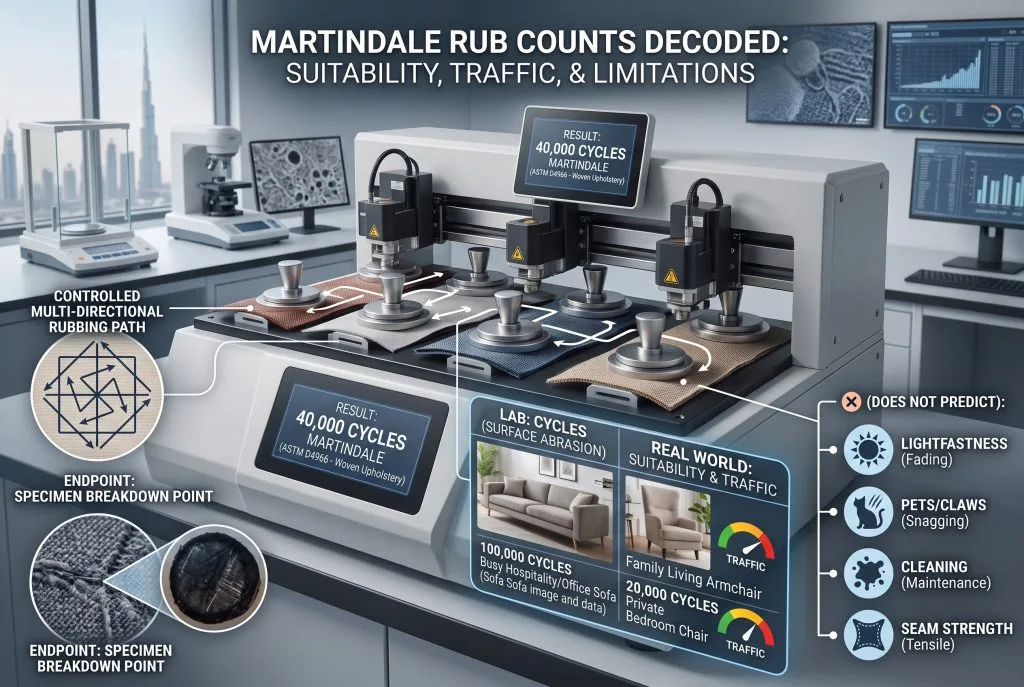
A furnishing fabric may be described as 20,000, 40,000 or even 100,000 Martindale rubs. The larger number can look like a simple quality score, but that is not what the test measures.
Martindale rub count is a laboratory result used to describe how a textile resists surface abrasion under a named test method. It helps compare fabrics and assess suitability for upholstery, but it does not predict exactly how many years a sofa or chair will last.
This guide explains what the number means, how the test works, why results must be read with their method and intended application, and which other fabric properties matter before approval.

The quick answer
A Martindale result tells you how many controlled abrasion cycles a tested specimen completed before reaching the stated endpoint. In general, a higher result indicates greater resistance to that laboratory abrasion procedure. It does not automatically mean the fabric is better, stain-proof, pet-proof or suitable for every high-use environment.
- Use it to assess: resistance to repeated surface rubbing under controlled conditions.
- Do not use it to predict: exact service life, cleaning performance, seam strength, fading, pilling or damage from claws and sharp objects.
- Always confirm: test method, reported endpoint, fabric construction, intended use and supporting performance data.

What is abrasion?
Abrasion is surface wear caused by friction. On upholstered furniture, it can occur where clothing repeatedly moves against a seat, where users slide across an edge, or where cushions rub against neighbouring components.
Abrasion is only one route to visible deterioration. A fabric may also change through pilling, seam movement, yarn snagging, staining, inappropriate cleaning, sunlight, moisture, coating failure or damage to the furniture beneath it. A rub count therefore answers one specific performance question rather than describing total durability.

How does the Martindale abrasion test work?
In a Martindale abrasion test, prepared fabric specimens are mounted in an instrument and rubbed against a specified abrasive surface under controlled pressure and movement. The instrument produces a multi-directional rubbing path rather than a simple straight line.
The specimens are inspected at defined intervals. Depending on the standard and reporting purpose, the result may relate to specimen breakdown, mass loss or a change in appearance. ISO 12947-2, for example, addresses determination of specimen breakdown through inspection at fixed intervals. ASTM D4966 also covers abrasion resistance of textile fabrics using the Martindale apparatus.
The correct description is normally cycles, although suppliers and customers often say “rubs”. When reading a specification, keep the exact wording used by the test report and do not assume that every published Martindale number represents the same endpoint.

What does a Martindale rub count mean?
If a specification states “40,000 cycles, Martindale”, it means a specimen was reported at that level under the stated Martindale procedure and conditions. To interpret the figure properly, look for the complete reference rather than the number alone.
| Specification detail | Why it matters |
|---|---|
| Test method and edition | Identifies the procedure used and allows like-for-like review. |
| Reported result | States the cycles reached and may show whether the test stopped at breakdown or another endpoint. |
| Pressure and setup | Test conditions can differ by application and standard. |
| Fabric construction | Woven, knitted, nonwoven, pile and coated materials may behave differently and may require different guidance. |
| Intended application | Upholstery use is not the same as drapery, wall covering or outdoor use. |
| Test report date and laboratory | Helps establish traceability and whether the evidence matches the current product. |

Is a higher Martindale number always better?
Not automatically. A higher verified result can provide useful evidence of greater resistance within the same method, but selecting upholstery is not a competition for the largest number.
Once a fabric meets the appropriate abrasion requirement for its intended application, other properties may become more important. Comfort, handle, visual character, pilling, seam performance, colourfastness, cleaning method, pattern scale and compatibility with the furniture construction can all affect the final decision.
Extremely high figures should also be read carefully. Confirm that the number comes from the relevant test method, applies to the exact fabric and colourway or construction being considered, and has not been presented without its limitations.

Why rub count is not a lifespan guarantee
A laboratory test controls the abrasive material, pressure, movement, specimen preparation and inspection. A real sofa does not live under controlled laboratory conditions.
- The number of users and frequency of use vary.
- Body weight, clothing, dust and transferred grit change the wear environment.
- Sunlight, heat, moisture and cleaning products can affect appearance and strength.
- Furniture shape, foam condition, edge radius and upholstery tension influence stress.
- Poor seams or workmanship can fail before the face fabric wears through.
- Snags, cuts, claws and concentrated damage are not the same as gradual abrasion.
For this reason, it is misleading to convert a rub count into a fixed number of years. The Association for Contract Textiles also cautions that abrasion results are not necessarily reliable indicators of fabric lifespan and that laboratory results may differ from the variables encountered in actual use.

How many Martindale rubs are enough?
There is no single number that is correct for every market, project and fabric construction. The appropriate requirement depends on the intended application, the governing specification, the chosen standard and any consultant or client criteria.
As one clearly defined industry example, the Association for Contract Textiles currently lists 40,000 Martindale cycles under ASTM D4966 at 12 kPa for high-traffic indoor upholstery made from woven fabrics. This is a voluntary ACT guideline for that stated construction and application. It is not a universal UAE legal threshold, it does not automatically apply to every textile type, and exceeding it does not promise a longer product life.
For a private bedroom chair, a family sofa, a busy restaurant banquette and a hotel lobby seat, the usage profile is different. Start with the actual location and expected traffic, then ask the supplier or project consultant which current requirement applies.

Martindale and Wyzenbeek are not interchangeable
Martindale and Wyzenbeek are both abrasion-test approaches, but they use different equipment, motion, abrasives and reporting language. Martindale commonly reports cycles; Wyzenbeek commonly reports double rubs.
Do not multiply, divide or use an online conversion chart to turn one result into the other. ACT states that there is no correlation between Wyzenbeek and Martindale results. Compare fabrics tested by the same relevant method wherever possible, or have the project specifier decide which evidence is acceptable.
| Question | Does Martindale answer it? | What else to review |
|---|---|---|
| Will repeated rubbing wear the surface? | It provides relevant controlled-test evidence. | Method, endpoint, construction and intended use. |
| Will the fabric pill? | No, not from an abrasion count alone. | Applicable pilling test and appearance assessment. |
| Will the colour fade near a window? | No. | Lightfastness data, exposure and window conditions. |
| Will seams remain secure? | No. | Seam slippage or seam-strength data and upholstery construction. |
| Will stains clean easily? | No. | Supplier care instructions, finish evidence and maintenance plan. |
| Is it suitable for a regulated project? | No. | Complete project specification, required certificates and approvals. |

What else determines upholstery performance?
Pilling and appearance retention
Pilling is the formation of small fibre balls or surface fuzz through use. Martindale equipment can be used in separate pilling procedures, but a Martindale abrasion count should not be mistaken for a pilling grade. Check the named test and result separately.
Seam performance and tensile properties
A fabric can resist face abrasion yet move or open at a seam when stretched. Seam construction, thread, stitch density, furniture geometry and the fabric’s physical properties work together. Professional projects may require separate seam-slippage, tensile or tear data.
Lightfastness and colour transfer
Abrasion resistance does not show how a colour responds to strong daylight or whether colour may transfer through dry or wet rubbing. Lightfastness and crocking or rubbing-colourfastness results address different risks and should remain separate on the specification sheet.
Cleaning and maintenance
Using an unsuitable cleaner can alter colour, texture, backing or finish even when the face textile has a high abrasion result. Follow the current supplier instructions for the exact fabric, and test any approved cleaning method discreetly before wider use.
Furniture design and workmanship
Sharp edges, exhausted foam, uneven tension and incorrect pattern placement can create concentrated stress. Good upholstery selection therefore combines textile data with an understanding of the furniture and the quality of fabrication.

Does fibre composition predict the rub count?
No. Fibre composition is important, but it does not determine abrasion resistance by itself. Yarn type, yarn twist, weave or knit structure, density, pile construction, backing, finishing and the complete fabric design all influence behaviour.
Two fabrics labelled 100% polyester can return different results. A cotton blend can outperform another synthetic construction under a particular method. Likewise, greater thickness, weight or price does not prove a higher Martindale performance. Use product-specific test evidence rather than assumptions based on one attribute.

Does a high rub count make fabric suitable for pets?
It can be one useful indicator for repeated surface wear, but it does not make a textile claw-proof or snag-proof. Pet suitability also depends on loop size, pile, weave tightness, surface texture, cleanability, colour, pattern and the animal’s behaviour.
For homes with pets, inspect a physical sample for catch points and ask what the published result actually covers. No routine abrasion number should be presented as a guarantee against scratching, chewing, puncture or staining.

How to compare two Martindale results properly
- Confirm the exact products. Match the design, construction, colourway and any backing or finish.
- Check the test method. Prefer results produced under the same named method and relevant conditions.
- Identify the endpoint. Establish whether the figure refers to breakdown, appearance change or another stated assessment.
- Verify the application. Make sure the fabric is offered for the intended upholstery environment.
- Review the complete specification. Include pilling, colourfastness, physical properties, cleaning and project-specific requirements.
- Inspect a representative sample. Evaluate texture, scale, drape where relevant and potential snagging under the room’s lighting.
- Request traceable evidence. For professional work, confirm report date, laboratory, specimen description and whether the tested construction matches the supplied material.

Common mistakes when reading rub counts
- Choosing the largest number without considering the intended use.
- Comparing Martindale cycles directly with Wyzenbeek double rubs.
- Assuming a high count guarantees a fixed number of years.
- Using an upholstery result as proof of fading, stain or pilling performance.
- Ignoring whether the tested fabric included a backing or treatment.
- Relying on an unsourced number without a method or report.
- Treating a voluntary guideline as a law or universal project requirement.

A practical supplier enquiry
When a rub count affects the buying decision, provide the real application rather than asking only for “the strongest fabric”. A useful request might read:
Please confirm the exact Martindale test method, reported cycles and endpoint for this fabric. The material is being considered for indoor seating in a frequently used hospitality area. Please also provide the current technical sheet, relevant physical and colourfastness results, care instructions, and any project documentation that applies to the supplied construction.
This gives the supplier enough context to respond with relevant evidence. When reviewing AMALI furnishing fabrics, share the seating type, location, expected usage, cleaning approach and any consultant requirements so the enquiry can be assessed against the actual brief.

Frequently asked questions
Is Martindale the same as rub count?
“Rub count” is an informal phrase commonly used for the result. A proper specification should identify Martindale as the method, state the result in cycles and include the relevant test reference and endpoint.
Is 40,000 Martindale suitable for commercial upholstery?
ACT uses 40,000 Martindale cycles under ASTM D4966 at 12 kPa as its voluntary high-traffic guideline for woven indoor upholstery. A particular project may use different criteria, so construction, application, authority, consultant requirements and the full performance specification must still be confirmed.
Does 100,000 rubs mean a fabric is twice as durable as 50,000?
No. The higher result indicates more cycles under the stated procedure, but it does not prove twice the service life. Real durability depends on multiple textile, furniture, user and maintenance factors.
Can I convert Martindale cycles to Wyzenbeek double rubs?
No reliable direct conversion should be used. The methods operate differently, and ACT states that their results do not correlate. Compare like with like or follow the method required by the project.
Does Martindale test pilling?
The Martindale apparatus can be used for separate pilling procedures, but abrasion resistance and pilling are not the same result. Read the method name, test purpose and rating independently.
Do curtains need a Martindale rating?
Curtains do not experience seating abrasion in normal use, so upholstery rub count is generally not the main selection criterion. Drape, width, weight, light control, colourfastness, care, heading and any project-specific requirements are usually more relevant.
Can I approve upholstery from the rub count alone?
No. Confirm intended use, construction, complete technical data, maintenance, physical sample and any applicable project requirements. The abrasion figure is one part of that decision.
The final decision
Martindale rub count matters because it provides structured evidence about resistance to repeated surface abrasion. It is most useful when the method, endpoint, construction and intended application are clearly stated.
Choose a fabric that meets the relevant requirement for the real environment, then assess the other properties that determine appearance, care and performance. The right question is not “Which fabric has the biggest number?” but “Which complete specification is appropriate for this furniture and this use?”
