
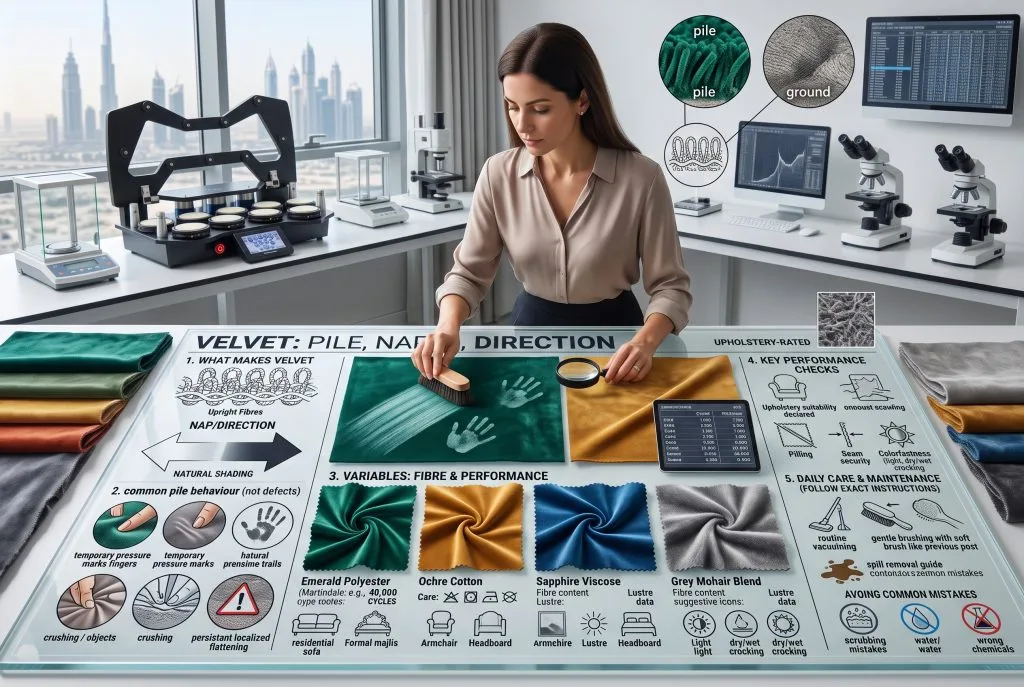
Velvet upholstery can make a sofa, armchair or headboard feel deeper, softer and more visually expressive. Its colour changes subtly as light moves across the surface, and even a plain velvet can create more dimension than a flat-woven fabric.
Those qualities come from velvet’s raised pile—and the pile also explains its most misunderstood characteristics. Pressure marks, directional shading, visible handprints and changes in surface appearance are not always stains or defects. At the same time, not every velvet is durable, easy to clean or appropriate for a busy household.
This guide explains the benefits and limitations of velvet upholstery, how fibre and construction affect performance, and what to check before choosing and caring for it in a UAE interior.

Velvet upholstery: the quick answer
Velvet is a pile fabric with short, closely spaced fibres standing above a ground construction. These fibres create its soft touch, depth of colour and directional sheen. Upholstery velvet can be an excellent choice when the exact product is approved for seating and its appearance, maintenance needs and test data suit the room.
- Main benefits: rich colour, tactile softness, visual depth, comfort and a wide range of contemporary or traditional appearances.
- Main limitations: pressure marking, directional shading, possible crushing, visible dust or pet hair, and product-specific cleaning restrictions.
- Most important buying rule: “velvet” describes a surface construction, not a guaranteed fibre, durability level or care method.
- Most important care rule: follow the exact manufacturer’s instructions; do not improvise with water, detergent, steam or stain remover.

What makes velvet different from flat upholstery fabric?
A flat-woven textile displays its yarns mainly through the interlaced surface. Velvet adds an upright layer of pile above its supporting ground. When that pile leans towards or away from the viewer, it reflects light differently. This is why brushing a hand across velvet can create a lighter or darker trail without adding or removing any colour.
Pile and nap
The pile is the raised fibre surface. The nap is its directional lay. Upholsterers must keep that direction consistent across seats, backs, arms and cushions unless the approved design deliberately requires otherwise. Pieces cut in opposite directions can appear to be different shades even when they come from the same roll.
Velvet is not one fibre
Velvet can be made using polyester, cotton, viscose, wool, silk or blends, and the pile fibre may differ from the ground. Composition influences lustre, handle, moisture response and care, but it does not work alone. Pile density, height, yarn security, backing, finishing and furniture construction also affect the result.

The main benefits of velvet upholstery
| Benefit | What it contributes | What still needs checking |
|---|---|---|
| Tactile softness | A warm, comfortable contact surface for sofas, chairs and headboards. | Exact fibre, pile stability and intended upholstery use. |
| Colour depth | Pile creates highlights and shadows that make colour feel layered. | Appearance in the room’s daylight and artificial lighting. |
| Visual interest | Even a plain colour changes with angle and movement. | Whether the customer accepts natural shading and marking. |
| Design versatility | Velvet can support restrained modern, formal classic or decorative schemes. | Scale, furniture shape, colour and surrounding finishes. |
| Potential upholstery performance | Some purpose-made velvets are engineered for frequent residential or contract seating. | Current end-use declaration and relevant test results for that exact article. |
Rich appearance without a printed motif
Velvet can give a room depth through surface structure rather than busy pattern. This makes it useful when the furniture needs presence but must still coordinate with patterned curtains, rugs or cushions.
A responsive surface
The pile records light, touch and use. Many people value this responsive, lived-in character. It can make a new piece feel less rigid and help a deep solid colour look more nuanced. Buyers who expect a perfectly uniform, unchanging surface may prefer a flatter weave.

The limitations to understand before buying
Velvet’s limitations are not reasons to reject it; they are reasons to specify it carefully. The most common disappointment occurs when a customer loves the showroom colour but has not been shown how the pile will respond to sitting, touching, light and cleaning.
- Directional shading: different pile directions reflect light differently and can resemble colour variation.
- Pressure marks: packaging, cushions, hands or normal sitting can temporarily change the pile’s angle.
- Crushing: repeated pressure can flatten the pile, especially on vulnerable constructions or poorly matched applications.
- Visible surface debris: lint, crumbs, dust and contrasting pet hair may be more noticeable on some colours.
- Cleaning sensitivity: water, rubbing, heat or unsuitable products can affect the pile, colour, backing or finish.
- Sunlight exposure: no indoor velvet should be assumed fade-proof without relevant evidence.
- Maintenance expectations: a velvet that looks immaculate in a formal room may require more attention in a daily family setting.

Shading, pressure marks, bruising and wear are not the same
Several different surface changes are casually called “marks”, but they do not have the same cause or remedy.
| Appearance | Likely explanation | Appropriate response |
|---|---|---|
| Light and dark areas that change when brushed | Normal nap direction or shading. | Gently align the pile only if the care instructions permit; accept natural movement as part of the surface. |
| Marks after unpacking or an object resting on the seat | Temporary pressure marking may have altered the pile angle. | Allow the fabric to acclimatise; use only the supplier-approved recovery method. |
| Persistent localised flattening | Crushing, wear or an unsuitable recovery attempt may have changed the pile. | Stop treating the area and obtain professional or supplier advice. |
| Changed colour that does not move with the nap | Possible staining, fading, dye transfer or chemical change. | Identify the cause and consult the cleaning instructions or a qualified upholstery cleaner. |
| Loss of pile or exposed ground | Physical wear or damage rather than simple shading. | Professional assessment; brushing cannot replace missing fibres. |
Do not repeatedly scrub a mark to test whether it will disappear. Friction can spread contamination, distort the pile and turn a manageable issue into visible damage.

Which type of velvet is best for upholstery?
The best velvet is not defined by one fibre name. It is the product whose declared use, construction, appearance and maintenance requirements match the furniture and room.
Polyester and synthetic-rich velvet
Synthetic-rich constructions can offer practical upholstery options, stable colour effects and a wide design range. However, the fibre name does not prove stain resistance, cleanability or high-traffic suitability. Check the individual specification.
Cotton velvet
Cotton velvet can have a dry, substantial and less overtly glossy character. It may show pressure and use distinctly, which some owners appreciate as patina. Moisture and cleaning behaviour must be confirmed before selection.
Viscose-rich velvet
Viscose can create fluid lustre and exceptionally rich colour. Some viscose-rich piles are sensitive to moisture, pressure or pile distortion, so they need particularly careful assessment for frequently used seating and spill-prone rooms.
Mohair, wool and natural-fibre blends
Specialist natural-fibre velvets can provide distinctive resilience, texture and colour, but composition alone cannot predict the result. Confirm moth-management, cleaning, shedding, pile behaviour, cost and application-specific performance with the supplier.

How to choose velvet for a sofa or armchair
- Define the real usage. Record who uses the furniture, how often, whether shoes or food are common, and whether the seat is formal or everyday.
- Confirm upholstery approval. Do not select a fashion, curtain or decorative velvet merely because it feels substantial.
- Inspect the pile. Look at density, height, direction, backing and how readily the surface marks when handled.
- Review current test information. Consider abrasion, pilling, colourfastness, seam behaviour and any project-specific requirement using the stated method and context.
- Check care realistically. A care regime must suit the household or facility, not merely sound acceptable at the sample stage.
- Approve a large sample. A small swatch rarely shows the full degree of directional shading.
- Plan pile direction. Confirm how it will run across every upholstered component and record that direction for production.
- Approve the colour in the room. View it beside the actual flooring, curtains, walls and timber under daytime and evening light.

Is velvet suitable for high-traffic areas?
Some upholstery velvets are designed and tested for heavy use; others are better reserved for occasional seating. A high abrasion result can be relevant, but it does not guarantee long service life or a permanently unchanged appearance. Pile retention, pilling, snagging, seams, cleaning, colourfastness and the furniture design also matter.
For hotels, restaurants, offices or other public interiors, request current documentation for the exact colourway and construction. The designer, consultant or operator should define the required test methods, thresholds, cleaning programme and applicable fire-performance obligations before approval.

Velvet in homes with children or pets
Velvet is neither automatically unsuitable nor automatically “pet-friendly”. Its practicality depends on the household and the product. A dense, securely constructed upholstery velvet may be easier to live with than an open, snag-prone weave, but claws can still damage fabric and contrasting hair can remain visible on the pile.
- Choose a colour that does not sharply contrast with common lint or pet hair.
- Examine whether the pile or any pattern contains catch points.
- Confirm the approved stain-cleaning method before the first accident.
- Consider removable professional upholstery cleaning access and replaceable cushion covers, without assuming those covers are machine washable.
- Use a real sample to test hair visibility and normal household handling, but do not perform destructive liquid or chemical tests unless authorised.

How UAE light and room conditions affect velvet
UAE interiors often combine strong exterior daylight with cool artificial lighting and continuous air-conditioning. Velvet can look dramatically different across those conditions. A deep green may appear almost black from one direction and brighter from another; a pale neutral may reveal pressure marks more through shadow than through colour.
Keep upholstered furniture away from intense direct sunlight where practical and use suitable window treatments as part of the room plan. This reduces exposure but does not make fabric fade-proof. Check the exact lightfastness information when sun exposure is material to the decision. The guide to fabrics for the UAE climate provides broader room-by-room context.

Why velvet colour must be judged at full scale
One small swatch can show the nominal colour but not the complete upholstered effect. Curved arms, seat depressions, piping and cushion faces send the nap in different visual planes. The completed sofa may therefore display a broader range of highlights and shadows than the flat sample.
Ask for a larger returnable sample or view an upholstered display where possible. Place the fabric both vertically and horizontally, turn it through 180 degrees and photograph it only as a supporting record—not as a substitute for observing it with your eyes in the room.

Pile direction, cutting and upholstery workmanship
Velvet normally has a clear directional nap. The chosen direction affects shade, touch and cutting yield. Every component should be marked and cut consistently, including replacement pieces made later. Turning a part to save fabric may create an obvious colour mismatch.
Good upholstery workmanship also manages tension, seam placement, curves, piping and cushion construction. Excessive tension can alter the surface, while loose application can wrinkle. Because fabric and furniture interact, a problem visible on the finished piece is not always explained by the textile alone.

Routine care for velvet upholstery
The following is a conservative routine, but the product-specific care label always takes priority.
- Remove loose debris regularly. Use the upholstery tool and suction level permitted by the furniture and fabric supplier. Avoid aggressive rotating brush heads unless specifically approved.
- Work with the nap. If brushing is allowed, use a suitable soft upholstery or velvet brush and follow the established pile direction.
- Rotate reversible loose cushions. When the furniture design and care guidance allow it, regular rotation can distribute pressure and light exposure more evenly.
- Avoid prolonged loading. Do not leave heavy objects, folded throws or sharp-edged items pressing into the pile.
- Control surrounding causes. Keep food, oily hair products, cosmetics, shoe polish and ink away from vulnerable seating where possible.
- Keep the instructions. Store the fabric identity, care information and cleaner contact with the furniture record.

What to do when something spills
Act promptly but calmly. Remove any solid material with a clean blunt edge, taking care not to spread it. If the manufacturer permits blotting, use a clean, absorbent, colourfast cloth and lift moisture with gentle pressure. Work from the outer edge towards the centre.
Do not rub, flood the area or apply a household mixture simply because it worked on another sofa. Water can leave rings or alter some piles; solvent can affect backing, adhesive, dye or finish; and detergent residue can attract new soil. Identify the spill, check the specified method and contact a qualified upholstery cleaner when the stain, fibre or instructions make the response uncertain.

Can steam restore crushed velvet?
Steam is frequently suggested online, but it is not a universal velvet remedy. Heat and moisture may relax certain pressure marks, yet they can also distort pile, set a mark, affect finishes or damage the complete upholstered construction. Never place an iron directly on velvet.
Use steam only when the textile or furniture manufacturer provides a suitable procedure, or when a competent upholstery professional has assessed the material. Permanent wear and missing pile cannot be steamed back into existence.

When professional cleaning is the better choice
Professional assessment is sensible for large stains, unknown substances, water rings, dye transfer, oil, widespread soiling, valuable furniture or pile that has changed after an attempted cleaning. Share the exact fabric identity and care instructions with the cleaner rather than asking them to identify the velvet by sight.
Test cleaning in an inconspicuous area when the approved procedure requires it. A test should assess colour, texture, pile direction, shrinkage, rings and residue after the area has fully dried—not only its appearance while wet.

What not to do to velvet upholstery
- Do not scrub a mark with a stiff brush or abrasive cloth.
- Do not assume removable cushion covers are machine washable.
- Do not saturate the fabric to rinse a small stain.
- Do not mix stain-removal chemicals or use bleach unless the exact product instructions explicitly allow it.
- Do not press the face with an iron or direct concentrated heat at it.
- Do not cut replacement pieces in the opposite nap direction.
- Do not treat normal directional shading as proof of a defective dye lot.
- Do not promise that a high abrasion number makes the fabric child-proof, pet-proof or maintenance-free.

Velvet upholstery selection checklist
| Check | Question to answer |
|---|---|
| Product identity | Have the design, colourway and current batch been recorded? |
| End use | Is the exact velvet approved for the intended residential or contract upholstery? |
| Composition | What are the pile and ground fibres, where separately stated? |
| Pile behaviour | Has the customer seen and accepted shading, pressure marking and nap movement? |
| Direction | Which way will the nap run, and is every component included in the cutting plan? |
| Performance | Do relevant test methods and results fit the actual use rather than just a marketing claim? |
| Light | Has the sample been checked in the room and is strong direct sun being managed? |
| Care | Are the written instructions practical for the owner or operator? |
| Workmanship | Does the upholsterer have the information needed for tension, seams, nap and matching? |
| Project compliance | Has current, product-specific documentation been reviewed where required? |
When comparing options, explore the AMALI furnishing-fabric collection and request the current specification and a representative sample for the intended furniture.

Frequently asked questions about velvet upholstery
Is velvet a good fabric for a sofa?
Yes, when the exact velvet is approved for upholstery and its pile behaviour, care requirements and performance suit the way the sofa will be used. A decorative velvet intended for curtains should not automatically be substituted.
Does velvet upholstery wear quickly?
Not necessarily. Purpose-made upholstery velvets can be durable, but velvet quality and performance vary widely. Review the entire specification and expected use rather than relying on softness, thickness or one abrasion result.
Why does my velvet sofa look like different colours?
The pile reflects light differently depending on its direction and viewing angle. Normal nap shading can make one area look lighter or darker. If the colour change does not move when the pile is gently repositioned, obtain advice before treating it.
Are pressure marks in velvet permanent?
Some marks relax as the fabric acclimatises or after an approved pile-care procedure; others are permanent crushing or wear. The result depends on fibre, construction, cause and duration. Avoid improvised steam or vigorous brushing.
Can I vacuum a velvet sofa?
Many upholstery velvets permit gentle removal of loose debris, but the attachment, suction and direction should follow the furniture or fabric instructions. An aggressive powered brush may disturb some piles.
Can velvet cushion covers go in a washing machine?
Do not assume so. A zip only allows the cover to be removed; it does not establish washability. Washing may affect pile, size, colour, backing and fit. Follow the exact care label.
Is velvet suitable if I have a cat or dog?
It can be suitable, but no velvet should be described as claw-proof or pet-proof without specific evidence. Check pile security, hair visibility, cleaning needs and the animal’s behaviour using a representative sample.
Does velvet fade in UAE sunlight?
Any coloured indoor textile can change with sufficient light exposure. The rate varies by dye, fibre, colour and exposure. Review product-specific lightfastness information and manage direct sun through furniture placement and suitable window treatments.

The final decision
Choose velvet upholstery when you value tactile softness, layered colour and a surface that responds visibly to light and touch. Do not choose it expecting every handprint, pressure mark or change in nap to remain invisible.
The strongest specification combines a suitable upholstery-rated velvet, a realistic understanding of its pile, product-specific performance and care information, consistent cutting direction, good workmanship and an approved sample viewed in the actual room. When those elements align, velvet can be both practical and distinctive rather than merely decorative.
