
Jacquard fabric is often described as though it were one material, like cotton or polyester. It is not. The word jacquard describes how a design is woven into a textile, while the fibre content, weight, finish and performance can vary considerably from one fabric to another.
This distinction matters when choosing fabric for curtains, sofas, dining chairs, cushions or decorative panels. Two jacquards can look equally detailed yet behave very differently because they use different yarns, weave structures, backings and finishes.
This guide explains what jacquard fabric is, how it differs from printed and embroidered textiles, and which details to check before approving it for an interior project.

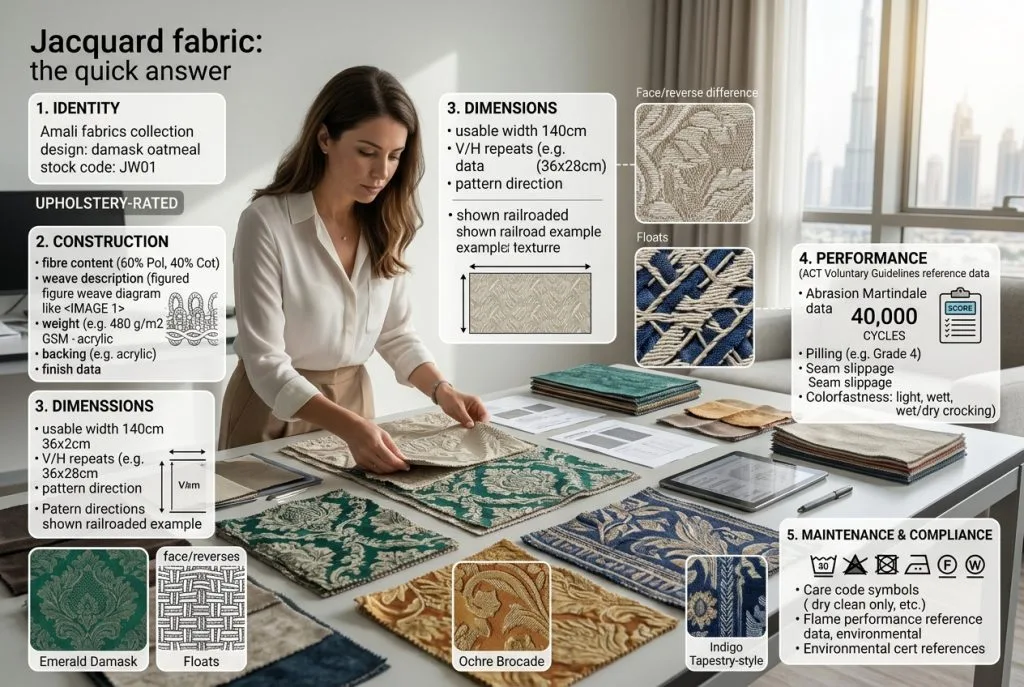
Jacquard fabric: the quick answer
Jacquard is a patterned textile made by controlling individual warp yarns, or small groups of them, during weaving. The motif is created by the interlacing of warp and weft yarns rather than simply being printed on the finished surface.
- Jacquard is a construction method, not a fibre. A jacquard may contain polyester, cotton, viscose, linen, wool, silk, metallic yarns or a blend.
- The pattern is part of the weave. Different yarns and weave structures can create colour, relief, sheen and shadow.
- It is not automatically heavy or durable. Some jacquards suit upholstery; others are intended only for curtains or decoration.
- Its face and reverse are often different. The back may reveal floats, colour inversions or construction yarns and should not automatically be treated as a finished face.
- Suitability must be confirmed from the specification. Check intended use, width, repeat, direction, composition, care instructions and relevant performance data.

What does “jacquard” actually mean?
In ordinary interior-fabric language, jacquard refers to cloth with a figured design produced through the weave. The term comes from the Jacquard mechanism associated with French inventor Joseph-Marie Jacquard. Early nineteenth-century versions used sequences of punched cards to determine which warp yarns were lifted for each row of the design. Modern production is electronically controlled, but the essential advantage remains: the loom can form much more complex woven imagery than a simple repeating weave.
A jacquard may be floral, geometric, abstract, damask-like, pictorial or almost plain. It may be matt and textural or smooth and lustrous. Therefore, “jacquard” does not describe one appearance any more than “printed fabric” describes one particular print.

Warp, weft and woven pattern
The warp yarns run along the length of a conventionally woven roll; the weft travels across its width. By lifting selected warp yarns and passing the weft through the resulting opening, the loom changes which yarns appear on the face. Repeating these decisions creates the motif, ground, outlines and tonal areas.
Different yarn colours can create a multicoloured image. Different interlacings can also reflect light in contrasting ways, producing a tone-on-tone pattern even when the yarn colours are similar.
How can you recognise a woven jacquard?
Turn the sample over. A woven motif will normally have corresponding yarn activity on the reverse: inverted colours, floats, tie-down points or a recognisable version of the design. A surface print usually does not reproduce the motif through the construction in the same way.
This is a useful first check, not a complete technical test. A jacquard base cloth can also receive printing, coating, embroidery or another finish after weaving. When the distinction affects specification or price, confirm the construction with the supplier rather than relying only on appearance.

Jacquard vs printed, embroidered and plain-woven fabric
| Construction | How the design is made | What to inspect |
|---|---|---|
| Jacquard | The motif is formed by controlled interlacing of yarns during weaving. | Face and reverse, floats, repeat, direction, texture and intended use. |
| Printed fabric | Colour or pigment is applied to a woven or non-woven base. | Print definition, penetration, colourfastness, base cloth and alignment. |
| Embroidered fabric | Decorative stitches are added to an existing ground fabric. | Stitch security, backing, snag risk, motif spacing and seam placement. |
| Plain-woven or simply textured fabric | A basic weave or yarn effect creates the surface without a complex figured motif. | Weight, drape, opacity, texture, composition and performance. |
None of these methods is automatically superior. The right construction depends on the required look, handling, application, cleaning conditions and budget. A well-specified print can be more suitable than an unsuitable jacquard, just as an upholstery-rated jacquard can be an excellent choice for demanding seating.

Jacquard, damask, brocade and tapestry: are they the same?
These terms overlap, and commercial naming is not always consistent. The safest way to understand them is to treat jacquard as the broad production concept and the other terms as more specific historical or visual constructions.
Damask
Damask commonly uses contrasting weave structures to create a motif through differences in light reflection. Many damasks are tone-on-tone and show a positive-and-negative relationship between the two sides. That does not mean every modern damask is intended to be reversible in use.
Brocade
Brocade generally describes a richly figured fabric whose pattern may appear raised or embroidered. Decorative supplementary yarns and floats can be visible on the reverse. Because everyday trade language varies, the actual construction and end-use specification remain more useful than the label alone.
Tapestry and tapestry-style jacquard
A furnishing fabric may be sold as “tapestry” because it has dense, multicoloured, pictorial patterning. Some such fabrics are machine-woven jacquards designed to create a tapestry-like effect. This should not be confused with every historical or handwoven tapestry technique.

What fibres are used in jacquard fabric?
Jacquard describes the patterning method, so it can be produced with many yarn types. Fibre content influences handle, lustre, moisture response, cleaning, crease behaviour and wear, but construction and finishing also matter.
- Polyester and synthetic blends can provide dimensional stability, varied texture and practical furnishing options, but performance still depends on the exact product.
- Cotton can give a natural, familiar handle and clear woven detail. Shrinkage and care must be checked rather than assumed.
- Viscose can add softness and lustre but may require more careful assessment for moisture, crushing or intensive use.
- Linen and linen blends can create dry texture and natural variation. Relaxation, movement and creasing may be part of the character.
- Wool can support rich colour and resilient furnishing constructions; cleaning and moth-management requirements should be confirmed.
- Silk and decorative yarns can create refined lustre and intricate effects but are not automatically suitable for strong sunlight or heavy wear.
Do not identify fibre content by touch alone. Read the current specification and request clarification where the composition or treatment is material to the project.

Why jacquard can look different as the light changes
A jacquard’s appearance is influenced by more than colour. Satin-like areas may reflect a window or lamp while neighbouring matt areas absorb more light. Raised yarns cast small shadows, and contrasting yarn directions can make a motif appear lighter from one viewpoint and darker from another.
This effect can be desirable, but it makes sample evaluation especially important. View the fabric vertically if it will become a curtain and across the curves and planes of a chair if it will become upholstery. Rotate it, fold it and observe it in morning, afternoon and artificial light before approving the colour.

Is jacquard fabric good for curtains?
Jacquard can be an excellent curtain fabric when the chosen article has suitable drape, width, weight and dimensional behaviour. Woven pattern can add depth without relying on a surface print, and the changing light across folds can emphasise the motif.
Check drape and scale
A stiff jacquard may form architectural folds; a softer one may fall more fluidly. Neither result is inherently better. Hang a sufficiently large sample or sample length so you can see whether the pattern disappears, distorts or becomes too dominant when pleated.
Decide whether lining is required
Lining may improve privacy, body and the appearance of the reverse from outside. It can also reduce direct exposure of the face fabric, although it does not make an unsuitable textile immune to UAE sunlight. The lining type and construction should match the required light control and curtain system.
Allow for pattern matching
A large vertical repeat can increase the length required for each cut, while a horizontal repeat affects alignment across joined widths. Confirm where the motif should begin at the heading and finish at the hem. For detailed quantity calculations, use the dedicated pattern-repeat guide rather than estimating from the visual scale.

Is jacquard fabric good for upholstery?
Some jacquards are engineered for upholstery and can perform well on sofas, armchairs, dining seats and headboards. Others are decorative drapery fabrics that should not be placed under repeated body movement. The presence of a dense-looking weave or a heavy hand does not prove upholstery suitability.
Examine floats and snag points
A float is a yarn that travels over several crossing yarns before being tied back into the structure. Floats help create colour and surface effects, but long or loosely secured floats can catch on jewellery, claws, rough clothing or sharp edges. Inspect both the motif and the ground, especially on seating that will receive frequent use.
Ask for application-specific evidence
Review the supplier’s declared end use and relevant test data for abrasion, pilling, seam behaviour, colourfastness and any project-specific requirement. A single abrasion figure does not describe every form of wear, and a residential result should not be presented as proof of contract compliance.
Consider pattern placement
Large motifs need deliberate positioning on seat, back and arm panels. Pattern centring and matching may increase consumption. Small repeat designs can be easier to distribute, but even they require consistent orientation across all components.

Where else can jacquard be used?
Depending on the product, jacquard may suit cushions, bed runners, decorative headboards, wall panels, table textiles or bedding accents. A fabric approved for a cushion is not necessarily suitable for washable bed linen, and a wall panel does not face the same abrasion as a dining chair. Specify the end use rather than approving a textile for “interiors” in general.
Pattern repeat, direction and railroading
Most figured jacquards have a clear top and bottom. The supplier may describe the direction in relation to the roll, and that orientation affects cutting, joins and finished appearance. A fabric should only be railroaded—turned so its roll width runs along the length of a sofa or other application—when the design, construction and supplier’s guidance permit it.
Record the vertical repeat, horizontal repeat, usable width, motif direction and any half-drop or offset arrangement. These are production measurements, not decorative footnotes. They influence how panels align and how much fabric must be ordered.

Fabric width, joins and consumption
The stated roll width is not always the fully usable patterned width. Selvedges, unpatterned margins or finishing variation can reduce the area available for cutting. A curtain wider than the usable width may require joined drops; a large sofa may need several matched cuts.
Before calculating consumption, confirm finished dimensions, repeat, orientation, matching standard, seam allowances and cutting plan. The curtain panel and fabric width guide explains the difference between roll width, finished panel width and window coverage. Exact jacquard consumption should then be checked against the project layout.

Does jacquard mean durable, luxurious or expensive?
Not by itself. Jacquard technology can produce intricate, dimensional textiles, but the label makes no guaranteed statement about durability, price, fibre quality, cleanability or service life.
| It can tell you | It cannot confirm by itself |
|---|---|
| The design is formed through controlled textile construction | The fibre content |
| The cloth can support detailed woven motifs | Whether it is suitable for curtains or upholstery |
| The reverse may reveal the woven pattern structure | Its abrasion, pilling or snag resistance |
| Pattern direction and repeat may affect making | Whether it is washable, stain-resistant or easy-clean |
| Texture and sheen may vary across the motif | Fire, lightfastness or contract-performance compliance |
Treat “luxurious” as an aesthetic judgement, not a specification. Judge value through design, yarn quality, weaving, finishing, suitability, expected use and the amount of pattern-matching work required.

How to evaluate durability and performance
Start with the application. A formal guest-room curtain, family sofa and hotel dining chair have different exposures and maintenance cycles. Then compare the current technical sheet with the relevant project specification.
- Declared end use: curtain, accessory, domestic upholstery or contract upholstery.
- Abrasion and pilling: read the method, result and application context, not only a large number.
- Colourfastness: consider light, rubbing and cleaning exposures relevant to the installation.
- Seam and structural behaviour: confirm that the weave can be cut, sewn and tensioned appropriately.
- Care: follow the product-specific instructions and assess whether the maintenance regime is realistic.
- Project requirements: request current evidence for any flame, environmental or other compliance claim required by the consultant or authority.

Jacquard fabric in UAE interiors
Strong daylight, large glazing and continuous air-conditioning can make a beautiful showroom sample behave differently at home. Place the sample in the actual room and observe the face throughout the day. A lustrous motif may become more pronounced near a bright window, while subtle tone-on-tone detail can recede in diffuse light.
For curtains, assess window orientation, lining, stack-back and direct-sun exposure. For upholstery, consider whether seating is positioned beside glazing and whether the room is used daily or only occasionally. The guide to fabrics for the UAE climate provides wider room-by-room context, but the final decision should still be based on the exact jacquard specification.

How to inspect a jacquard sample properly
- Confirm the identity. Record the supplier, collection, design, colourway and batch or lot reference where available.
- Read the specification. Check composition, width, repeat, direction, end use, care and applicable test information.
- Inspect both sides. Look for floats, loose decorative yarns, backing, colour inversion and whether the reverse will be visible.
- Assess the motif at scale. A small cutting may omit important colours or fail to show the full repeat. Request a returnable larger sample when necessary.
- Position it as installed. Hang curtain fabric vertically; curve upholstery fabric over the intended furniture profile without permanently stretching the sample.
- View it in the project light. Check daylight and evening lighting, and observe it from normal room distances.
- Compare coordinating materials. Place it beside flooring, paint, timber, metal, bedding and other textiles rather than judging it in isolation.
- Approve the correct material. Confirm whether the cutting represents colour only or the actual production batch being supplied.

Common mistakes when choosing jacquard fabric
- Assuming jacquard is a particular fibre, weight or quality grade.
- Choosing a drapery jacquard for seating because it feels heavy.
- Judging the full design from a sample smaller than one repeat.
- Ignoring the reverse when it will be visible on curtains or loose cushions.
- Forgetting to record the top, bottom and direction of the motif.
- Calculating metres from plain fabric dimensions without allowing for pattern matching.
- Calling a fabric reversible without supplier confirmation.
- Treating an abrasion result as proof of every type of durability.
- Assuming woven colour cannot fade or change through cleaning and use.
- Approving a showroom swatch without checking it in the intended UAE interior.

A practical jacquard specification checklist
| Question | Why it matters |
|---|---|
| What is the exact end use? | Separates curtain, accessory, domestic seating and contract requirements. |
| What is the composition? | Supports informed handling, care and appearance decisions. |
| What are the usable width and repeats? | Determines layout, joins, matching and consumption. |
| Which way is up? | Prevents rotated or inconsistent motifs. |
| Can it be railroaded? | Affects furniture layout and possible seam positions. |
| Are there long or vulnerable floats? | Helps assess snag exposure for the intended setting. |
| Is the reverse meant to be seen? | Informs lining, backing and construction choices. |
| What care method is specified? | Ensures maintenance expectations are realistic. |
| Which test data applies? | Provides evidence for the exact use and project requirement. |
| Has the correct batch been approved? | Reduces surprises from normal production variation. |
When comparing options, browse the AMALI furnishing-fabric collection and request the current specification and a representative sample for the intended application.

Frequently asked questions about jacquard fabric
Is jacquard a material or a pattern?
It is primarily a method of producing woven pattern, not a fibre. “Floral” or “geometric” describes the motif; polyester, cotton or viscose describes composition; jacquard describes how the figured construction is created.
Is every jacquard fabric thick?
No. Jacquards range from relatively light decorative textiles to substantial upholstery fabrics. Weight and thickness must be checked on the specific article.
Is jacquard better than printed fabric?
Not universally. Jacquard offers woven depth and texture; print can offer different colour effects, scale and cost options. Suitability depends on the base cloth, specification, use and desired appearance.
Can both sides of jacquard fabric be used?
Only when the manufacturer or supplier identifies the construction as reversible or approves both sides for the intended use. A recognisable reverse is not automatically a finished face.
Does jacquard fabric snag easily?
Some constructions have exposed floats or decorative yarns that may catch; others are compact and well secured. Inspect the weave and select according to the actual exposure rather than applying one rule to all jacquards.
Can jacquard be washed?
“Jacquard” does not determine the care method. Some products may allow washing, while others require professional cleaning or another method. Follow the exact care instructions and consider the complete made-up item, including lining, backing and trim.
Is jacquard suitable for a sofa in a busy family room?
It can be, if the product is declared suitable for the expected upholstery use and its construction, maintenance and performance evidence fit the room. Pay particular attention to floats, pilling, seam behaviour and cleaning requirements.
Why does a jacquard sample change colour when I turn it?
Different weave areas and yarns reflect light differently. Directional lustre can make the same motif appear lighter, darker or more prominent as the viewing angle changes. Evaluate the fabric in its intended orientation and room lighting.

The final decision
Choose jacquard for the depth, texture and visual control that a woven design can provide—not because the name promises a particular fibre or level of performance. First decide where the fabric will be used. Then verify its composition, end-use rating, width, repeat, direction, reverse, care and relevant test data.

A representative sample viewed in the actual room will tell you far more than a product name alone. When the visual character and technical specification both suit the project, jacquard can be a distinctive and highly considered choice for curtains, upholstery and decorative interior applications.