
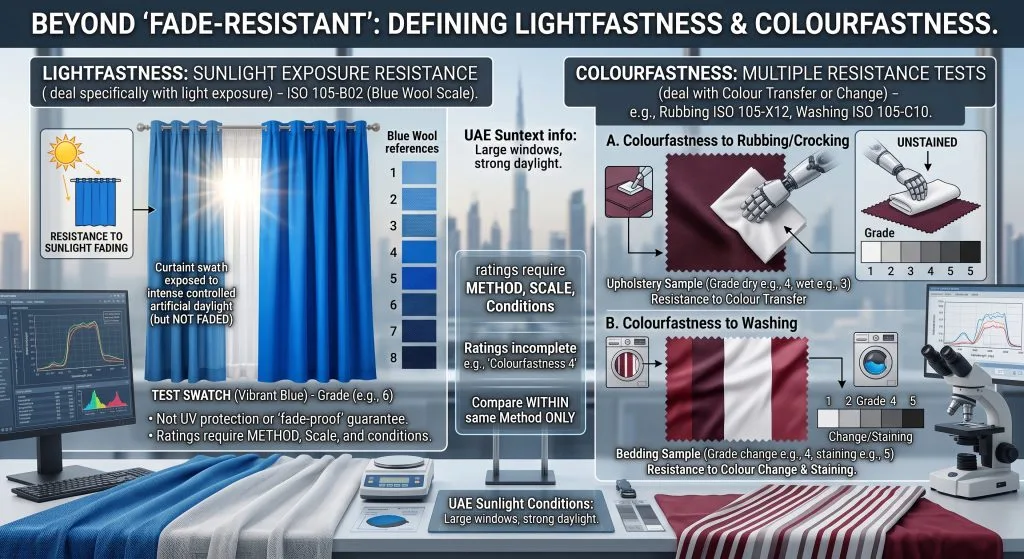
Lightfastness and colourfastness both describe how well a textile’s colour resists change, but they are not interchangeable. Lightfastness deals specifically with exposure to light. Colourfastness is the broader family of resistance tests covering influences such as rubbing, washing, water, perspiration or dry cleaning.
This distinction matters when choosing curtains, upholstery and bedding. A fabric may resist colour transfer during rubbing yet still fade near a bright window. Another may retain colour well in light but release dye during an unsuitable cleaning process.
This guide explains the terminology, common test methods, rating scales and practical questions to ask before approving furnishing fabric for a UAE home or professional interior.

The quick answer: lightfastness versus colourfastness
| Term | What it means | Typical concern |
|---|---|---|
| Lightfastness | Resistance of a textile’s colour to change when exposed to a specified light source | Curtains fading at a sunny window or upholstery changing near glazing |
| Colourfastness | Broad resistance of colour to change or transfer under a specified influence | Colour changing during cleaning or rubbing onto another surface |
| Colourfastness to rubbing | Resistance to colour transfer during controlled dry or wet rubbing | Dark upholstery marking pale clothing or a damp cloth |
| Colourfastness to washing | Resistance to colour change and staining during a stated laundering procedure | Bedding or washable covers losing colour or staining adjacent material |
| Colourfastness to water | Resistance to colour change or transfer under a defined water-exposure test | Moisture affecting a coloured textile |
A rating is useful only when it identifies the test method, conditions and scale. “Colourfastness 4” is incomplete information if it does not say whether the result refers to light, dry rubbing, wet rubbing, washing or another exposure.
What is lightfastness?
Lightfastness is the ability of a coloured textile to resist a visible colour change under a defined light exposure. The test may use an artificial source designed to represent a standard daylight condition. The exposed specimen is then assessed against references or an unexposed portion.
The colour may become lighter, duller, warmer, cooler or otherwise shift; “fading” is convenient everyday language, but not every change is a simple loss of depth. Different dyes, fibres, finishes and colours can respond differently even within one collection.
Why lightfastness matters for furnishing textiles
- Curtains can receive prolonged daylight across large surfaces.
- Sofa backs, arms or cushions near windows may receive uneven exposure.
- Hotel lobbies and atriums may combine large glazed areas with long daily exposure.
- Replacement pieces may reveal how much the installed material has changed over time.
- Very bright and deep colours can show change differently from pale neutrals.
Lightfastness should be considered together with window direction, glazing, external shading and how long curtains or blinds remain open. A good laboratory result reduces one risk; it does not make the textile immune to indefinite sun exposure.
What is colourfastness?
Colourfastness is not one universal test. It is an umbrella term describing how colour behaves when a textile is exposed to a particular influence under stated conditions. The relevant influence depends on the product and how it will be used.
For example, rubbing may be important for sofa upholstery, washing for bedding, light for curtains and dry cleaning for a textile whose care label requires that process. A supplier may therefore report several colourfastness results for one fabric.

The main types of colourfastness
Colourfastness to rubbing or crocking
Rubbing tests assess how much colour transfers from a textile surface to a standard rubbing cloth. Procedures commonly include separate dry and wet assessments because moisture can change the result. “Crocking” is a widely used industry term for this transfer.
This is particularly relevant for dark or strongly coloured upholstery, cushions and other materials that contact clothing. A wet-rubbing result may differ from a dry result, so a single unspecified grade does not tell the complete story.
Colourfastness to washing
Washing fastness evaluates colour under a defined laundering procedure. Testing may consider both the change in the original textile and staining transferred to adjacent materials. The result applies to the stated procedure, not every possible washing temperature, detergent or machine programme.
A removable sofa cover is not automatically washable. Follow the finished product’s care instructions because backing, thread, zips, interlining and construction may respond differently from the face fabric.
Colourfastness to water
Water fastness concerns a controlled exposure to water and its effect on colour change or staining. It should not be interpreted as a complete stain-resistance, waterproofing or washability claim. Real spills may contain oils, acids, sugars, cleaning agents or other substances absent from the test.
Colourfastness to perspiration
Perspiration testing is important in apparel and may also be relevant to textiles that receive frequent body contact. It uses defined test conditions rather than attempting to reproduce every individual person’s perspiration or every furniture environment.
Colourfastness to dry cleaning
This evaluates behaviour under a specified dry-cleaning method. It matters only when the textile or finished item is intended to be dry cleaned. A dry-cleaning rating does not prove suitability for wet washing, steam extraction or household spot cleaners.

How lightfastness testing works
A recognised method such as ISO 105-B02 exposes textile specimens to controlled artificial light representative of a defined daylight source. The specimen and reference materials are exposed under specified conditions, allowing the degree of colour change to be assessed consistently.
This is an accelerated comparison, not a miniature calendar. A test result cannot be converted reliably into an exact number of months or years in a Dubai apartment, villa, hotel or office. Real exposure changes with window direction, glazing, season, distance from the glass, curtain position and hours of daylight.
Understanding the blue-wool scale
ISO lightfastness testing may use blue-wool references arranged in increasing resistance to light. Results are commonly expressed on a scale associated with those references, often from 1 at the lower end to 8 at the higher end. The exact reference set and test edition must remain attached to the result, because different reference systems or procedures may not produce identical outcomes.
A higher grade indicates stronger resistance within that test framework. It does not mean “eight years”, “eight times longer” or “no fading”.

How other colourfastness ratings are assessed
Many colourfastness procedures assess either a change in the specimen or staining of an adjacent reference material. ISO grey scales are widely used for these visual comparisons. Depending on the standard, a result may be reported from grade 1 to grade 5, sometimes with half grades.
Within the relevant grey-scale assessment, grade 5 generally represents little or no visible difference and grade 1 represents a substantial change or staining. This direction is different from systems where a higher exposure number carries another meaning, which is why the test name must always accompany the grade.
| Reported information | What it tells you | What is still missing |
|---|---|---|
| “Lightfastness: 6” | Potentially a relatively strong result on a stated light scale | Exact standard, reference set, conditions and acceptance requirement |
| “Dry rubbing: 4–5” | Potentially limited colour transfer under a named dry-rubbing assessment | Test method and whether the grade concerns staining or colour change |
| “Wet rubbing: 3” | A wet-contact result under a particular test | Applicable specification and comparison with the same method only |
| “Wash fastness: 4” | Performance during a stated laundering procedure | Temperature, detergent, cycle, adjacent material and exact method |
| “Colourfast” | A general marketing statement | Which exposure was tested, result, method, date and limitations |

Why two standards cannot always be compared
ISO, AATCC and other organisations publish different methods for colour testing. Even when two methods address light or rubbing, their apparatus, exposure, reference materials, evaluation and reporting may differ. Results should be compared only when the method and conditions are compatible.
Do not convert an ISO blue-wool lightfastness grade into an AATCC result using a simple chart unless the relevant standard or qualified laboratory explicitly supports that comparison. Similarly, a grey-scale rubbing grade is not another form of a lightfastness number.
A complete result should read like a technical statement: property, test method, condition and grade—not simply a number beside the word “fastness”.

Lightfastness is not the same as UV protection
Lightfastness describes how the tested textile’s own colour resists change under the stated exposure. UV protection or UV transmission concerns how much radiation a material blocks or transmits under a different test. A fabric can therefore have a lightfastness result without any verified claim about protecting furniture, flooring or people behind it.
Do not infer a UV-blocking percentage, thermal benefit or skin-protection claim from a lightfastness grade. Each requires appropriate product-specific evidence.

Fading, colour transfer and shade variation are different
| Observation | Possible explanation | Useful next check |
|---|---|---|
| Window side becomes paler over time | Light-related colour change | Exposure pattern, lightfastness data and window protection |
| Dark fabric marks a pale cloth | Colour transfer or crocking | Dry and wet rubbing data plus care instructions |
| Fabric changes after laundering | Washing conditions, dye response or construction change | Care label and applicable washing-fastness method |
| Two new rolls differ slightly | Production or dye-lot variation | Batch references and controlled side-by-side assessment |
| Two materials match in one light but not another | Metamerism | Compare under multiple relevant illuminants |
| Velvet looks light from one direction | Pile direction and reflected light | Align both pieces in the same orientation |
These effects can sometimes occur together, but they require different evidence and remedies. Calling every colour difference “fading” or every transfer “poor dye quality” can lead to an incorrect diagnosis.

Why colour and fibre type both matter
Fastness belongs to the complete coloured textile—not merely to a generic fibre. The dye or pigment, fibre chemistry, shade depth, production route, finish and intended application all contribute. One red polyester fabric cannot establish the result for every red polyester, and one colourway cannot automatically represent an entire collection.
Deep, bright, pale and fluorescent-looking colours may respond differently under the same exposure. Prints may contain several colourants with different resistance. Request data for the exact design and, where relevant, the exact colour rather than accepting a broad statement about the base material.

Lightfastness for curtains
Curtains can receive both direct and reflected daylight. Exposure may be strongest at leading edges, hems or the sections closest to the glass, while folded or overlapping areas remain protected. When the curtain is later rearranged, this uneven exposure can become more visible.
- Review the lightfastness result and its test method.
- Confirm whether the stated value applies to the selected colour.
- Consider lining where it supports the required curtain construction.
- Assess window direction, glazing, balcony depth and external shading.
- Use sheers, blinds or operational routines to manage intense exposure where appropriate.
- Do not promise that any indoor curtain colour will remain unchanged indefinitely.

Colourfastness for upholstery
Upholstery combines light exposure with friction, body contact, clothing, spills and cleaning. Dry and wet rubbing results may therefore be as important as lightfastness. Dark denim, damp clothing or an unsuitable cleaning cloth can complicate the visual evidence because colour may transfer in either direction.
Review pilling, abrasion and seam performance separately. A fabric can have excellent rubbing colourfastness while lacking the surface or structural performance required for a busy sofa. Colour retention is one part of upholstery suitability, not a complete durability grade.

Colourfastness for bedding and removable covers
Bedding experiences repeated washing, detergent, body contact and friction. Check the finished product’s care label and colourfastness information relevant to its laundering process. Do not increase temperature or use bleaching products unless expressly permitted.
Wash deep and pale colours according to the supplier’s directions, particularly during early laundering. If a removable upholstery cover includes piping, backing, zips or several fabrics, the complete cover may require a different process from an unsewn fabric sample.

UAE sunlight and interior conditions
Strong UAE daylight makes lightfastness particularly relevant near large windows, glazed doors and atriums. However, geographic location alone cannot predict the exposure at one item. A north-facing shaded apartment and a west-facing villa room can create very different conditions.
Air-conditioning does not prevent light-related change, and tinted glass should not be assumed to remove every relevant wavelength. Record where the textile will be installed and how the window treatments are normally used. The AMALI guide to fabrics for the UAE climate provides wider room-by-room selection context.

How to read a fabric specification
When a specification lists a fastness value, ask five questions:
- Which property was tested? Light, dry rubbing, wet rubbing, washing, water or another influence?
- Which method and edition were used? Record the complete standard reference.
- Which scale applies? Confirm what the minimum and maximum values mean.
- Which product does the result cover? Verify the design, colour, finish and construction.
- What requirement must it satisfy? Compare it with the actual residential or project specification.
Example of useful reporting: Colourfastness to dry rubbing — ISO 105-X12 — Grade 4. This is more meaningful than “colourfastness: good” because the property, method and result are identified.
A result still needs interpretation by the supplier, specifier or appropriate technical reviewer. The example above explains reporting structure; it is not a universal minimum for every product or project.

How to reduce fading and colour transfer
Manage light exposure
- Use curtains, sheers or blinds during the strongest exposure where practical.
- Position vulnerable furniture away from prolonged direct sunlight when the room permits.
- Rotate reversible cushions periodically if approved by the furniture design and care guidance.
- Review glazing and shading as part of the room rather than relying only on the textile.
Follow the stated care method
- Blot spills rather than rubbing aggressively, when consistent with the care instructions.
- Use only approved cleaning agents, temperature and process.
- Test a permitted cleaner in an inconspicuous area before wider use.
- Avoid improvised bleach, steam or solvent treatment.
- Use clean, colour-neutral cloths where the manufacturer recommends spot cleaning.
Browse the AMALI fabric collection to identify suitable designs, then request current specifications for the exact colour and intended application before making a performance decision.

Common mistakes to avoid
- Using lightfastness and colourfastness as identical terms.
- Publishing a rating without its test method.
- Assuming every test uses the same scale.
- Converting an accelerated light test into exact years of service.
- Assuming a high lightfastness result prevents colour transfer during rubbing.
- Treating water fastness as proof of waterproofing or stain resistance.
- Assuming a removable cover can be machine washed.
- Applying one colourway’s result to every colour in a collection.
- Diagnosing pile direction, metamerism or batch variation as fading.
- Inferring UV protection, thermal performance or safety from a colourfastness rating.

Fastness review checklist
- Exact fabric design and colour identified
- Intended application confirmed
- Relevant exposure identified: light, rubbing, washing or another influence
- Complete test method and edition recorded
- Rating scale correctly interpreted
- Dry and wet rubbing results separated
- Colour change and staining distinguished
- Window direction and real exposure assessed
- Care method checked against the finished item
- Project acceptance criterion verified where applicable
- No lifespan, UV or fade-proof claim inferred

Frequently asked questions
Is lightfastness the same as colourfastness?
Lightfastness is one type of colourfastness dealing specifically with light exposure. Colourfastness is the broader term and may refer to resistance to rubbing, washing, water, perspiration, dry cleaning or other defined influences.
What is a good lightfastness rating for curtains?
The appropriate rating depends on the test method, project requirement, selected colour and actual window exposure. Ask for the complete result and compare it with the intended residential or professional application rather than using one universal number.
Does a lightfastness rating of 8 mean eight years?
No. On a blue-wool lightfastness scale, the number expresses performance relative to test references. It is not a number of years and cannot predict an exact service life in a particular room.
What does colourfastness to rubbing mean?
It indicates resistance to colour rubbing off and staining another material under a stated dry or wet procedure. Both conditions may be reported because the results can differ.
Can a colourfast fabric still fade?
Yes. A claim may refer to one exposure, such as dry rubbing, without establishing lightfastness. Even a fabric with a good light-test result can change during sufficiently intense or prolonged real-world exposure.
Why is wet rubbing sometimes lower than dry rubbing?
Moisture changes the test condition and may increase colour transfer for some textiles. The two results should be read separately; one should not be substituted for the other.
Does lining stop curtain fabric from fading?
Lining may reduce some exposure on the back of a face fabric and support the curtain construction, but it does not make the visible surface fade-proof. Edges and areas receiving light from the room side may still change.
Can two colours in the same fabric have different fastness?
Yes. Different dyes, pigments and shade depths can behave differently. Confirm whether the reported result applies to the exact colour selected, especially for colour-sensitive or high-exposure projects.

Read the property, method and result together
Lightfastness tells you how a textile’s colour performed under a specified light test. Colourfastness describes a wider set of tests for particular exposures such as rubbing, washing or water. Neither term is meaningful enough for a purchase decision when presented without the method and result.

Identify the way the textile will be used, request data for the exact design and colour, and interpret each grade within its own standard. Combine that evidence with realistic control of sunlight and correct care. This produces a far more reliable specification than accepting “fade-resistant” or “colourfast” as an unsupported promise.