
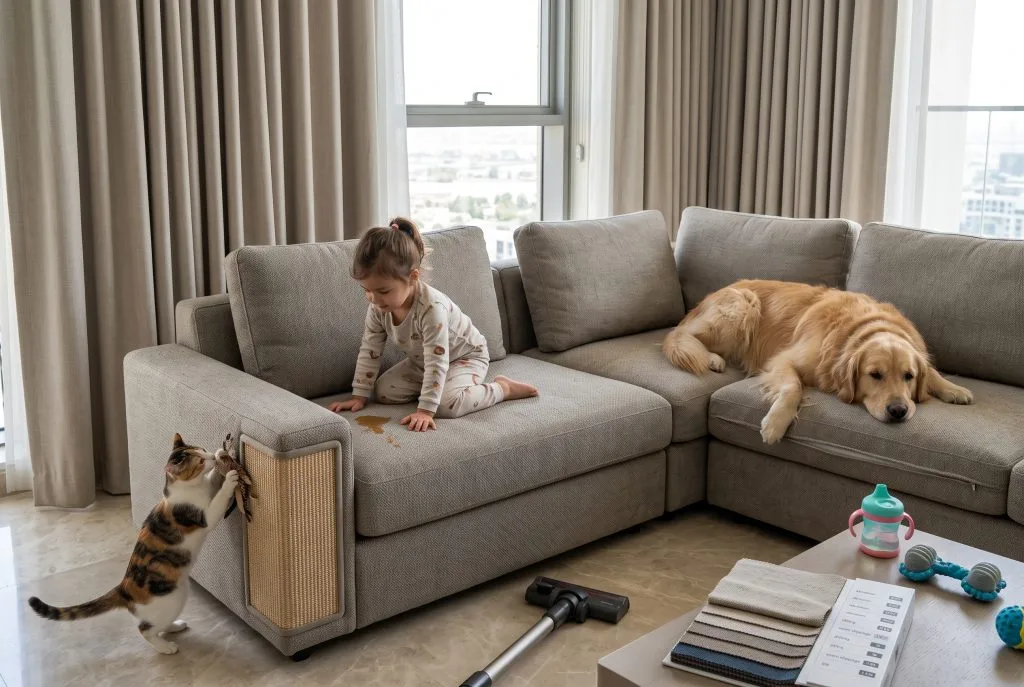
Fabric in a home with children or pets needs to do more than look attractive in a showroom. It may face food, drinks, sticky hands, pet hair, claws, repeated cleaning, strong daylight and concentrated wear on the same seats every day.
The best starting point is usually a dense, stable, low-snag upholstery fabric with a practical colour and a cleaning method your household can follow. However, no fabric is completely child-proof, pet-proof or immune to staining and scratching. The right choice depends on the behaviour in your home and the exact performance of the textile.
This guide explains which constructions are easier to live with, which fabrics require extra care, what technical information to check and how to choose curtains and upholstery that remain practical without making the room feel purely functional.

The quick answer: what fabric should families choose?
For frequently used sofas and chairs, consider tightly woven polyester or synthetic-rich blends, dense microfibre, short-pile performance upholstery and other fabrics specifically recommended for demanding seating. A tested wool or blended construction may also perform well. The fibre name alone is not enough: check the finished fabric’s pilling, abrasion, seam behaviour, colourfastness, lightfastness and care instructions.
Homes with cats or snagging risks usually benefit from compact surfaces with few exposed loops. Homes concerned mainly with spills need a documented, realistic cleaning method. If pet hair is the main problem, colour contrast and surface texture may matter more than an extreme abrasion figure.
- Choose for the household’s most frequent problem, not a generic “family-friendly” label.
- Prefer stable weaves and low-profile surfaces where claws or toys may catch.
- Confirm written cleaning instructions before selecting a pale colour.
- Use current physical samples to test hair visibility, texture and colour at home.
- Review performance data instead of judging durability by thickness or touch.
- Consider removable components, spare covers and repairability as part of the furniture design.
- For curtains, assess care and light exposure as well as the safety of the complete operating system.

Start with the real risks in your home
Two family homes can need very different textiles. A household with a long-haired cat, a toddler and a formal sitting room does not have the same priorities as a home with a large dog and an everyday sectional sofa.
| Household risk | Useful fabric qualities | What still needs checking |
|---|---|---|
| Food and drink spills | Clear written care, accessible surface and a colour or pattern compatible with regular use | Permitted cleaners, stain limitations, backing, foam and drying method |
| Cat claws | Dense construction, low profile and minimal exposed loops | No textile is scratch-proof; also review furniture shape and scratching behaviour |
| Dog paws and digging | Stable upholstery, secure seams and replaceable cushions or covers | Abrasion, snagging, soil removal and the condition of padding |
| Pet hair | Smoother or compact surface and a colour that does not create extreme contrast | How easily the exact textile can be vacuumed without damage |
| Frequent cleaning | Documented repeatable care method suitable for the household | Chemical limits, colourfastness, texture change and drying |
| Strong daylight | Appropriate lightfastness and a practical room-protection plan | Window direction, glazing, direct sun and colour sensitivity |
| Allergy or sensitivity concern | Cleanable surfaces and a maintenance plan that limits dust accumulation | Product-specific documentation and advice from an appropriate medical or veterinary professional |
Write down the top two risks before looking at colourways. A household that prioritises easy hair removal may choose differently from one that needs resistance to repeated wet spills.

Best upholstery fabric options for children or pets
Tightly woven polyester and synthetic-rich blends
Dense polyester or synthetic-rich weaves are widely available in plain, textured and patterned designs. A stable construction with suitable test results can be a practical choice for family sofas, dining chairs and playroom seating.
Polyester does not automatically mean stain-proof, pet-proof or bleach-cleanable. Check the exact fabric’s pilling, rubbing, lightfastness, seam and care information. An open polyester bouclé can still snag, while a compact blended weave may be easier to manage.
Dense microfibre and suede-like textiles
Microfibre upholstery often has a close, low-profile surface with fewer obvious loops for claws to catch. It can feel comfortable and may release loose pet hair more readily than a highly textured weave, depending on the particular construction.
Test for visible pressure marks and directional shading. Oils and some spills can behave differently from water-based marks, so obtain the precise cleaning instructions instead of assuming that every microfibre uses the same method.
Short-pile performance velvet
A tightly constructed, upholstery-rated velvet can be a comfortable family option and may have fewer exposed loops than a loose weave. Its visual depth can also make a room feel considered rather than purely practical.
Velvet pile changes appearance with direction, touch and pressure. Pet hair may be more or less visible depending on colour, and clawing can still damage the surface. Review pile direction, pilling, abrasion, seam suitability and care for the exact product.
Performance-rated wool and blended textiles
Wool-rich and other engineered blends can provide a refined appearance with suitable resilience when developed for upholstery. They may work well in family spaces where comfort, texture and design quality are as important as performance.
Confirm the care process, pilling, lightfastness and application. A fabric that performs well in a professional setting may still be inconvenient if the household cannot follow its cleaning requirements.
Solution-dyed or indoor–outdoor performance fabrics
Some solution-dyed and indoor–outdoor textiles are designed for stronger light exposure, moisture or demanding maintenance. They can be considered for sunny family rooms, breakfast seating or covered outdoor areas when the specification matches the application.
Do not assume that outdoor suitability makes a fabric ideal indoors. Compare hand, breathability, texture, backing and comfort, and verify every cleanability or colourfastness claim. The intended environment must be stated by the supplier.
| Fabric option | Why families may consider it | Possible limitation |
|---|---|---|
| Dense synthetic-rich weave | Versatile design range and potential for stable everyday performance | Loose versions can snag; care and performance remain product-specific |
| Microfibre | Compact surface, soft hand and relatively few visible loops | May show directional marks or react differently to oily soil |
| Short-pile performance velvet | Comfortable, visually rich and potentially low-snag when tightly built | Shading, pressure marks and pile direction are part of the appearance |
| Wool or tested blend | Refined character and potential for resilient upholstery performance | Care requirements, cost and pilling must suit the household |
| Solution-dyed performance textile | May suit bright or demanding environments when properly specified | Not every option has the desired indoor hand or permits every cleaner |

Fabric constructions that need extra caution
No category is automatically forbidden, but certain surfaces can create more maintenance or damage risk in an active household:
- Loose open weaves: toys, jewellery and claws can catch exposed yarns.
- Long-loop bouclé: its texture can trap crumbs and hair or invite snagging.
- Delicate silk-rich fabric: often better suited to controlled decorative use unless specifically developed for active upholstery.
- Very loose chenille: the soft yarn structure may pull or change in high-friction positions unless the exact product is designed for them.
- Complex heavy texture: recessed areas can hold dry soil and may be difficult to access during routine cleaning.
- Unverified stain-resistant fabric: a label without clear care, limitations or supporting product information is not enough.
A tested, well-constructed product within one of these groups may still suit your home. Request a sample and specification rather than relying only on the category name.

What makes a fabric less likely to snag?
Look closely at the surface. Closely spaced yarns, a firm structure and limited loops generally provide fewer obvious catching points than long floats, open textures or oversized loops. Run your fingertips lightly over the sample without deliberately damaging it, and inspect it from the side.
No woven or pile fabric is claw-proof. A cat that uses a sofa as a scratching surface or a dog that repeatedly digs before lying down can damage even a robust upholstery. Scratching posts, nail care, throws and behaviour management remain part of protecting the furniture.

How to choose fabric that handles pet hair
Hair visibility is a combination of colour, contrast, fibre length and surface. A black sofa can show pale fur clearly; a cream sofa can emphasise dark fur. Mid-tones, subtle mixtures and small textures often make loose hair less visually dominant between cleaning sessions.
Test your real pet hair on a returnable or expendable sample with the supplier’s permission. Allow the hair to settle, then use the approved vacuum or brush method. This small practical test is more informative than a generic “pet-friendly” description.
A highly textured surface may disguise hair while making it harder to remove. A smooth fabric may release it more easily while showing every strand. Choose the balance that suits how frequently you clean and how the room is used.

Spills, stains and cleanability
“Easy clean”, “stain resistant” and “washable” are not interchangeable terms. They may describe different technologies, finishes, test conditions or care processes. Ask what types of soil were considered, which cleaning agents are permitted and whether the instructions apply to the fabric or the complete upholstered item.
Read the care instructions before buying
Some upholstery allows a water-based spot-cleaning method; other textiles require solvent or professional care. Removable covers are not automatically machine washable. Water, heat or agitation can change size, colour, coating, backing or seam shape even when the cover has a zip.
Do not improvise with stronger chemicals
Bleach, disinfectant, enzyme cleaner, steam and household mixtures can affect different textiles in different ways. Follow the current manufacturer’s instructions, test an approved method in an inconspicuous location and keep all cleaning products away from children and animals during use and drying.
If chemical exposure or sensitivity is a concern, request precise product and finish information. Terms such as “non-toxic”, “eco-friendly”, “organic” or “chemical-free” should not be accepted as proof without a clearly identified standard, scope and current supporting document.

Performance data to check
A physical sample helps assess touch, texture, pattern and snagging risk. Technical data helps evaluate declared performance. For heavily used upholstery, review the relevant information supplied for the exact fabric and colour.
| Performance check | What it indicates | Household relevance |
|---|---|---|
| Abrasion resistance | Surface wear under a stated laboratory method | Useful for everyday sofas and frequently used chairs |
| Pilling resistance | Tendency to develop attached fibre balls or fuzz | Important where bodies, clothing and pets create friction |
| Seam performance | How the fabric behaves around a sewn seam under stress | Relevant to cushion fronts, corners and favourite seats |
| Colourfastness to rubbing | Potential colour transfer or change during dry or wet rubbing | Relevant to clothing, damp paws and spot cleaning |
| Lightfastness | Resistance to colour change under specified light exposure | Important beside UAE windows and in bright living rooms |
| Care instructions | Approved cleaning and maintenance procedures | Determines whether household spills can be handled correctly |
Do not use abrasion as a precise prediction of years of service. Laboratory methods do not reproduce every claw, spill, seam, cleaning product or furniture design. Durability and appearance retention depend on the complete material and how it is used.

Colour and pattern can make daily care easier
Mid-tone colours, two-tone yarns, subtle mottling and small patterns can make crumbs, lint, minor marks and pet hair less obvious between cleaning sessions. They do not prevent soil; they reduce visual contrast.
Very pale solids may show food, denim transfer and paw marks. Very dark solids can reveal dust, scratches and pale hair. Strong large-scale patterns may conceal small changes but require more planning for matching and future repair.
Bring a current physical sample into the room and compare it in daylight and evening light. The AMALI guide to fabrics for the UAE climate explains how room function and sunlight can shape the broader textile choice.

Furniture design matters as much as the fabric
A family sofa is easier to maintain when its construction supports cleaning and repair. Consider separate seat cushions, reversible cushions where the design permits, accessible gaps, replaceable covers and a frame that does not expose sharp edges to the textile.
Piping, deep buttons, pleats and heavy tufting create visual detail but can trap crumbs, hair and dust. Tight corners and insufficient padding can concentrate wear. Discuss the shortlisted fabric with the upholsterer so its stretch, backing, direction and seam behaviour suit the furniture.

Choosing curtain fabric for a family home
Curtains normally face less body friction than sofas, but they collect dust, may be pulled by children or pets and can sit close to food, floors or open windows. Choose a stable construction with care instructions appropriate to the installation. Long loose fringes, beads and delicate trims may be impractical where they invite pulling or chewing.
Consider the finished length as well as the textile. Floor-puddling curtains can collect more hair and dust and may be disturbed by active pets. A clean floor finish or carefully controlled break is often easier to maintain in busy rooms.
Window safety is not only about fabric
Operating cords, chains, tiebacks, hardware and furniture placement are separate safety considerations. In homes with young children, prioritise a system without accessible looped or dangling cords and follow the hardware manufacturer’s installation and safety instructions. Do not place climbable furniture where it creates access to the window treatment.
This is one reason a complete curtain specification should cover fabric, lining, heading, track or pole, controls, fixing and room layout rather than treating the textile as the whole product.

UAE sunlight, dust and air-conditioning
Strong daylight near large UAE windows can place additional pressure on upholstery colour. Review lightfastness separately from abrasion and use window treatments or furniture placement to reduce unnecessary direct exposure where practical.
Dust and pet hair may circulate in air-conditioned rooms and settle into textured surfaces. A fabric that can be vacuumed gently and regularly according to its care instructions may be easier to maintain than one that depends on occasional aggressive cleaning.
Test sample colours beside the room’s flooring and walls. Warm evening lighting, tinted glazing and reflected sunlight can change how neutral upholstery appears, so final approval should happen in the intended room.

How to test fabric samples at home
- Request a current, labelled sample. Keep the design, colour and direction attached.
- Use the largest practical size. Small cuttings may not reveal pattern, shading or hair removal.
- Place upholstery on the furniture. Test it across the seat, arm, cushion and curves.
- Check the surface. Look for open yarns, long loops and directional pile without deliberately damaging the sample.
- Compare pet hair. With permission, test a small amount of real hair and the approved removal method.
- Review colour in context. Check daylight, evening lights and nearby finishes.
- Do not perform an improvised stain test. Obtain a separate expendable cutting and follow the supplier’s approved procedure.
- Read the specification. Confirm application, performance, care and all claim limitations.
- Ask the upholsterer. Verify seams, backing, stretch, pattern placement and required quantity.
- Confirm stock and batch. Reserve enough material for the complete job and agreed spare covers.
Browse the AMALI fabric collection to create a shortlist, then compare current physical samples and technical information against the behaviour of your own household.

A practical room-by-room approach
| Room or item | Likely challenge | Priority |
|---|---|---|
| Main family sofa | Daily sitting, food, hair and favourite-seat wear | Stable low-snag construction, practical care, pilling and seam performance |
| Dining chairs | Food spills and repeated edge contact | Accessible surface, documented spot care and secure upholstery |
| Playroom seating | Frequent marks, movement and informal use | Replaceable components, compact texture and realistic cleaning routine |
| Bedroom headboard | Hair products, rubbing and dust | Comfortable cleanable surface without excessive recesses |
| Living-room curtains | Pet hair, dust, sunlight and pulling | Stable cleanable fabric, practical floor finish and safe controls |
| Pet’s favourite chair | Claws, body oils, hair and concentrated wear | Dense surface, washable protective layer and repair strategy |

Common mistakes to avoid
- Buying a fabric solely because it is described as pet-friendly.
- Assuming polyester or outdoor fabric is automatically stain-proof.
- Selecting open bouclé for a scratching cat without considering loops.
- Choosing only by rub count and ignoring pilling, seams and care.
- Believing that a zip makes an upholstery cover machine washable.
- Using an unapproved cleaner because it worked on another sofa.
- Testing bleach, steam or stain remover on the only approval sample.
- Choosing a colour without checking real pet-hair contrast.
- Ignoring furniture seams, foam, padding and replaceability.
- Using long puddled curtains in a high-hair or very active room without a maintenance plan.
- Leaving curtain cords or loops accessible to young children.
- Accepting health, environmental or chemical claims without defined supporting evidence.

Final family fabric checklist
- Children’s ages and pets’ behaviour considered
- Main risks ranked: spills, claws, hair, light or cleaning
- Exact fabric approved for the intended application
- Dense weave or low-snag surface assessed
- Current physical sample checked at home
- Colour and pet-hair contrast reviewed
- Abrasion, pilling, rubbing and seams considered as relevant
- Lightfastness reviewed for bright windows
- Written cleaning method suits household routine
- Claims and certifications verified for the exact product
- Furniture design supports cleaning and repair
- Curtain length and controls reviewed for family safety
- Batch, quantity and spare-material plan confirmed

Frequently asked questions
What is the best sofa fabric for children and pets?
A dense, stable, low-snag upholstery with suitable performance data and a realistic cleaning method is a strong starting point. The final choice depends on whether spills, claws, pet hair, sunlight or frequent washing creates the greatest risk in your home.
Is microfibre good for homes with pets?
Dense microfibre may offer a low-profile surface with few exposed loops, making it worth considering. Check the exact product’s cleaning method, pilling, abrasion, oily-soil guidance and directional shading before approval.
Is velvet suitable for children and pets?
A tightly constructed upholstery-grade velvet may suit an active home when its performance and care are appropriate. It is not claw-proof and may show pile movement, pressure marks or hair depending on colour and direction.
Should I avoid bouclé if I have a cat?
Long or loose loops can present more catching points for claws, so they require caution. A compact tested texture may behave differently from an exaggerated open bouclé. Inspect a current sample and consider your cat’s scratching behaviour.
Are removable sofa covers always washable?
No. A removable cover may still require professional or specialist cleaning. Follow the care instructions for the exact fabric and finished cover because water, heat and agitation can alter size, colour, backing or seam shape.
Which colour hides pet hair best?
A colour close to the pet’s hair generally reduces contrast. Mid-tone mixtures and subtle textures can also make loose hair less noticeable. Test real hair on the sample because texture affects both visibility and removal.
Does stain-resistant fabric mean it is safe for every cleaner?
No. Stain resistance is a product-specific characteristic with defined limitations. Use only the approved cleaning agents and process. Request current documentation when chemical content, sensitivity or environmental claims influence the purchase.
What curtain style is practical with young children?
Choose a manageable finished length, stable fabric and an operating system without accessible dangling or looped cords. Hardware, fixing, furniture placement and manufacturer safety instructions matter alongside the fabric.

Choose for your household, not the label
The most practical family textile is one that addresses the way your children and pets actually use the room. Dense synthetics, microfibres, performance velvets, tested blends and specialised solution-dyed fabrics can all be appropriate when their construction, care and performance match the need.

Shortlist by application, inspect a current sample, verify every important claim and plan for regular maintenance, repair and safe curtain operation. No material removes the need for household habits, but the right combination of fabric and furniture design can make everyday living considerably easier.