
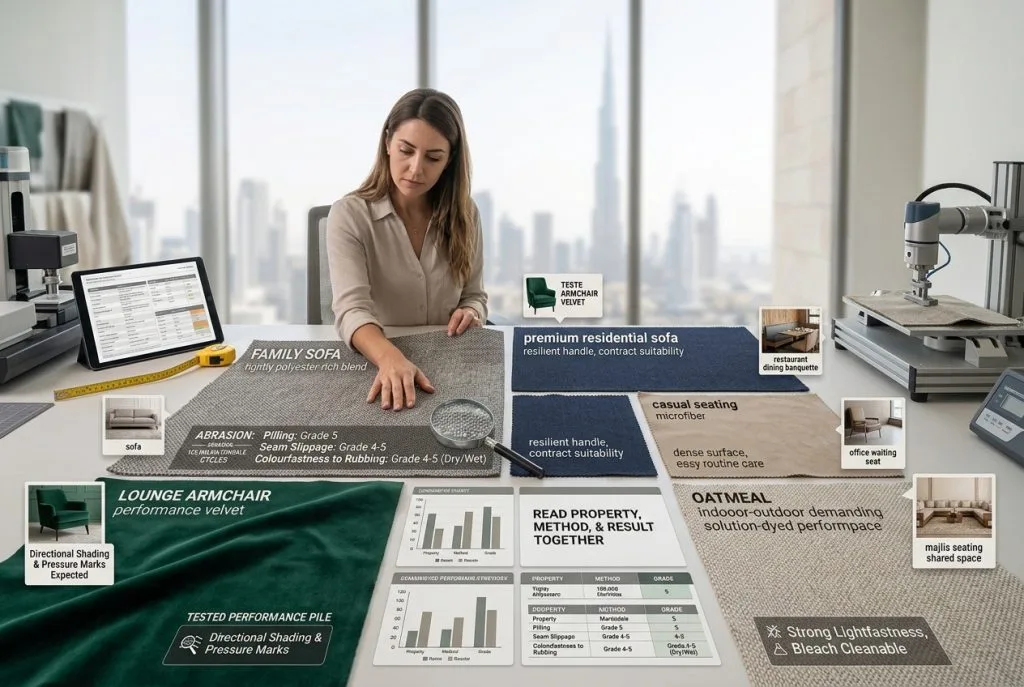
The best upholstery fabric for a high-traffic area is not simply the thickest material or the one with the highest number on a sample label. It must combine a stable construction, suitable surface, verified performance, practical maintenance and the right appearance for the furniture and setting.
A family sofa, restaurant banquette, hotel-lobby chair and office waiting seat all experience different wear. Some face constant friction; others are exposed to food, frequent cleaning, strong daylight or clothing that transfers colour. The correct textile is the one specified for those real conditions.
This guide compares useful fabric families, explains the performance data that matter and provides a practical selection method for busy UAE homes and professional interiors.

The quick answer: which upholstery fabrics work best?
For many high-traffic interiors, the strongest candidates are tightly constructed polyester or synthetic-rich weaves, performance-rated microfibres, commercial-grade wool blends, tested performance velvets or chenilles, and application-specific solution-dyed textiles. None is automatically suitable based on fibre name alone.
Shortlist fabrics only when their manufacturer or supplier recommends them for upholstery and their current technical data matches the expected use. Look beyond abrasion to pilling, seam performance, colourfastness to rubbing, lightfastness, care and any project-specific compliance requirement.
| Fabric family | Potential strengths | Important checks | Typical applications |
|---|---|---|---|
| Tightly woven polyester or synthetic-rich blend | Wide design range, stable construction and practical maintenance options | Pilling, seam strength, lightfastness, rubbing and exact care method | Family sofas, dining chairs, waiting areas and hospitality seating |
| Microfibre or suede-like textile | Dense surface and comfortable hand with limited open yarns | Cleaning method, oily marks, shading, backing and product-specific performance | Residential sofas, media rooms and casual seating |
| Wool or wool-rich blend | Resilient handle, refined appearance and strong potential for contract use | Exact blend, pilling, care, moth management, cost and test data | Premium residential, offices, lounges and selected hospitality areas |
| Performance velvet or chenille | Rich texture, visual depth and comfortable surface | Pile direction, pressure marks, pilling, cleaning, shading and seam suitability | Lounges, sofas, accent seating and hospitality when properly specified |
| Solution-dyed performance textile | May offer strong colour stability and cleanability when designed for demanding use | Indoor versus outdoor rating, chemical-care limits, hand, backing and verified claims | Sunny rooms, terraces and demanding shared spaces where specified |
| Tightly woven natural–synthetic blend | Natural visual character with performance support from blended fibres | Blend ratio, staining, wrinkling, shrinkage, pilling and cleaning restrictions | Busy homes and design-led commercial interiors with managed care |

What does “high traffic” mean for upholstery?
High traffic means frequent, repeated use, but frequency is only one part of the risk. A chair used all day in a calm office and a dining banquette used for shorter periods may experience different combinations of abrasion, spills, cleaning and seam stress.
Busy residential use
A main family sofa, television-room sectional or everyday dining chair may be used by several people daily. Children, pets, snacks, denim, sunlight and informal cleaning can matter as much as the number of times someone sits down. Removable cushions and replaceable covers may also influence the best choice.
Hospitality and shared interiors
Hotel lounges, restaurants, cafés, serviced apartments and waiting areas can combine continuous use with scheduled cleaning and appearance standards. A fabric must remain presentable across many seats, and replacement material may need to coordinate with an earlier installation.
High-risk locations within one room
Not every upholstered item needs the same specification. Entrance seating, dining chairs, sofa arms, front edges and favourite positions normally experience more contact than decorative chairs or headboards. Mapping the wear points can prevent both under-specification and unnecessary cost.

Performance matters more than fibre name alone
“Polyester”, “wool”, “cotton” or “viscose” describes fibre content, not the complete behaviour of the finished upholstery. Yarn type, weave or knit structure, density, finishing, backing, dyeing, pile and furniture construction all affect how a textile performs.
Two fabrics with the same fibre composition can have very different pilling, seam and abrasion results. Conversely, a thoughtfully engineered blend may outperform a poorly constructed fabric made from a fibre that is generally considered durable. Use composition to understand the material, but use application guidance and relevant test data to judge suitability.

Best fabric options for demanding upholstery
Tightly woven polyester and synthetic-rich fabrics
Polyester and synthetic-rich constructions are widely available in plains, textures, jacquards and blended looks. A dense, stable weave can be a practical choice for family seating or commercial interiors when the product is rated for the expected traffic and its care method suits the site.
Do not assume that every polyester upholstery is stain-proof, fade-proof or suitable for bleach cleaning. Those are product-specific claims. Check pilling, colourfastness, seam behaviour, backing and written cleaning guidance for the exact design and colour.
Microfibre and suede-like textiles
Microfibre constructions can provide a smooth, comfortable surface with fewer exposed yarn loops than an open decorative weave. They are often considered for casual sofas and media rooms where comfort and everyday practicality are priorities.
Inspect the surface from several angles because touch and pressure may create temporary shading. Confirm how the specific fabric responds to water-based marks, oils and repeated cleaning; “microfibre” does not describe one universal maintenance system.
Wool and wool-rich blends
Wool and well-developed wool blends are used in many premium residential and contract interiors. They can offer a resilient hand and refined colour depth, while blends may adjust strength, cost, handle or maintenance characteristics.
The word “wool” does not remove the need for evidence. Review abrasion, pilling, lightfastness, care and the intended application. Consider the site’s cleaning capability and storage or pest-management conditions, particularly where spare material will be retained.
Performance velvet and chenille
Velvet and chenille are sometimes dismissed as delicate, but construction and specification matter more than the category name. A tested upholstery-grade product may be appropriate for frequent use and can bring depth and softness to lounges, sofas and hospitality seating.
Pile creates direction and natural shading. Pressure marks, changes in reflection and differences between adjacent pieces can be part of the visual character rather than colour inconsistency. Approve the pile direction, examine pilling and seam data, and ensure the planned care routine respects the surface.
Solution-dyed performance textiles
In solution dyeing, colour is introduced as the manufactured fibre is formed rather than applied only to a finished surface. Products designed around this process may be specified where light exposure, moisture or demanding cleaning are relevant.
The process name is not a complete guarantee. Check the exact fibre, indoor or outdoor recommendation, lightfastness result, chemical limitations, backing, hand and warranty conditions. A textile engineered for an outdoor terrace may not provide the feel or appearance wanted in a formal interior.
Natural–synthetic blends
Cotton, linen or other natural-looking blends can offer texture and visual warmth while synthetic fibres may support stability or wear performance. They can suit busy homes and design-led commercial settings when the complete construction has suitable results.
Check whether creasing, slubs, colour movement or natural variation are intentional characteristics. Review shrinkage and cleaning guidance before choosing a removable cover, because an upholstery fabric being removable does not automatically make it machine washable.

Fabrics that need extra caution in high-traffic areas
No fabric family should be rejected without examining the actual product, but some constructions deserve closer scrutiny for demanding seating:
- Loose or open weaves: exposed yarns may snag, distort or collect debris, depending on construction and use.
- Long loops and exaggerated bouclé: the texture can catch on claws, jewellery or hardware and may be difficult to clean.
- Delicate silk-rich textiles: often better reserved for controlled decorative applications unless specifically engineered and documented for demanding upholstery.
- Very light colours in food-service areas: maintenance demands may be disproportionate even when the fabric itself is technically durable.
- Heavy surface textures: crumbs, dust and abrasion may affect appearance between raised and recessed areas.
- Unverified “performance” fabrics: a marketing description without application guidance, care information or test data is not enough for a high-use project.
A tested option within one of these groups may still be entirely suitable. The purpose of the caution is to trigger a closer product-level review, not to create an absolute ban.

How to read abrasion resistance correctly
Abrasion testing estimates how a fabric surface resists controlled rubbing in a laboratory. Martindale results are commonly reported as cycles, while Wyzenbeek results are commonly reported as double rubs. They use different motions and procedures, so their numbers should not be directly converted or treated as equivalent.
A result should always be read with the test method, pressure or applicable test condition, and the intended-use recommendation. More is not automatically better after a fabric already meets the project’s requirement. Extremely high figures do not prove that seams, colour, surface texture or cleaning performance will last equally well.
Abrasion is one selection input—not a service-life prediction. Furniture design, seam placement, usage, maintenance, spills, sunlight and the complete upholstery build also affect the result in practice.

Performance checks beyond rub count
| Performance factor | What it evaluates | Why it matters |
|---|---|---|
| Abrasion resistance | Surface wear under a stated laboratory method | Useful for screening textiles for the expected traffic level |
| Pilling resistance | Tendency to develop attached fibre balls or surface fuzz | Affects appearance where clothing and bodies create friction |
| Seam slippage or seam performance | Movement or failure of yarns near a sewn seam | Important on tight upholstery, corners and high-stress seating areas |
| Breaking or tensile strength | Resistance to being pulled apart under defined conditions | Helps assess the stability of the textile construction |
| Colourfastness to rubbing | Potential transfer or change from dry or wet rubbing | Relevant where clothing, moisture and cleaning contact the surface |
| Lightfastness | Resistance to colour change during specified light exposure | Important beside UAE windows and in bright atriums or lounges |
| Cleanability | Approved methods and agents for removing soil or spills | Determines whether the maintenance team can care for the textile safely |
| Flammability or project compliance | Performance under a named test or required assembly condition | May be mandatory for a particular hospitality or commercial project |
Not every residential project needs every test. The list helps buyers ask the right questions and allows consultants to align evidence with the actual specification.

Cleanability is part of durability
A fabric can resist friction yet lose its appearance through unsuitable cleaning. Before approval, confirm what should happen after a water-based spill, oily mark, dust build-up or routine maintenance. Ask which cleaning agents are permitted, whether professional cleaning is required and whether the instructions apply to the fabric alone or the finished upholstered item.
Terms such as “easy clean”, “stain resistant” and “bleach cleanable” require product-specific evidence and limitations. Do not extend one colourway’s or one finish’s instructions to another product. Stronger chemicals are not automatically more effective and may damage dye, fibre, coating, backing, foam or adhesive.

Colour and pattern choices for busy spaces
Mid-tone colours, textured plains and small-scale multi-tone patterns can make everyday lint, minor marks and visual wear less immediate than very pale solids or extremely dark smooth surfaces. This does not make them cleaner; it only changes how readily normal use is seen.
Very dark fabric can reveal dust and light-coloured fibres. Very pale fabric may show colour transfer or food marks. Strong directional patterns require careful placement and can increase replacement complexity. Choose appearance in relation to the actual cleaning schedule rather than following a universal “best colour” rule.
For large installations, also consider future repair. A pattern or subtle mixture may make a small local change less conspicuous, but replacement fabric from a later batch may still show variation. Retaining labelled spare material from the original order can be valuable where the maintenance plan allows it.

UAE sunlight changes the specification
High-use seating near a large UAE window must handle both physical wear and significant light exposure. An excellent abrasion result does not establish lightfastness. Review the declared lightfastness separately, then use blinds, sheers, curtains or room planning to reduce unnecessary direct exposure where appropriate.
Air-conditioned interiors may reduce some environmental stresses, but they do not remove sunlight, dust or repeated cleaning. Consider window direction, glazing, daily sun path and how frequently the room is occupied. The guide to fabrics for the UAE climate explains how exposure and room function can inform the wider textile scheme.

The furniture construction also affects fabric life
Even a well-specified textile can perform poorly on an unsuitable or badly executed upholstery build. Sharp frame edges, inadequate padding, excessive tension, poorly placed seams and insufficient support can concentrate stress. Loose covers create different movement and friction from tightly upholstered surfaces.
Share the shortlisted fabric with the upholsterer before ordering. Ask about stretch, pattern direction, seam location, piping, tufting, backing and the condition of the existing foam and frame. Re-covering worn furniture without correcting structural or padding problems can shorten the useful result.

High-traffic fabric choices by setting
| Setting | Main risks | Selection priorities |
|---|---|---|
| Family living room | Daily friction, food, children, pets and sunlight | Stable weave, suitable pilling and abrasion results, realistic care and colour that fits the household |
| Dining chairs | Food, repeated edge wear and frequent movement | Cleanability, seam stability, compact pattern scale and secure upholstery construction |
| Majlis seating | Large coordinated areas, repeated gatherings and visual continuity | Consistent batch, comfortable hand, replaceability, pattern planning and maintenance access |
| Hotel lobby | Continuous use, luggage contact, daylight and appearance expectations | Contract suitability, broad performance review, mock-up, documented cleaning and spare-material strategy |
| Restaurant banquette | Spills, food oils, cleaning and seam stress | Approved cleaning method, surface stability, seam design and project-required compliance |
| Office waiting area | Frequent users, clothing transfer and concentrated seat wear | Abrasion, rubbing colourfastness, pilling, easy routine maintenance and professional appearance |
| Serviced apartment | Guest turnover, variable use and maintenance pressure | Repeatable care process, robust construction, replaceable components and reliable supply information |

Residential fabric versus contract-grade fabric
“Contract-grade” should indicate that a textile has been developed or assessed for defined professional applications, but the label alone is not a substitute for documentation. Check the exact application, testing, maintenance and project requirements. A fabric suitable for an office may not automatically satisfy a hotel, restaurant or healthcare brief.
A well-chosen residential upholstery may be appropriate for a busy home without carrying every commercial test. Equally, a contract textile may bring unnecessary cost or a less suitable hand to a low-risk decorative chair. Match the evidence and construction to the real use rather than selecting the strongest-sounding category.

How to test and approve a sample
- Define the traffic. Record who will use the furniture, how often, and the main risks.
- Confirm upholstery suitability. Use current supplier or manufacturer information, not appearance alone.
- Request the technical sheet. Review relevant test methods, results, care and limitations.
- Obtain a current physical sample. Keep its code, colour and direction attached.
- Place it on the furniture. Evaluate the textile across the seat, back, arm and curves.
- Check the room. Compare colour under daylight and normal artificial lighting beside real finishes.
- Review direction and scale. Mark pile or pattern orientation and decide motif placement.
- Discuss fabrication. Ask the upholsterer about seams, stretch, backing, piping and quantity.
- Verify cleaning. Ensure the site’s normal maintenance process matches written instructions.
- Confirm stock and batch. Reserve sufficient material for all pieces and any planned spare quantity.
- Approve a mock-up where justified. Use a complete chair, cushion or representative seat for repeated projects.
- Retain the approval sample. Label the accepted fabric, colour, direction, date and batch reference.
Browse the AMALI fabric collection to create an initial shortlist, then request current physical samples and application-specific information before final approval.

Common mistakes to avoid
- Choosing the thickest fabric and assuming it is the strongest.
- Ranking fabrics only by fibre content.
- Comparing Martindale cycles directly with Wyzenbeek double rubs.
- Treating an extremely high abrasion result as a lifespan guarantee.
- Ignoring pilling, seam performance, rubbing and lightfastness.
- Assuming “performance fabric” means every stain or chemical is covered.
- Using loose loops around pets without considering snagging.
- Selecting a pale restaurant textile without a realistic cleaning plan.
- Approving velvet without agreeing its pile direction.
- Ignoring foam, frame, seam and upholstery workmanship.
- Assuming a foreign voluntary guideline automatically satisfies a UAE project’s requirements.
- Ordering without reserving one batch for all coordinated pieces.

Final high-traffic upholstery checklist
- Room, furniture and traffic level defined
- Main risks identified: friction, spills, pets, sunlight or cleaning
- Exact fabric approved for upholstery use
- Current specification sheet reviewed
- Abrasion method and result checked
- Pilling, seam and rubbing performance considered
- Lightfastness reviewed for window exposure
- Written cleaning method matches site practice
- Colour, pattern and direction approved in the room
- Upholsterer reviewed seams, stretch, backing and furniture condition
- Project-specific fire or compliance evidence confirmed where required
- Quantity, batch and spare-material plan agreed
- Labelled approval sample retained

Frequently asked questions
Is polyester the best upholstery fabric for high-traffic areas?
Polyester and polyester-rich fabrics can be strong candidates, but composition alone does not determine suitability. Check the weave or knit, abrasion method, pilling, seam performance, colourfastness, care and manufacturer-recommended application for the exact product.
What rub count is good for a busy sofa?
Use the threshold required by the relevant project specification and read it with the named test method. Martindale and Wyzenbeek figures are not directly interchangeable. A higher abrasion number does not by itself predict lifespan or replace other performance checks.
Is velvet suitable for everyday upholstery?
An upholstery-grade velvet with suitable test results and care guidance may work for everyday seating. Consider pile direction, pressure marks, shading, pilling, cleaning and the furniture’s seam design before approval.
Which fabric is best for upholstery with pets?
Dense, stable surfaces with limited loops are often easier to consider than open or highly looped constructions, but no textile is claw-proof. Review snagging risk, pilling, cleanability and colour, and protect the furniture through realistic pet and maintenance habits.
Does dark upholstery hide dirt better?
Not always. Dark smooth fabrics can show dust, pale fibres and dried marks. Mid-tone, textured or multi-tone designs may make minor everyday changes less obvious, but colour never replaces cleaning.
What is the difference between durable and easy-clean fabric?
Durability covers several ways a textile retains structure and appearance during use. Easy-clean describes a claimed maintenance characteristic under stated conditions. A fabric may resist abrasion but require specialist cleaning, or clean easily but be unsuitable for heavy seam stress.
Do hotel and restaurant fabrics need special certification?
They may require specific performance evidence determined by the project, consultant, authority, use and complete assembly. Do not assume one general “contract” or fire-retardant label is sufficient. Verify the exact current requirement and applicable documentation before approval.
Should I keep spare upholstery fabric?
For a large coordinated installation or fabric that may be difficult to match later, a labelled spare quantity from the original batch can support future repairs. The appropriate amount depends on the furniture, pattern, storage conditions and maintenance plan.

Choose for the whole life of the furniture
The best high-traffic upholstery fabric balances tested performance with comfort, appearance, cleaning and the furniture’s construction. Tightly woven synthetics, microfibres, wool blends, performance piles and solution-dyed textiles can all be excellent choices when their exact specifications match the setting.
Define the real use first, compare current physical samples, review more than abrasion and confirm how the textile will be fabricated and maintained. That approach produces a more dependable decision than choosing by thickness, fibre name or the largest number on a label.
