
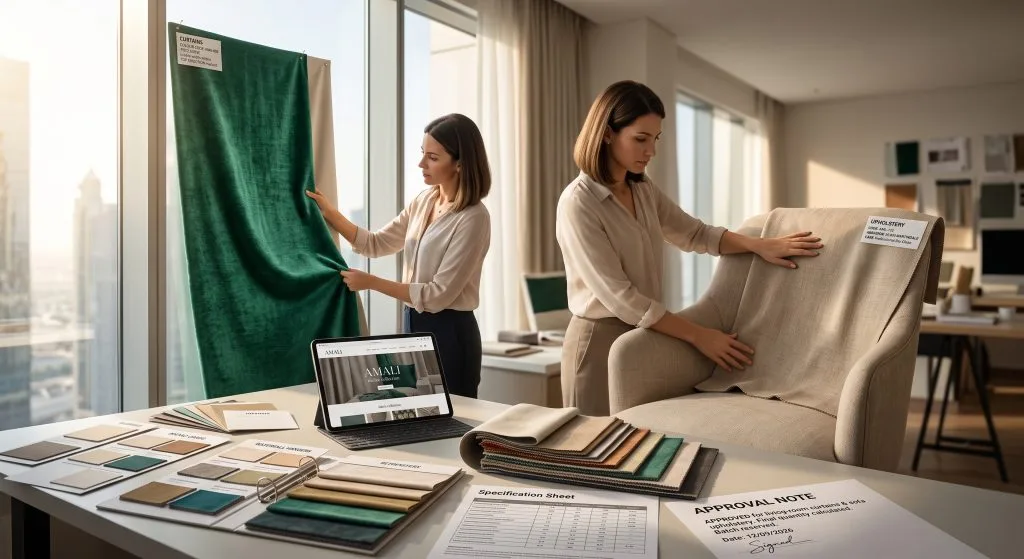
A fabric sample is more than a colour swatch. It is the first practical opportunity to check whether a textile has the right appearance, texture, weight, drape and construction for its intended use. However, a small cutting cannot answer every question, and curtain fabric should not be evaluated in exactly the same way as upholstery fabric.
For curtains, the sample must be considered vertically, against the window and with the proposed lining. For upholstery, it must be assessed on the furniture, against its curves, seams and level of use. In both cases, colour should be viewed in the actual room rather than approved from a screen or showroom alone.
This guide explains which samples to request, what to inspect, which performance information to verify and how to record a clear final approval before fabric is cut or ordered.

The quick answer: how should you select fabric samples?
Start with the application, not the colour. Decide where the textile will be used, how much light or wear it will receive, what finish and performance the project requires, and how it will be fabricated. Then shortlist samples that are technically suitable before making the final aesthetic comparison.
- Confirm whether the fabric is recommended for curtains, upholstery or both.
- Request the largest practical, current physical sample.
- Record the fabric code, colour, width, composition and direction.
- View curtain fabric vertically and upholstery fabric on the intended furniture.
- Check colour in the actual room during daylight and under normal evening lights.
- Review pattern repeat, scale, texture, sheen and pile direction.
- Use the current specification sheet for performance claims; do not judge them by touch alone.
- Confirm availability, batch and required quantity before final approval.

Begin with the room and the application
A beautiful sample can still be the wrong material for the job. Before collecting colours, write a short requirement for the room. This prevents attractive but unsuitable fabrics from reaching the final shortlist.
Questions for curtain fabric
- Is the curtain decorative, privacy-filtering, dimout or part of a blackout arrangement?
- Will it be unlined, lined or layered with a sheer?
- What heading style, fullness and finished length are planned?
- How much direct or reflected sunlight reaches the window?
- Does the fabric need to cover a normal window, a wide opening or a full wall?
- Will the curtains be opened daily, handled occasionally or used in a high-turnover room?
Questions for upholstery fabric
- Is it for a decorative chair, everyday family sofa, dining seat, headboard or commercial seating?
- How frequently will it be used, and what kind of wear is expected?
- Are children, pets, food, make-up or frequent cleaning relevant?
- Does the furniture have tight curves, deep tufting, loose covers or broad uninterrupted surfaces?
- Will any part sit near strong daylight?
- Does the residential or commercial project specify test, care or compliance requirements?
Climate and room use also affect the choice. The AMALI guide to fabrics for the UAE climate provides a broader starting point for rooms exposed to strong sunlight, air-conditioning and different levels of daily use.

Choose the right type and size of sample
Not every sample is intended for final approval. A small cutting is efficient for early comparison, while a larger piece is more useful when scale, drape, pattern placement or directional shading matters.
| Sample format | Best use | Main limitation |
|---|---|---|
| Small swatch or memo | Initial colour, handle, weave and shortlist comparison | May not show full pattern, drape, large-area colour or directional effects |
| Hanger or waterfall sample | Comparing colourways and viewing a larger section vertically | Often still too small for full pattern placement or finished construction |
| Large returnable sample | Testing colour, texture, direction and scale in the actual room | May not represent the exact production batch unless confirmed |
| Cut length | Assessing curtain drape, transparency, pattern and fabrication behaviour | Requires more material and may be chargeable or subject to availability |
| Finished mock-up | Approving construction, lining, seams, folds, comfort and overall appearance | Takes more time and is normally reserved for high-value or repeated projects |
| Production-batch cutting | Final colour and batch approval before a substantial order | Only useful if it is traceable to the fabric reserved for supply |
Ask whether the sample is merely representative of the design or is cut from current stock. For a large residence, hotel or multi-room project, this distinction can be commercially important.

What to check on every fabric sample
Keep the supplier label attached and photograph it for reference. Do not separate an unlabelled swatch from its code, because similar neutrals and related constructions can be difficult to identify later.
| Item | Why it matters | What to confirm |
|---|---|---|
| Supplier and fabric code | Identifies the exact design or construction | Complete reference, not colour name alone |
| Colour code | Separates similar colourways | Numeric or named colour reference |
| Recommended application | Indicates whether the textile is intended for curtains, upholstery or another use | Suitability for the actual application |
| Composition | Helps interpret handle, care and expected behaviour | Full fibre composition from current data |
| Usable width | Affects seams, layout and quantity | Usable—not merely nominal—width where provided |
| Pattern repeat | Affects matching, placement and consumption | Vertical and horizontal repeat |
| Direction | Controls pattern orientation, pile and cutting layout | Top, selvedge, nap or railroaded orientation |
| Care method | Affects practical suitability and maintenance | Current manufacturer instructions |
| Performance data | Supports suitability for the intended level of use | Relevant test method, result and limitations |
| Batch or roll reference | Connects approval to intended stock | Required for colour-sensitive or multi-piece orders where applicable |
If a field is missing, ask the supplier instead of estimating it from appearance. Weight, fibre content, abrasion resistance and flame performance cannot be verified by holding a swatch.

How to assess a curtain fabric sample
View it vertically at the intended window
Curtains hang; they do not lie flat on a desk. Pin or temporarily suspend the sample with its top direction correct. Step back to the normal viewing position and inspect it when front-lit from the room and backlit by daylight.
A weave may look dense on a table but become more open against a bright window. A pale colour may appear luminous in daylight and deeper after sunset. If privacy or light control matters, test the complete proposed arrangement rather than the face fabric alone.
Test the lining and layers
Place the proposed lining behind the face fabric. A lining can alter perceived colour, opacity, body and drape. If the design uses a sheer and a main curtain on separate tracks, examine the layers independently and together in the room conditions in which they will be used.
Examine drape, body and recovery
Gather the fabric loosely into folds, then release it. This gives a basic impression of whether it falls softly, holds a sculpted shape or tends to spring outward. A small sample cannot perfectly reproduce a full curtain, but it can reveal whether the hand is broadly compatible with the intended heading and look.
Check width before approving the design
Fabric width affects the number and position of joins, especially on wide or tall curtains. Confirm whether a design runs conventionally or can be used railroaded, and whether rotating it would change the pattern, sheen, stretch or performance. For the relationship between fabric-roll width and finished curtain sizing, see the curtain panel and fabric width guide.

How to assess an upholstery fabric sample
Place it on the actual furniture
Lay the sample across the seat, back or arm in the orientation proposed for cutting. The same textile can appear different on a broad sofa, a small dining chair and a deeply buttoned headboard. Curves and seams may also change the way a stripe, motif or pile reflects light.
Assess comfort without mistaking softness for durability
Touch the face with the parts of the body that will contact it: a seat fabric may feel different on the arm than between the fingers. Consider roughness, warmth, surface drag and whether clothing is likely to catch on an open texture. Then check the specification separately. A soft fabric may perform well, and a firm fabric may not suit heavy use; handle alone does not establish durability.
Check the weave and backing
Look for a stable construction appropriate to the furniture form. Hold the sample naturally rather than pulling it aggressively. If the project requires backing, lamination or another treatment, ask how that addition may affect flexibility, breathability, appearance, care and tested performance.
Consider seams, piping and pattern placement
Place the sample across an edge or cushion corner. Large motifs may disappear on narrow dining chairs, while a stripe that looks straight on a flat sample can emphasise irregular furniture geometry. Ask the upholsterer how the pattern will be centred, matched and continued between adjoining components.

Colour must be approved in the real room
Showroom lighting, daylight direction, tinted glazing, lamps and nearby finishes can all change colour appearance. Compare the sample beside the actual paint, flooring, timber, stone and coordinating textiles. Check it during the hours when the room is normally occupied.
Never approve an exact match from a product photograph alone. Camera white balance, editing and screen settings can change what you see. Photographs are useful for creating a shortlist and documenting combinations, but the current physical sample should govern final colour approval.
Two materials may also appear to match under one light source and separate under another—a colour phenomenon known as metamerism. When curtains, upholstery, paint and joinery must coordinate closely, view them together in daylight and under the room’s artificial lighting.

Inspect texture, sheen, pile and direction
Turn the sample slowly while keeping the light fixed. Lustrous weaves can create highlights at one angle and look deeper at another. Velvet, chenille and other pile surfaces may appear lighter or darker when their direction changes.
Mark the intended top before sharing or approving a directional sample. Otherwise, a designer, customer and fabricator may each evaluate it in a different orientation. Direction also affects cutting yield and pattern placement, so it belongs in the approval record rather than being treated as an informal observation.

Check pattern scale and repeat before quantity is calculated
A small swatch may show only part of a large motif. Ask to see the complete vertical and horizontal repeat, ideally on a larger sample or product image supported by confirmed measurements. Decide which part of the pattern should appear at the centre, top or most visible area of the finished item.
Pattern matching normally requires additional fabric. The amount depends on repeat dimensions, furniture or curtain measurements, number of drops or components, design direction and the fabricator’s cutting plan. Do not place the final order from an area measurement alone; obtain a fabrication-based quantity that includes matching and sensible cutting allowance.

Use specifications to verify performance
A sample helps you judge appearance and touch. A current technical data sheet helps you judge declared performance. For upholstery, relevant information may include abrasion testing, pilling, seam performance, colourfastness to rubbing, lightfastness and care. For curtains, relevant fields may include composition, width, weight, care, lightfastness, dimensional behaviour and any project-required flame-performance evidence.
Read the test method with the result. Numbers produced by different abrasion methods are not automatically interchangeable, and a laboratory result is not a precise prediction of service life. Suitability still depends on the construction, furniture design, maintenance and real conditions of use.
For hotels, restaurants, offices and other professional interiors, do not assume that a residentially suitable fabric meets the project’s contract requirements. Ask the consultant or responsible authority which evidence is required, then verify that the documentation applies to the exact fabric, finish and treatment being proposed. Fire and compliance requirements may vary by project, assembly and jurisdiction.

Cleaning and maintenance must suit the setting
Review the manufacturer’s current care instructions before approval. Consider whether the item can be removed for cleaning, whether professional cleaning is required and how frequently spills or dust are likely to occur. A pale textured upholstery may be visually ideal for a formal room but impractical for a busy dining area if the maintenance plan does not support it.
Do not conduct an improvised stain, bleach, steam or washing test on the only approval sample. Ask for a separate test cutting and written guidance. An unapproved chemical or cleaning method can alter colour, texture, coating or backing and may not represent normal care.

A step-by-step fabric sample approval process
- Write the application brief. State the room, item, expected use, design objective and any mandatory project requirements.
- Filter for technical suitability. Remove fabrics not recommended or documented for the intended use.
- Create a controlled shortlist. Compare a manageable number of relevant options rather than collecting many unrelated swatches.
- Label every sample. Preserve the fabric code, colour, width, direction and supplier reference.
- Test in position. Hang curtain samples vertically and place upholstery samples on the intended furniture.
- Compare complete materials. Add the proposed lining, backing and adjacent finish samples.
- Review changing light. Check relevant daylight periods and normal evening lamps.
- Inspect scale and direction. Confirm pattern repeat, motif placement, sheen and pile orientation.
- Review technical evidence. Match the specification and test documentation to the project requirement.
- Obtain a fabrication quantity. Include width, pattern matching, seams and application-specific allowances.
- Confirm current stock. Check quantity, batch, lead time and reservation conditions before committing.
- Record final approval. Keep a signed or otherwise traceable sample and approval note before cutting begins.
Example approval note: Fabric code and colour confirmed; application: living-room curtains; sample viewed vertically with approved lining in daylight and evening lighting; top direction marked; current stock and batch reference confirmed; final quantity subject to fabricator calculation.

What to send when requesting samples
A clear request helps the supplier recommend relevant options and reduces unnecessary sample handling. Use a brief like this:
Project: two-bedroom UAE apartment
Application: full-length living-room curtains and everyday sofa upholstery
Curtain requirement: soft plain texture, warm neutral, lined, strong afternoon daylight
Upholstery requirement: coordinated neutral, suitable for regular residential seating, care information required
Existing finishes: warm-white walls, beige stone floor, walnut timber
Samples requested: largest available current samples, with codes, widths, direction, composition, care and relevant technical sheets
Customers and design teams can begin by browsing the AMALI fabric collection, noting suitable codes and colourways, then requesting physical samples for evaluation in the intended space.

Common mistakes when selecting fabric samples
- Selecting by colour first and checking application suitability later.
- Approving curtains from a sample laid flat on a showroom table.
- Judging upholstery only by softness and assuming it is durable.
- Using a tiny swatch to approve a large pattern or full wall of colour.
- Ignoring lining, backing, foam and other materials behind the fabric.
- Comparing colours under one light source or through phone photographs.
- Losing the label or approving a colour name without its exact code.
- Failing to mark the top, pile or pattern direction.
- Calculating quantity before checking width and pattern repeat.
- Treating one abrasion number as a complete durability guarantee.
- Assuming a contract or fire requirement without checking the actual project specification.
- Approving an old showroom sample without confirming current stock or batch.

Final sample-selection checklist
- Application and room use defined
- Fabric recommended for curtain or upholstery use as required
- Current physical sample obtained
- Code, colour, width and composition recorded
- Top, pattern and pile direction marked
- Sample tested in its real orientation and location
- Daylight and artificial lighting checked
- Adjacent finishes compared
- Lining, backing or substrate included in evaluation
- Pattern repeat and placement confirmed
- Care guidance reviewed
- Relevant technical results and methods reviewed
- Fabricator calculated the required quantity
- Availability and batch checked
- Final approval sample retained

Frequently asked questions
Can the same fabric be used for curtains and upholstery?
Sometimes, but only when the manufacturer recommends both applications and the fabric meets the practical requirements of each. A curtain textile may drape beautifully but lack suitable upholstery performance; an upholstery textile may be too stiff or heavy for the desired curtain style.
How large should a fabric sample be?
Use the largest practical sample available. A small swatch is suitable for initial screening, but a larger piece is better for checking pattern, drape, colour scale, sheen and direction. Significant or repeated projects may require a cut length or finished mock-up.
Can I choose curtain fabric from an online photograph?
An online image can help you shortlist designs, but it should not be the only basis for final colour or texture approval. Screens, cameras and room lighting can all change appearance. Request a current physical sample when accuracy matters.
How do I know whether upholstery fabric is durable?
Check the intended application and current technical data, including relevant abrasion and other performance tests. Interpret results with their stated test methods and project requirements. Touch and thickness alone do not reliably establish durability or service life.
Should curtain samples be tested with lining?
Yes, if the finished curtain will be lined. The lining can affect opacity, body, colour appearance and drape. Test the proposed combination at the actual window rather than assuming the face fabric will look unchanged.
Why does a fabric sample look different when turned?
The surface may be directional. Pile, brushed texture, sheen and some weaves reflect light differently when rotated. Mark the intended top and compare pieces in the same direction before deciding that their shades differ.
What technical information should I request with a sample?
Ask for the exact code, colour, composition, usable width, weight where relevant, repeat, direction, recommended application, care guidance and application-specific performance data. Professional projects may also require current test reports, certificates or submittal documents specified by the consultant.
Should I keep the approved sample?
Yes. Retain a labelled approval sample where practical, especially for custom, multi-piece or commercial work. It provides a clear reference for colour, texture, direction and the decision made before fabrication.

Select the performance first, then approve the appearance
The best fabric sample is not simply the one with the most attractive colour. It is a current, clearly labelled sample from a textile suitable for the application, reviewed in the correct orientation, lighting and material combination.
Use physical samples to understand colour, texture, drape, scale and direction. Use technical documentation to verify declared performance. Then connect the approval to current stock, the fabricator’s quantity and a traceable batch wherever the project requires it. That disciplined process makes curtain and upholstery selections easier to compare, easier to communicate and less likely to produce surprises after installation.
