
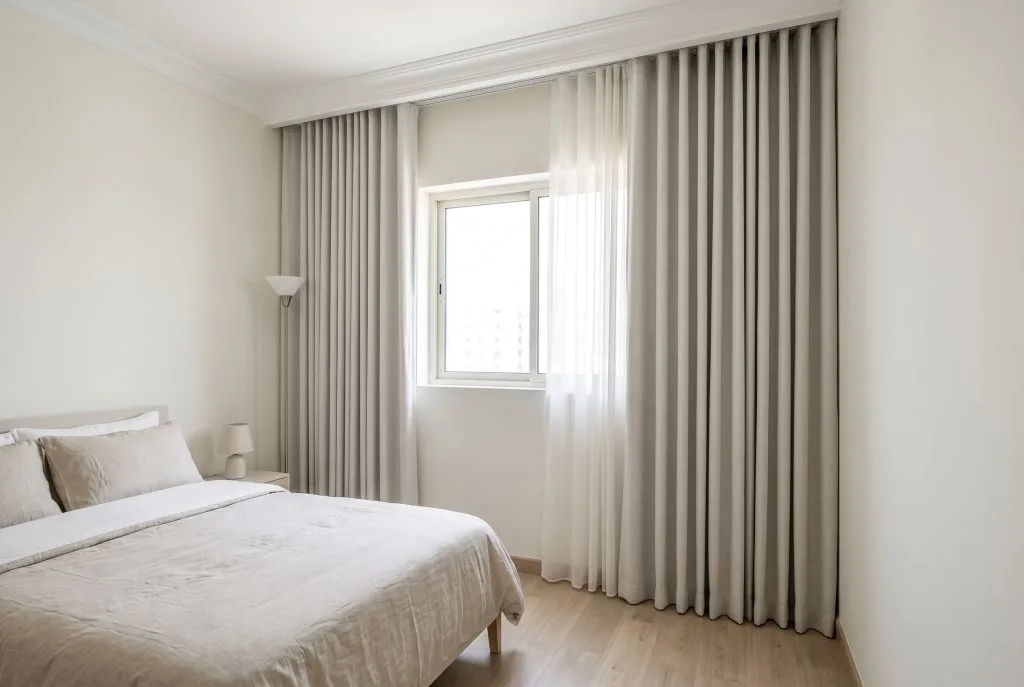
To make a small bedroom feel taller with curtains, create a continuous vertical line: position the track or pole higher than the window where the room allows, choose an appropriate floor-length drop and keep the heading visually tidy.
This changes the perceived proportions, not the actual ceiling height. The effect is usually strongest when the curtains fit well and the surrounding wall is not broken up by bulky trim, cluttered layers or a conspicuously short hem.
The right arrangement still needs to provide bedroom privacy, operate freely and attach to a suitable structure. This guide explains how to balance the visual effect with those practical requirements, including a worked measurement example.
The quick answer
- Mount the curtain system high enough to emphasise the wall’s height, where suitable fixing and clearance are available.
- Use a long, clean drop that finishes close to the floor without dragging in a narrow walkway.
- Allow space for the open curtains to gather beside the glass where possible.
- Choose orderly folds and a heading proportionate to the room.
- Keep colour and pattern deliberate; avoid unnecessary horizontal interruptions.
- Measure from the reference point required by the actual heading and supplier.
Do not buy longer curtains first and hope they will fit. Decide the hardware position, check its suitability and then establish the finished curtain dimensions.

Why hanging curtains higher can change the room’s proportions
A pole sitting immediately above a low window frame makes the top of the window a strong horizontal boundary. Raising the curtain’s starting point extends the visible textile line into the wall above it, encouraging the eye to read more of the room’s height.
For a compact room, this can be useful even when the window itself is quite small. The aim is not to disguise every part of the architecture, but to avoid making the window frame the only reference for the room’s vertical proportions.
The result is a design effect rather than a measurable increase in space. Furniture height, ceiling details, lighting and the amount of visible wall will still influence how the bedroom feels.

Choose the highest practical position—not an automatic ceiling position
A ceiling-mounted track can create a simple starting line, while a high wall-mounted pole can achieve a similar visual direction. Neither is automatically correct for every room.
Check coving, bulkheads, curtain recesses, window openings and the projection of handles or sills. A track positioned too close to the wall may prevent the fabric from moving freely. A bulky pole squeezed against the ceiling may leave insufficient room for its heading.
False ceilings and existing services
In rooms with a suspended or false ceiling, do not assume the visible board can carry the completed curtain system. Ask the installer to confirm the supporting structure, fixings and load suitability, including both curtain layers if planned. Concealed services must be checked before drilling.
Keep air-conditioning outlets, access panels and other building services unobstructed. Do not cover or interfere with fire-safety equipment. Where there is uncertainty, have the relevant installer or building team approve the position rather than treating a styling guide as an installation specification.
If a bulkhead limits the height
Use the highest suitable line below or within the existing detail, rather than forcing an awkward arrangement above it. A consistent, well-fitted curtain beneath a bulkhead may look more intentional than a system that conflicts with the ceiling shape.

Choose floor length for a continuous line
Where the wall and floor are unobstructed, floor-length curtains offer a strong vertical connection. A hem stopping well above the floor breaks that line and can make the curtain look undersized.
For a small bedroom, a modest floor clearance is often easier to live with than fabric pooling on the floor. It allows daily opening and cleaning without a pile of material beside the bed. The precise clearance should suit the floor, fabric and maker’s measuring convention.
Measure at several points along the proposed curtain run. Floors and ceilings are not always level, so one measurement in the middle may miss a high spot that causes the hem to drag. Agree the final drop with the maker after checking the full run.
When shorter curtains are the practical choice
A desk, fitted cabinet or another obstruction directly beneath the window may make a long drop unsuitable. Do not trap the fabric behind furniture simply to achieve the appearance of height. Consider a shorter treatment or an appropriate blind, and keep the surrounding composition simple.
A functional window treatment is preferable to a floor-length curtain that blocks access, bunches behind a headboard or cannot be opened properly.

Worked example: calculate the drop from the correct reference
The following is an illustrative custom-curtain example, not a universal ordering formula. Assume the supplier explicitly asks for the distance from the bottom of the installed track’s glider eye to the finished hem, with its heading arrangement already accounted for.
- Ceiling height above the finished floor: 270 cm.
- Confirmed measuring reference: 4 cm below the ceiling.
- Distance from that reference to the floor: 270 − 4 = 266 cm.
- Chosen hem clearance for this example: 1 cm.
- Requested reference-to-hem drop: 266 − 1 = 265 cm.
The 265 cm figure is valid only for that stated convention. Another supplier may request an overall fabric length or measure from the top of the track. Eyelet curtains have fabric extending above the pole, and hook positions can also change where the curtain hangs.
Confirm what the seller means by “drop” before ordering. Room height, pole height and overall curtain length are not interchangeable measurements. Do not add another heading allowance if the maker has already included it.

Give open curtains somewhere to gather
The space occupied by a curtain when open is called its stack-back. If the entire stack sits over the glass, the window can feel narrower and the room may lose useful daylight.
Extending the track or pole beyond the window can create space for the fabric to gather against the adjacent wall. The required extension depends on curtain width, fabric bulk, lining, heading and the opening arrangement; a fixed extra distance will not suit every installation.
Check both sides. A wardrobe door, room corner or bedside unit may leave less room on one side. An asymmetric or one-way arrangement may be practical, but it needs to be planned with the hardware and furniture rather than improvised after purchase.
Should curtains run wall to wall?
A wall-to-wall curtain can create a continuous backdrop, especially around an off-centre window. However, it also needs more fabric and gathering space. In a very small bedroom, it may conceal useful wall space or interfere with storage.
Use it where the room supports the arrangement, not as a requirement for a taller effect. A neatly proportioned window-width installation with adequate side extension can also work.

Choose a heading that keeps the top line calm
The heading controls how the fabric gathers and how much space the system occupies. Choose it together with the track or pole rather than treating it as a decorative detail to add later.
| Heading or system | Possible visual benefit | Planning consideration |
|---|---|---|
| Wave-style heading on a compatible track | Regular folds and a clean upper line. | Requires the correct carriers, spacing and depth for the waves. |
| Pinch pleat | Tailored vertical folds with defined gathering. | Confirm finished coverage and how fullness is incorporated. |
| Pencil pleat | A compact gathered heading. | Distribute the gathering evenly and confirm the hook position. |
| Eyelet on a pole | Broad, regular folds. | Allow room above the pole and sufficient projection for movement. |
No heading guarantees a taller-looking room. The proportions and fit matter more than the label. For this particular goal, a deep, contrasting valance or very bulky decorative pole may draw attention across the room instead of upwards; use those features only if that is the intended style.

Use enough fullness without crowding the room
A curtain stretched almost flat may not produce the vertical folds you want. Excessive bulk, however, can crowd a small window area and occupy valuable space beside the bed.
Use the fullness recommended for the selected fabric and heading. Ready-made panel dimensions may describe flat fabric width, while custom pleated curtains may be ordered by finished coverage with fullness already built in. Do not multiply a finished-coverage measurement a second time.
Lining and a second layer change the depth of the arrangement too. Check how far the complete system projects into the room, including folds, handles and brackets, before confirming furniture clearance.

Choose colour and pattern to support the vertical effect
Curtains close to the wall colour can reduce the contrast at the window’s edges and create a quieter background. This is a useful styling option, not a rule that every small bedroom must be white or beige.
Darker curtains can still work when their proportions are deliberate and the rest of the room supports them. If a strong colour makes the window feel too dominant, test a softer contrast before assuming the problem is the fabric’s darkness alone.
A subtle vertical stripe can reinforce the direction of the folds, but it is not essential. Plain fabric with a good drape may be enough. Broad horizontal bands or a strong border halfway up the curtain can interrupt the continuous line you are trying to create.
Evaluate a hanging sample in the room’s daylight and evening light. A photograph or flat swatch cannot fully show the effect of folds, transparency and lining. Review furnishing-fabric specifications as well as the appearance when selecting material for a custom treatment.

Keep bedroom privacy and light control separate from styling
A pale sheer can give a light visual layer during the day, but it should not be relied on for nighttime privacy. A bedroom may need a separate opaque or blackout curtain that closes independently.
Matching the curtain to the wall does not determine its blackout performance. Check the actual fabric or lining specification, then consider overlap and the gaps around the installation. Raising a track does not, by itself, eliminate light leakage.
In a bright UAE bedroom, decide how much morning or street light you want to exclude before choosing the decorative surface. If two layers are required, check that the recess or wall projection can accommodate both without obstructing the window or ventilation.

What if your existing curtains are too short?
First check whether there is a usable hem allowance and whether alteration is appropriate for the fabric and lining. A workroom can advise whether the existing curtain can be lengthened evenly without leaving an obvious old fold or other unwanted marks.
Do not raise the pole until you know the curtains will still reach the intended endpoint. If alteration is not suitable, compare a correctly sized ready-made option with a custom drop. A conspicuous extension band may become a horizontal feature, so choose it intentionally rather than disguising an accidental shortfall.
When comparing curtain options, confirm the measured drop, quantity of panels, heading compatibility and coverage together. Longer fabric alone will not solve an unsuitable width or hardware arrangement.
A practical plan before you order
- Photograph the window, ceiling detail and surrounding furniture.
- Confirm a suitable high mounting position with the installer.
- Check structure, services, window movement and track projection.
- Choose the heading and required light-control layers.
- Measure the run and drop using the supplier’s stated reference points.
- Check floor level at several positions and agree hem clearance.
- Plan the open curtain stacks and furniture clearance.
- Approve a hanging sample or representative fabric-and-lining combination.
- Confirm all dimensions before cutting or ordering.

Frequently asked questions
How high should I hang curtains to make a bedroom feel taller?
Use a position above the window that creates a longer vertical line, potentially near the ceiling if the structure and clearances allow. There is no universal distance below the ceiling: coving, fittings, heading and services all affect the choice.
Do floor-length curtains work on a small window?
They can, provided the area below is unobstructed and the proportions suit the room. The longer textile line can make the window area feel taller, even though the glass is smaller.
Should curtains touch the floor in a small bedroom?
They can just meet it, but a small agreed clearance is often practical for daily use and cleaning. Avoid uncontrolled pooling in tight circulation spaces. Confirm the drop against the actual floor level.
Do vertical stripes make curtains look taller?
They can support a vertical emphasis, but the effect is a styling choice rather than a guarantee. Mounting position, length and orderly folds usually deserve attention before adding a stripe.
Can blackout curtains still give a light, uncluttered look?
Yes. Choose a suitable colour, heading and proportion while checking the material’s light-control specification. Plan for the bulk of the full curtain system; a pale colour does not automatically mean a sheer or lightweight construction.
Can I mount a curtain track directly to a false ceiling?
Only after the installer confirms appropriate support, fixings and load suitability. Do not assume the visible ceiling board is adequate, and check concealed services before any drilling.
What if furniture prevents a floor-length curtain?
Choose an arrangement that allows the window and furniture to function safely. A shorter curtain or appropriate blind may be better. Do not sacrifice access or trap fabric behind furniture for a visual effect.

The final decision
To help a small bedroom feel taller, prioritise a suitable high starting point, a clean curtain drop and an uncluttered heading. Give the open fabric enough space and use colour and pattern to support the room rather than divide it unnecessarily.
The most effective arrangement is also one that works: properly supported, accurately measured and suitable for the bedroom’s privacy, light and daily use.
