
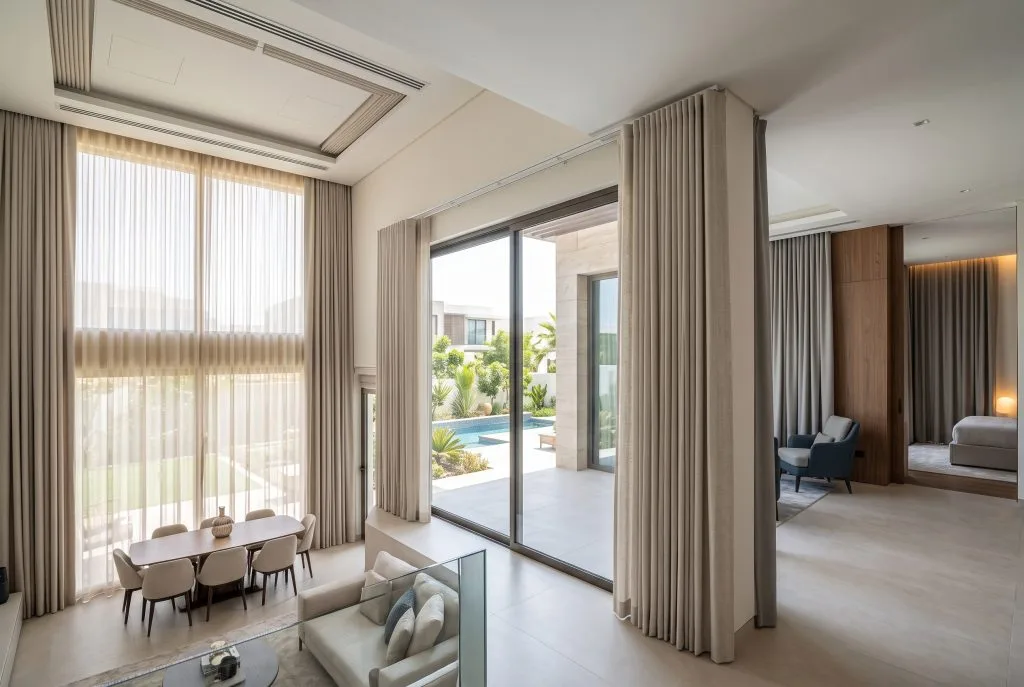
The best curtain ideas for modern UAE villas work with the architecture rather than simply covering the glass. Wide garden doors, tall living-room windows and private bedrooms need different solutions, even when the overall interior follows one coordinated style.
A useful starting point is a softly textured curtain with a clean heading, combined with a separate light-control layer where needed. However, floor-to-ceiling curtains, concealed tracks and motorisation are options, not requirements for every window.
This guide brings together practical design ideas for villa living rooms, bedrooms, Majlis spaces and garden-facing doors. It explains how to balance appearance with privacy, daylight, stack-back and maintenance before choosing fabric or committing to ceiling details.

Start with a window-by-window plan
A villa can contain several very different window conditions. A shaded courtyard opening may need little glare control, while another room receives direct sun during its busiest hours. Do not assume that one curtain specification will suit the entire property.
Walk through each room at the times it is normally used. Note where people sit, which doors open regularly, and whether neighbours or outdoor lighting affect privacy after dark. Photographs and a simple window schedule make these observations easier to discuss with a curtain maker.
- Record each opening separately, including its position and approximate dimensions in centimetres.
- Identify the final floor level, ceiling details, window handles and nearby air-conditioning outlets.
- Decide whether the priority is preserving a view, filtering daylight, reducing glare or stronger light exclusion.
- Mark where open curtains could gather without obstructing doors or furniture.
- Separate early planning dimensions from the final measurements approved for manufacture.

1. Layer sheer and opaque curtains in main living areas
A separate sheer and opaque layer is a versatile starting point for a living room that changes from a bright daytime space to an evening gathering area. The sheer softens the view of the window; the denser layer provides additional screening when wanted.
With independent tracks, the layers can move separately. Ask to see how the intended sheer looks against the actual lining or outer curtain, since the layer behind it can change its apparent colour. The preferred arrangement depends on which surface you want visible from inside.
Do not rely on sheers alone for assured nighttime privacy. When interior lights are on, people outside may be able to see through them. Check the selected fabric and complete arrangement under realistic evening conditions.
For a restrained modern scheme, try warm ivory sheers with stone-coloured outer curtains and repeat the stone tone in one smaller furnishing. This is an illustrative palette, not a required UAE style.

2. Use continuous curtains selectively across wide glazing
A long, uninterrupted curtain treatment can visually connect a row of windows or sliding doors. It can be particularly effective when several openings share the same height and the wall has few interruptions.
Before extending the track across the whole wall, identify where the curtain will sit when open. Stack-back means the space occupied by the gathered curtain. This varies with the fabric, lining, heading and system; it should not be estimated from a universal percentage.
A wall-to-wall treatment may be unsuitable if it covers access panels, interferes with cabinetry or leaves curtains piled across a doorway. Sometimes separate treatments that share a fabric and heading create a more useful result than one continuous run.

3. Frame double-height spaces without overlooking the engineering
Tall curtains can emphasise the scale of a double-height living room. A relatively quiet fabric often lets the architecture lead, while a stronger texture can give a plain wall more depth.
The practical questions should come before the final fabric order. The supplier needs to assess the complete curtain weight, track span, support conditions and access for fitting and maintenance. A decorative false ceiling should not be assumed to provide adequate support.
Discuss seams and fabric direction early. Wide-width fabric does not automatically produce a seamless curtain at every height, and rotating a textile may change its pattern, drape or approved use. Ask the maker to confirm the proposed construction.
- Request a complete curtain-and-track specification, not just a fabric price.
- Agree how the curtain will be removed and rehung for cleaning.
- Check whether manual operation is comfortable for the intended users.
- Coordinate motor power and access, if applicable, before ceiling finishes are completed.
If a full-height treatment creates difficult access or excessive bulk, ask whether separate upper and lower shading zones would better suit the architecture. A single dramatic curtain is not the only coherent design.

4. Keep garden doors easy to use
Curtains beside a terrace or garden door must accommodate movement, not simply look symmetrical when closed. Identify the door leaf used most often and choose an opening direction that keeps fabric away from it.
A one-way draw may suit a door where useful wall space is available on one side. A centre-opening pair may work better on a symmetrical opening with room for stacks at both ends. Neither arrangement is automatically superior.
Have the maker check handles, projecting frames and curtain clearance. A near-floor finish is often easier to manage here than fabric deliberately pooled on the floor. Keep the actual walking route clear, including when only part of the treatment is open.
5. Give bedrooms their own light-control specification
A bedroom can use the same visible colour family as the rest of the villa while having a different lining or secondary layer. That preserves visual continuity without forcing a living-room specification onto a sleeping space.
For stronger darkness, discuss blackout fabric or lining and the installation together. Side gaps, the meeting point and the area above the track can admit light even when the textile itself blocks light transmission.
A concealed track may improve the visual finish, but concealment alone does not establish blackout performance. Ask how the proposed arrangement addresses the relevant gaps and whether the household wants a separate sheer for daytime use.
Begin with the privacy and darkness requirement, then compare suitable curtain options in the preferred colour and texture.

6. Coordinate connected rooms without making them identical
In an open-plan villa, the curtains may be visible from several rooms at once. Repeating a heading style or a compatible undertone can create continuity even when the fabrics differ.
For example, a textured neutral curtain in the family living room can relate to a slightly richer plain in the Majlis. Bedroom curtains can carry a similar exterior-facing tone while meeting different privacy needs. Exact matching is optional.
Compare the complete selection against fixed finishes such as flooring, timber and wall paint. A grey that feels balanced beside cool tile may appear quite different beside cream stone.

Three modern curtain palettes to explore
- Warm architectural neutral: warm white sheers, oatmeal outer curtains and natural timber. Compare undertones carefully rather than assuming all off-whites match.
- Soft contrast: pale stone curtains against deeper furniture, with a small olive or muted blue accent elsewhere in the room.
- Quiet monochrome: layered shades of ivory and greige, differentiated by texture rather than strong pattern. Retain some tonal variation so the scheme does not look flat.
These are original styling suggestions. Test actual samples in the villa’s daylight and evening lighting before approving colours.

7. Choose a heading that suits the architecture
The heading is the top construction that shapes the curtain and connects it to the hardware. Its appearance, depth and operating requirements should be considered together.
| Heading | Design effect | Planning consideration |
|---|---|---|
| Wave-style | Regular, flowing folds | Confirm compatible hardware, heading specification and space for the folds |
| Pinch pleat | Tailored and structured | Agree finished coverage and the maker’s built-in fullness |
| Pencil pleat | Gathered, softer detail | Confirm gathering, hook position and the final required width |
| Eyelet | Visible pole with broad folds | Check pole compatibility, projection and the effect of brackets on movement |
Wave-style headings are one modern option, not a mandatory choice. A simple pinch pleat can suit contemporary architecture, while an exposed pole may be appropriate where a ceiling recess is impractical.
Do not apply a generic fullness multiplier to an order already specified by finished pleated coverage. Ask whether the quotation describes flat fabric width or finished curtain coverage, and let the maker calculate the selected heading.

8. Plan concealed tracks before the ceiling is finished
A recessed track can create a clean transition between ceiling and curtain. Its success depends on the whole assembly: the track, moving folds, brackets, any motor and access for installation or servicing.
There is no universal curtain-pocket depth that works for every single- or double-track system. Obtain the selected system’s dimensions and the maker’s required clearances before approving the ceiling detail.
Coordinate the recess with lighting, air-conditioning and other building services. Do not bury serviceable equipment behind a permanent finish or place fabric where it disrupts ventilation. These details belong in the project coordination discussion, not in an improvised installation after decorating.

9. Consider motorisation where it solves a real problem
Motorised operation can be useful for large, heavy or difficult-to-reach curtains. Manufacturer guidance identifies these as common applications, but the suitable system depends on the installation rather than the appearance of the motor.
Before buying, confirm the complete curtain weight and layout, available power, chosen controls, servicing access and behaviour during a power interruption. If smart-home control is wanted, verify compatibility with the exact system; the word “smart” does not guarantee integration.
A straightforward manual treatment can remain a good choice for smaller, accessible windows. Motorisation is an optional project decision, not an assumed AMALI service or a requirement for a modern interior.

Treat glare, heat and fading as separate questions
A window can create glare without feeling especially warm, and a darker room is not automatically an efficiently shaded one. Window-treatment performance depends on the product, fit, glazing and conditions at the window.
Public building-science guidance recommends setting priorities for each opening, including solar gain, glare, privacy and views. For an exposed villa window, consider the existing exterior shading and glazing as well as the interior curtain. Do not expect one decorative fabric to solve every issue.
Ask for relevant lightfastness information where sun exposure is significant. Lightfastness concerns resistance to colour change from light; it is not a promise that a fabric will never fade.
Avoid choosing purely by the label “thermal”. Request supporting product information if thermal performance is important, and do not apply a generic energy-saving percentage to a particular villa. For wider material-selection context, see the UAE climate fabric guide.

Make maintenance part of the design
Large curtains are substantial textile items, and their care needs should be understood before ordering. Check whether the finished curtain can be washed, needs specialist cleaning or has different requirements because of its lining and trims.
Removable does not mean machine-washable. Ask how cleaning could affect dimensions and how tall or heavy curtains will be handled. Keep the approved care instructions with the fabric reference.
Consider the daily surroundings too. A curtain beside a frequently opened garden door may need a different hem arrangement and cleaning routine from one in a rarely used formal room. Keep decorative pooling to locations where it will not obstruct movement or create unwanted maintenance.

Build a complete quotation brief
Compare quotations on the same scope. A low fabric-only price cannot be compared directly with a quotation that includes lining, making, hardware and fitting.
- Room and opening reference, with site photographs and final measurements when available.
- Desired appearance, fabric reference and approved colourway.
- Required privacy and light-control performance.
- Heading, opening direction, number of layers and stack-back arrangement.
- Finished drop measurement convention and intended floor clearance.
- Track or pole, support assessment and any motor or controls.
- Lining, seams, pattern direction, making details and care requirements.
- What is included, what is excluded, and who confirms dimensions before manufacture.
For fabric-led schemes, shortlist curtain and furnishing fabrics before finalising the complete specification with the maker. Check that each selected textile is suitable for its intended curtain construction.

Common villa curtain mistakes to avoid
- Specifying identical linings for rooms with different privacy and light-control needs.
- Treating floor-to-ceiling or wall-to-wall curtains as compulsory.
- Finishing a ceiling pocket before the track and fold clearances are known.
- Ignoring the working side of a garden door.
- Selecting a tall curtain without planning seams, support and cleaning access.
- Assuming a sheer provides privacy after dark.
- Choosing a motor without confirming load and control compatibility.
- Approving colours only from a phone screen or small showroom swatch.

Frequently asked questions
What curtain style suits a modern UAE villa?
Clean headings, considered proportions and coordinated textures are useful starting points. Wave-style and tailored pleated curtains can both work. Choose the system around the architecture, privacy requirement and available stack-back rather than a single fashionable look.
Should every room have floor-to-ceiling curtains?
No. Full-height curtains can create visual continuity, but furniture, doors, ceiling details and maintenance may favour another arrangement. Use them where they improve the room and can operate properly.
Are sheer curtains enough for a garden-facing living room?
They may provide the desired daytime appearance, but they do not guarantee privacy at night. Consider overlooking, exterior lighting and the actual fabric. Add a suitable independent opaque layer where greater screening is required.
Can ready-made curtains work in a villa?
Yes, where the available sizes, heading and hardware meet the opening’s needs. Custom making becomes useful for unusual heights, wide spans, complex corners or a closely coordinated installation. Confirm per-panel dimensions and required coverage.
Do dark curtains block more heat than light curtains?
Visible colour alone does not establish thermal performance. Consider the complete fabric or lining, its window-facing properties, installation and glazing. Ask for product-specific evidence instead of selecting by colour as a performance shortcut.
Are motorised curtains necessary for double-height windows?
Not always, but they are worth discussing when manual operation would be difficult. Have the supplier assess the complete installation and explain suitable controls, power requirements and maintenance access.
Should I use the same curtains throughout the villa?
You can repeat a colour family or heading for continuity while changing the lining or fabric by room. Connected spaces benefit from being reviewed together, but bedrooms and exposed windows may need different functional specifications.

Choose curtains that belong to the villa
A successful villa curtain scheme balances the open and closed appearance with everyday use. Start with the windows, agree privacy and light control, then choose fabric, heading and hardware as one coordinated system. The result should feel considered when guests arrive and remain easy to live with afterwards.
