
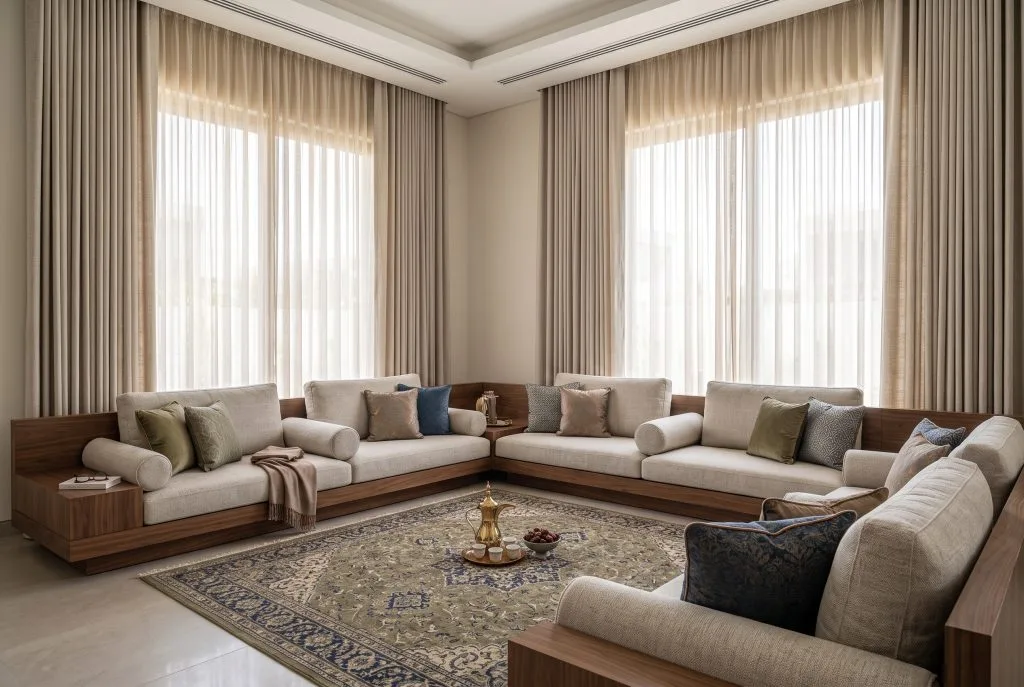
The most successful textile ideas for Majlis interiors begin with hospitality: comfortable seating, welcoming colour, privacy when it is needed and fabrics that suit the way guests use the room. A beautiful scheme should remain comfortable through a long conversation, not simply photograph well.
There is no single correct Majlis style. A room with low perimeter seating, a contemporary arrangement of sofas or a more formal reception space can each express the household’s preferences. What matters is that upholstery, curtains, cushions and rugs work together without compromising everyday use.
This guide explains how to select those layers for a UAE home, with practical fabric checks and three illustrative colour schemes. The combinations are design suggestions, not prescribed cultural styles or ready-made AMALI product packages.

Start with how your Majlis is used
A Majlis is more than a decorative reception room. UNESCO describes its role as a place for gathering, conversation and the sharing of community knowledge. For a home interior, that makes the experience of sitting together a useful starting point for textile decisions.
Before choosing a colour, consider who uses the room, how often guests visit and whether it also serves as a family sitting area. A daily-use Majlis with refreshments needs a different maintenance plan from a room reserved for occasional formal gatherings.
- Identify the seating surfaces people will use most, including arms, front edges and back cushions.
- Note when the room receives direct sunlight and whether nearby windows create overlooking concerns.
- Decide whether cushions are mainly decorative, provide back support or need to serve both purposes.
- Keep entrances, serving routes and access to windows clear.
- Set a realistic cleaning routine before selecting delicate surfaces or elaborate trims.

Give each textile layer a clear role
A coordinated Majlis does not require the same fabric everywhere. Upholstery must suit repeated sitting; curtains need the right drape and light control; cushions can introduce a stronger pattern. Choose each material for its job, then connect the layers through colour, texture or a repeated detail.
| Layer | Main role | Check before choosing |
|---|---|---|
| Seat upholstery | Comfort and a durable visual foundation | Upholstery suitability, surface feel, cleaning and construction |
| Back cushions and bolsters | Support, rhythm and colour | Finished dimensions, filling, seam placement and usable seat depth |
| Curtains | Privacy, daylight control and a finished window | Lining, track position, stack-back and nearby seating |
| Accent cushions | Pattern and smaller colour changes | Comfort, removable-cover care and trim suitability |
| Rug or carpet | Visual connection between seating groups | Placement, edge stability, cleaning and movement around the room |

Choose upholstery before the smaller accents
In a Majlis with extensive perimeter seating, upholstery occupies a large visual area. Approve this fabric first, alongside the existing floor and wall finishes. A small cushion swatch is easier to change later than several metres of fitted seating.
For everyday family use
Start with fabrics explicitly recommended by the supplier for upholstery. Assess the weave, surface texture and documented care instructions rather than selecting by fibre name alone. Polyester, cotton, linen and blended fabrics can have very different characteristics depending on how the finished textile is made.
A softly textured mid-tone can be a practical visual starting point, but no colour makes a fabric stain-proof. Ask what the care instructions permit for the actual fabric and whether any finish has restrictions. Removable covers are not automatically machine-washable.
For a more formal room
Velvet, jacquard and restrained sheen can introduce depth without requiring every surface to be ornate. Try a plain upholstered seat with patterned back cushions, or a richer main upholstery with simpler curtains.
Velvet has a pile: its appearance can change with direction, touch and viewing angle. Review a sufficiently large sample and agree the cutting direction with the upholsterer. Jacquard describes a patterned weaving technique, not a guarantee of strength or a particular fibre.
For long seating runs
Ask the maker to show how seams, cushion divisions and pattern placement will work across the whole arrangement. A motif that looks balanced on one cushion may appear awkward where two seating runs meet. Approve the corner arrangement as well as the straight sections.
When browsing furnishing and upholstery fabrics, record the exact design and colourway for each shortlisted option. Similar-looking samples are not interchangeable specifications.

Check durability without relying on one number
For heavily used seating, request relevant performance information such as abrasion, pilling, seam behaviour and colourfastness. Abrasion concerns rubbing wear; pilling concerns i will share blog post with you and you will make realistic HD 8k detailed featured image which defines whole concept in one image with the resolutions of 1536 by 1024. oksmall fibre balls on the surface. Neither alone describes every way upholstery may change in use.
A high Martindale result does not translate directly into years of service. ACT cautions that abrasion figures are only part of evaluating durability. Ask for the test method, the supplier’s recommended application and any limitations, rather than comparing isolated numbers.
A frequently used home Majlis and a public reception area also need different specification discussions. For a commercial project, have the responsible project team confirm the applicable requirements. A voluntary test guideline should not be presented as a universal UAE compliance rule.

Build colour around the room you already have
Lay the shortlisted upholstery against the actual floor, timber and wall finishes. Warm ivory can look very different beside cream stone and beside a cool white tile. Begin with these fixed elements before buying smaller accents.
Choose one principal colour direction and a limited set of supporting tones. This is a styling method, not a strict numerical formula. You might repeat a muted blue from a patterned cushion in a curtain border, while keeping the seating and rug quieter.
A Majlis does not need gold, red or beige to feel appropriate. Equally, a rich traditional palette does not need to be diluted into a neutral scheme. Let the household’s preferences and existing objects guide the result.

Three textile combinations to explore
Warm stone with olive and walnut
Consider stone-coloured textured upholstery, warm ivory curtains and a small number of muted olive cushions. A restrained geometric cushion can link the olive to walnut furniture or timber details. Keep the largest textile surfaces relatively calm if the floor already has strong veining.
This combination can suit a relaxed contemporary Majlis. Compare the ivory and stone together under the room’s evening lights so that neither appears unexpectedly yellow or grey.
Sand with deep blue and soft bronze
Try sand-toned seating with deeper blue back or accent cushions and understated bronze-coloured details. A small-scale woven pattern can bridge the two main colours. Use sheen selectively, perhaps on a cushion face or piping, rather than across every upholstered surface.
This is an option for a more formal mood without covering the entire room in dark fabric. Inspect any shiny yarns close up: a decorative surface should still feel comfortable where guests lean against it.
A personally meaningful patterned textile with quiet companions
If the household owns a valued woven textile or patterned piece, use its actual colours as the starting point. Repeat one colour in the upholstery and another in a smaller cushion, while keeping the curtains comparatively simple.
Do not assume that a generic geometric print represents a specific regional craft. If a textile is sold with a heritage or handmade description, confirm its origin and construction. A meaningful object can lead the room without every new fabric imitating it.

Choose Majlis curtains for privacy as well as appearance
Plan curtains around the hours when the room is occupied. A daytime gathering may benefit from softened daylight; evening use may require a more opaque layer, especially when windows face neighbours or a street.
Independent sheer and opaque layers can provide flexible control. A sheer alone should not be treated as guaranteed nighttime privacy: visibility depends on the fabric and the difference between interior and exterior lighting. Check the proposed arrangement under realistic conditions.
Blackout is useful when strong light exclusion is wanted, but it is not automatically necessary for every Majlis. Ask what the fabric or lining actually does, and remember that gaps at the sides, centre and top affect the installed result.
For the decorative layer, consider a plain textured curtain if the seating is patterned. Where the upholstery is simple, curtains can introduce a larger motif. Review curtain options alongside the upholstery samples, not as a separate purchase made at the end.
Leave space for curtains to operate
Perimeter seating can conflict with a curtain track, stack-back or hem. Stack-back is the space occupied by the curtains when open. Confirm that fabric can move without becoming trapped behind seats or dragging across arms.
Do not automatically extend curtains wall to wall or add a deep pelmet. Check window access, air-conditioning outlets, ceiling details and the support needed for the proposed hardware. The arrangement should suit the room rather than follow a fixed visual rule.

Use cushions to support guests, not fill every seat
In low seating arrangements, back cushions and bolsters may be essential to comfort. Treat their dimensions and filling as part of the seating design, not as decoration added afterwards. An overly deep cushion can reduce the usable sitting area.
Ask for a sample seat arrangement if possible. Sit with the proposed back cushion, check arm support and leave enough room to change position comfortably. A photograph cannot establish whether the combination works for the people who will use it.
For decorative cushions, repeat a fabric at deliberate intervals to create rhythm across a long seating run. There is no required cushion count. Stop adding them when they begin to interfere with sitting, serving or the household’s preferred level of simplicity.
Keep coarse trims, hard ornaments and long fringes away from frequent contact areas. A plain reverse or simpler piping can make a decorative cushion more pleasant to use.

Balance pattern across connected seating
View pattern at two distances: close enough to assess the weave and far enough away to see the room. Small repeats can read almost like texture from the entrance, while larger motifs become individual focal points.
If the upholstery has a strong repeat, use quieter curtains or rugs to leave it visual space. If you prefer several patterns, vary their scale and connect them through a shared colour. These are composition tools, not rules that forbid richly patterned rooms.
Have the upholsterer plan matching and fabric quantities before ordering. Pattern repeats, directional pile, usable roll width and cushion construction can all affect consumption. A fabric’s roll width is not the finished seating width it will cover.

Let the rug connect the seating without obstructing it
Consider the rug together with the upholstery rather than selecting it only for an empty centre area. A patterned rug can supply the main motif when the seating is plain; a quieter rug can give elaborate cushions and upholstery more breathing room.
Check its position against entrances, doors, serving tables and the route between seats. Avoid curled edges or loose layers that move underfoot, and use an appropriate securing method for the floor and rug. The right dimensions depend on the layout; there is no single Majlis rug size.

Approve samples in the actual room
Bring the shortlisted fabrics together in daylight and with the lamps normally used for evening gatherings. Hang the curtain sample vertically and place the upholstery sample in the intended seat orientation. A flat sample board will not show exactly how folds or pile catch the light.
- Compare samples beside the floor, wall, timber and any existing rug.
- Ask for a larger sample when the pattern repeat cannot be understood from a small cutting.
- Check both appearance and feel where hands, arms and backs will touch the fabric.
- Confirm the product code, colourway, usable width, direction and care instructions.
- Ask how supply batches will be coordinated for adjacent pieces and record the approved selection.
Keep the approved reference and written specification for the maker. A phone photograph is useful for remembering a scheme, but should not be the sole colour approval.

Common Majlis textile mistakes to avoid
- Choosing curtains and upholstery independently, then discovering that their undertones clash.
- Using a decorative fabric on seats without confirmed upholstery suitability.
- Filling every seating position with accent cushions.
- Specifying a strong pattern without checking corner joins and cushion alignment.
- Assuming a sheer curtain provides privacy at night.
- Treating a high abrasion result as a promise of stain resistance or service life.
- Approving a tiny swatch without seeing the repeat, drape or pile direction.
- Spending the whole budget on face fabrics and leaving too little for making, lining and suitable hardware.

Frequently asked questions
What is the best fabric for Majlis seating?
There is no universally best fabric. Choose upholstery rated for the expected use, with an appropriate feel, construction and care routine. Compare actual specifications and samples rather than assuming one fibre or fabric name guarantees performance.
Should Majlis curtains match the sofa?
They can, but an exact match is optional. A shared undertone or repeated accent colour often provides enough connection. If the upholstery is strongly patterned, plain curtains may make the overall scheme easier to balance.
Can velvet work in a Majlis?
Yes, when the particular velvet is suitable for upholstery and its appearance and care needs suit the household. Review pile shading, pressure marks and the approved cutting direction before committing to a large seating run.
Are neutral colours better for a small Majlis?
A restrained palette can create visual continuity, but neutral colours are not mandatory. Keeping the largest surfaces coordinated and limiting competing focal points can also work with deeper colours. Test the scheme in the actual lighting.
Do all Majlis windows need blackout curtains?
No. Select light control according to privacy, glare and how the room is used. A suitable opaque layer may be sufficient; choose blackout when stronger light exclusion is wanted and discuss installation gaps with the maker.
How can I refresh a Majlis without replacing everything?
Keep sound, comfortable seating and begin with coordinated cushion covers, an adjusted curtain scheme or a rug that connects existing colours. Check which change solves the actual problem before purchasing several decorative layers.

A welcoming Majlis begins with considered choices
Choose the seating fabric for comfort and use, plan the windows for privacy and operation, and let cushions and rugs add character without crowding the room. Review the complete scheme in place and resolve construction details before ordering. The best result is a Majlis that expresses the household’s taste and makes guests comfortable staying for conversation.
