
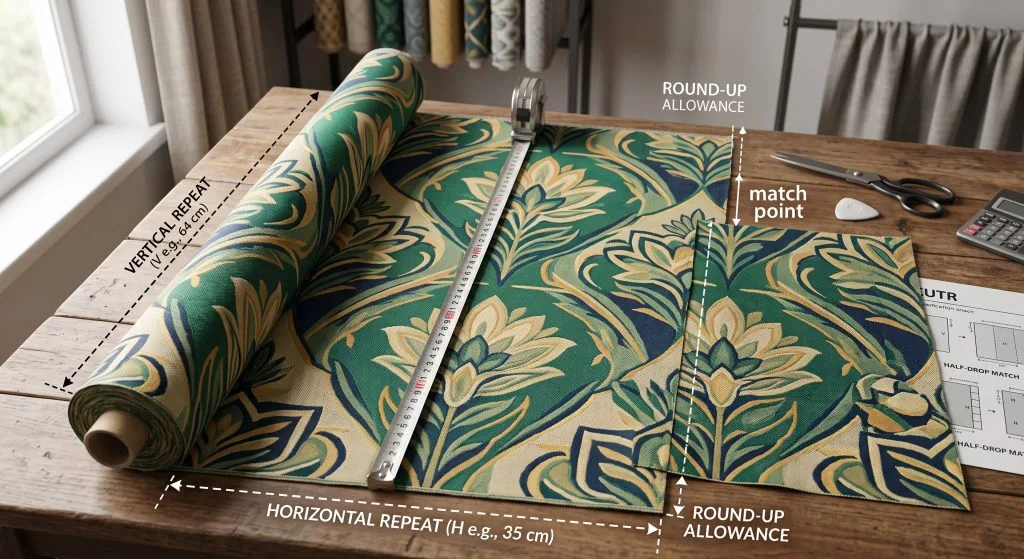
A patterned fabric may require noticeably more material than a plain fabric for the same curtain, sofa or headboard. The extra fabric is not necessarily waste caused by poor cutting. It is often needed to make the design align across seams, panels and adjoining components.
The measurement that controls this alignment is called the pattern repeat. A small repeat may add very little to the order, while a large or complex repeat can increase consumption, cutting time and offcuts.
This guide explains vertical and horizontal repeats, straight and half-drop matching, how repeat affects curtain calculations, and why upholstery and custom fabrication should be estimated from the actual design rather than a generic metre allowance.

The Quick Answer
- Pattern repeat is the distance before the same design position appears again.
- Vertical repeat runs along the length of the roll and usually affects the cut length of curtains.
- Horizontal repeat runs across the fabric width and affects centring, joins and pattern placement.
- Matching adjacent widths normally requires every cut length to start at the same design position.
- A cut drop is commonly rounded up to a whole vertical repeat, but half-drop and irregular designs require a more specific cutting plan.
- Fabric width, fullness, seams, pattern placement, hems and heading allowances all affect total consumption.
For colour-critical projects, the complete quantity should also be reserved from one production batch where possible. Running short and reordering later may introduce both a pattern-planning problem and a shade difference.

What Does Pattern Repeat Mean?
A textile pattern is built from a design unit that repeats across the cloth. The repeat measurement describes the distance from one identifiable point in the design to the next identical point in the same direction.
For example, if the top of a particular flower appears every 64 cm along the roll, the vertical pattern repeat is 64 cm. If the same flower appears every 35 cm across the width, the horizontal repeat is 35 cm.
The repeat is not the same as the size of one visible motif. A leaf may be only 12 cm high while the complete arrangement of leaves, branches and background does not repeat for 64 cm.

Vertical Repeat vs Horizontal Repeat
| Measurement | Direction | Why it matters |
|---|---|---|
| Vertical repeat | Along the length of the roll, usually parallel to the selvedge | Determines where successive drops must be cut so motifs align at the same height |
| Horizontal repeat | Across the usable fabric width, from selvedge to selvedge | Affects centring, side matching, placement and the appearance of joined widths |
| Fabric width | Across the roll | Controls how many vertical widths or drops may be required |
| Finished drop | From the curtain’s hanging point to its finished hem | Forms the base length before headings, hems and pattern matching are added |
Product specifications may show the repeat as two numbers, such as V 64 cm × H 35 cm. Confirm which measurement comes first rather than assuming every supplier follows the same notation.

Straight Match, Half-Drop and Other Repeat Types
Straight Match
With a straight match, corresponding motifs align at the same height on adjoining fabric widths. The next drop is normally cut to begin at the same point in the vertical repeat as the previous one.
Half-Drop Match
In a half-drop design, the motif on the adjoining width is offset—commonly by half of the full vertical repeat—rather than aligning directly across. Cutting every drop in an identical sequence can waste fabric or create the wrong join.
A half-drop must be identified before quantity is confirmed. The workroom may alternate odd and even drops, use separate cutting sequences or calculate against the full repeat depending on the fabric and required result.
Random or Non-Match Pattern
Some textures and scattered designs are intended to look irregular and may not require precise matching. This can reduce additional consumption, but the decision should be visual: a supposedly random design may still contain obvious lines or clusters when several widths are joined.
Bordered, Engineered or Placement Design
A border or engineered design has a planned position rather than an unrestricted all-over repeat. Consumption depends on where the border or motif must appear on the finished piece. Conventional repeat formulas may not be sufficient.

Why Pattern Matching Uses More Fabric
A plain curtain drop can be cut as soon as the finished length and making allowances fit. A patterned drop may need to continue to the next complete repeat so it begins and ends at a position that aligns with the neighbouring drop.
Suppose the required cut length before matching is 280 cm and the vertical repeat is 64 cm:
- 280 ÷ 64 = 4.375 repeats.
- A partial repeat cannot provide a full matching cycle.
- Round up to 5 complete repeats.
- 5 × 64 cm = 320 cm matched cut length per width.
The repeat adds 40 cm to this particular cut width. If the curtain needs four widths, the repeat allowance adds 160 cm before any separate contingency is considered.
This is a planning example, not a universal workroom rule. Some designs can be cut more efficiently by using the offcut from one drop to begin another, while centring a large motif or handling a half-drop may require more material.

The Main Factors in Curtain Fabric Consumption
- Track or pole width: the total span the finished curtain must cover.
- Fullness: extra width needed to create folds or pleats.
- Usable fabric width: the width available after unusable selvedges or construction requirements are considered.
- Finished drop: the installed curtain length.
- Heading and hem allowances: material needed above and below the visible drop.
- Vertical repeat: the length increment required for matching successive widths.
- Horizontal repeat and motif position: factors controlling centring and side joins.
- Match type: straight, half-drop, random or engineered.
- Number of panels: one curtain, a pair or multiple panels across a wide opening.
- Fabric flaws and contingency: project-specific allowances for inspection, cutting and future needs.
The detailed difference between roll width, panel width, flat width and finished coverage is explained in AMALI’s curtain panel and fabric width guide.

A Step-by-Step Curtain Fabric Formula
The following method gives a transparent preliminary estimate for conventional curtains made from standard-width fabric. A professional workroom should confirm the final order.
Step 1: Calculate the Required Flat Fabric Width
Required flat width = track width × fullness ratio
Add returns, centre overlap or other construction allowances if the chosen system requires them. Do not apply a generic allowance without knowing the heading and hardware.
Step 2: Calculate the Number of Fabric Widths
Number of widths = required flat width ÷ usable fabric width
Round the result to a workable whole number according to the workroom plan. For a symmetrical pair, the number may be adjusted so both sides contain equal or visually balanced widths.
Step 3: Calculate the Base Cut Drop
Base cut drop = finished curtain drop + heading allowance + hem allowance
Construction allowances vary by heading, lining, interlining, hem style and workroom method. Obtain the actual allowance instead of assuming one standard number.
Step 4: Round the Cut Drop to the Pattern Repeat
Matched cut drop = round up (base cut drop ÷ vertical repeat) × vertical repeat
For plain fabric with no required vertical match, use the base cut drop. For half-drop, irregular or placement designs, stop and obtain a specific cutting plan.
Step 5: Calculate Total Linear Metres
Total fabric length = number of widths × matched cut drop
Convert centimetres to metres and then add only the contingency justified by the design, order quantity and workroom recommendation.

Worked Example: Patterned Curtains
Consider a pair of curtains with these preliminary specifications:
- Track width: 240 cm
- Fullness: 2×
- Usable fabric width: 140 cm
- Finished curtain drop: 250 cm
- Combined heading and hem allowance: 30 cm
- Vertical straight-match repeat: 64 cm
| Stage | Calculation | Result |
|---|---|---|
| Required flat width | 240 cm × 2 | 480 cm |
| Fabric widths | 480 cm ÷ 140 cm | 3.43, rounded to 4 widths |
| Base cut drop | 250 cm + 30 cm | 280 cm |
| Repeat-rounded drop | 280 cm ÷ 64 cm = 4.375, rounded to 5 repeats | 320 cm per width |
| Total preliminary length | 4 × 320 cm | 1,280 cm, or 12.8 m |
Without repeat rounding, the four base cut drops would total 11.2 m. In this example, matching increases the preliminary length by 1.6 m. The final order may still change for centring, returns, seam planning, pair balance, half-drop construction, fabric inspection or workroom contingency.

Why Horizontal Repeat Still Matters
Vertical repeat controls much of the length calculation, but horizontal repeat controls how the design sits across the finished piece. A large central motif may need to be positioned at the centre of each curtain, headboard or chair back.
If the usable width does not contain a convenient number of horizontal repeats, the workroom may trim more from one or both sides to centre the design or create balanced joins. This can reduce the usable width and increase the number of drops required.
Stripes and checks need special attention. A stripe may require accurate centring, while a check exposes even a small misalignment across seams. The horizontal repeat, usable width and seam position should be reviewed together.

Standard-Width vs Wide-Width Fabric
With standard-width fabric, curtains are commonly constructed from several vertical widths joined together. Pattern matching therefore affects every adjoining drop.
Some wide-width or room-high fabrics can be used across the curtain width, potentially reducing vertical seams. The calculation changes because the roll may be turned or “railroaded,” making the roll width serve the finished drop while the required curtain width is taken from the roll length.
Do not assume every wide fabric can be railroaded. Pattern direction, pile, weave, stretch, coating, usable width and manufacturer guidance must support the orientation. A design that looks correct vertically may appear sideways when turned.

How Pattern Repeat Affects Upholstery
Upholstery consumption cannot be calculated reliably from sofa length alone. Each component—seat, back, arm, border, cushion and outside panel—requires a cutting shape. Patterned fabric must be allocated so important motifs sit appropriately and adjoining areas relate to one another.
- A large repeat may require every seat cushion to begin at the same motif.
- A centred medallion may create large offcuts around a chair back.
- Checks and stripes may need alignment across seats, fronts and borders.
- Half-drop patterns can change how adjoining pieces are nested on the cloth.
- One-way motifs and pile fabrics restrict rotation of pattern pieces.
For upholstery, supply the furniture dimensions, photographs and—ideally—the upholsterer’s cutting plan. The fabricator should confirm consumption after reviewing the actual fabric width, repeat and match requirement.

Bedding, Cushions and Other Fabricated Items
Pattern placement also matters on duvet covers, bed runners, cushions, table textiles and wall panels. A large motif may need to be centred on the visible face, while mirrored pairs may require compatible placement.
Reversible or two-sided items can require additional planning because both faces may need an acceptable orientation. Piping, borders and contrast panels create further alignment decisions. A plain-fabric consumption allowance should therefore not be reused without checking the patterned design.

Pattern Repeat and Fabric Cost
The price per metre does not show the complete installed cost. Two fabrics with the same metre price may produce different project totals if one has a large repeat, narrow usable width or complex placement requirement.
Compare fabrics using the estimated total required metres, not just the unit price. Also consider fabrication time: detailed pattern matching, careful cutting and additional seams may increase labour even when the extra material is modest.
This does not mean a large pattern is poor value. When properly planned, matching allows the design to flow across the finished interior rather than appearing interrupted or accidental.

How to Read the Fabric Specification
- Total width: the physical width from edge to edge.
- Usable width: the portion suitable for the finished application.
- Vertical repeat: the full design cycle along the roll.
- Horizontal repeat: the full design cycle across the width.
- Match: straight, half-drop, random or another specified arrangement.
- Direction: whether the pattern has a clear top and bottom or may be railroaded.
- Application: curtain, sheer, upholstery, accessory or another intended use.
If the repeat is shown as “nil,” “none” or zero, exact repeat matching may not be required. Still inspect textures, stripes, ombré effects and directional surfaces before cutting. Browse the AMALI fabric catalogue to compare available furnishing-fabric specifications and applications.

Common Fabric-Consumption Mistakes
- Ordering only the finished square metres of the curtain or furniture surface.
- Using total roll width instead of usable fabric width.
- Forgetting heading, hem, seam, return or overlap allowances.
- Rounding the whole order once instead of rounding each matched cut drop correctly.
- Ignoring horizontal centring because the vertical repeat was calculated.
- Treating a half-drop pattern as a straight match.
- Assuming wide-width fabric can always be turned sideways.
- Using a generic upholstery chart without adjusting for repeat and motif placement.
- Ordering the balance later without checking batch availability.
- Cutting before the fabric, repeat and pattern direction are physically verified.

What to Send for an Accurate Fabric Estimate
- Fabric collection, design and colour reference
- Total and usable fabric width
- Vertical and horizontal repeat
- Straight, half-drop, random or placement match
- Photograph showing the full repeat and direction
- Finished dimensions of every item
- Curtain track width, finished drop, heading and fullness
- Lining, interlining, returns and centre-overlap requirements
- Required motif position or centring
- Number of windows, rooms or furniture pieces
- Contingency or future-repair requirement
For a substantial order, a marked cutting plan or workroom calculation is more reliable than a verbal estimate. Confirm the final quantity before purchasing, because cut fabric may be subject to different return conditions from an unopened standard product.

Frequently Asked Questions
What is pattern repeat in fabric?
It is the distance before the same position in a textile design appears again. The vertical repeat runs along the roll; the horizontal repeat runs across its width.
Does every patterned fabric need matching?
No. Random textures and some scattered designs may not require exact alignment. Obvious motifs, stripes, checks, half-drops and engineered designs usually need more deliberate placement.
How do I add a vertical repeat to a curtain drop?
Add the required heading and hem allowances to the finished drop. Divide this base cut drop by the full vertical repeat, round up to the next complete repeat, and multiply back by the repeat. Confirm half-drop and placement designs separately.
Does a larger repeat always use more fabric?
Often, but not in a perfectly linear way. Consumption depends on how the required cut length falls within the repeat, how many widths are needed and whether offcuts can be reused. Horizontal placement and match type may be equally important.
What does a 64 cm half-drop repeat mean?
It generally means the full vertical design cycle is 64 cm and adjoining pattern columns are offset, commonly by 32 cm. Confirm the supplier’s notation and cutting instruction before calculating because labels can vary.
Can I calculate upholstery fabric from the sofa width?
Not accurately. Upholstery consumption depends on the cutting shapes for seats, backs, arms, borders and cushions, plus fabric width, repeat, motif placement and direction. The upholsterer should calculate from the actual furniture and fabric.
Why is patterned fabric more expensive to make up?
It may require additional material, more planning, careful centring and slower cutting or sewing. The total cost depends on both extra metres and fabrication labour.
Should I order extra fabric for future repairs?
It can be sensible for colour-critical or bespoke projects, but there is no universal percentage. Consider the pattern repeat, likely repair size, number of rooms, storage conditions and the risk that the same batch may be unavailable later.

The Final Answer
Pattern repeat affects fabric consumption because adjoining pieces must be cut at compatible points in the design. Vertical repeat changes cut length, horizontal repeat affects centring and seams, and match type determines the cutting sequence.

For a reliable order, combine the repeat with usable fabric width, finished dimensions, fullness, construction allowances and the actual placement plan. Use preliminary formulas to understand the quantity, then have the fabricator confirm the final metres before the material is cut.