
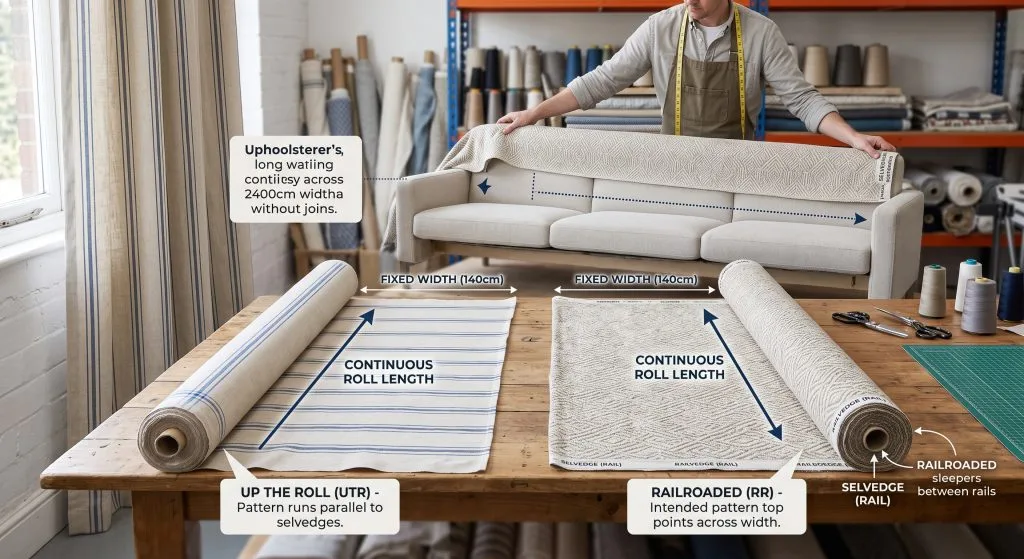
When a fabric specification says “Railroaded: Yes”, it is describing the intended direction of the design on the roll. This small technical note can determine whether a sofa has one clean, continuous upholstered surface or several joins—and whether a stripe appears horizontal or vertical after fabrication.
Railroaded fabric is commonly used across long upholstery pieces, banquettes, headboards and some wide-width window treatments. However, turning an unsuitable fabric sideways can rotate the motif, change the way a pile reflects light, affect stretch or place seams in the wrong direction.
This guide explains railroaded versus up-the-roll fabric, how roll width and pattern direction interact, when railroading may reduce seams, and what to confirm before ordering material for curtains, furniture or a professional interior project.
The Quick Answer
- Up the roll means the design’s upright direction normally follows the length of the roll, parallel to the selvedges.
- Railroaded means the intended upright direction runs across the fabric width, from one selvedge to the other.
- Railroaded fabric can use the continuous roll length to cover a long horizontal surface with fewer seams.
- Railroading does not make a narrow fabric wider; it swaps which fabric dimension serves the height and which serves the length.
- A solid-looking fabric is not automatically safe to turn. Pile, stretch, weave, coating and manufacturer instructions may still make it directional.
- Always confirm direction from the specification, sample arrow, selvedge marking or supplier before cutting.

What Does Railroaded Fabric Mean?
A fabric roll has two principal dimensions:
- the fixed width between the two selvedges; and
- the continuous length that unwinds from the roll.
On a conventional up-the-roll pattern, the top of a flower, stripe or geometric motif points along the roll length. On a railroaded pattern, the intended top points across the width, towards one selvedge.
The term is easy to remember by imagining railway tracks: the selvedges are the two rails and the direction of the railroaded design runs across them like the sleepers between the rails.
Some suppliers use abbreviations such as RR for railroaded and UTR for up the roll. Others use “off the roll,” “continuous” or a directional arrow. Because terminology is not perfectly uniform, the physical orientation should be confirmed rather than inferred from one word.

Railroaded vs Up-the-Roll Fabric
| Consideration | Up the roll | Railroaded |
|---|---|---|
| Upright pattern direction | Along the continuous roll length | Across the fixed width, from selvedge to selvedge |
| Typical orientation | Selvedges remain vertical on an upright curtain drop | Selvedges may run horizontally when the design is installed upright |
| Common advantage | Suitable for conventional curtain drops and vertically oriented motifs | Continuous roll length can span long upholstery or wide treatments |
| Main dimensional limit | Fixed fabric width limits the width of one unjoined piece | Fixed fabric width limits the height or depth of the turned piece |
| Main risk if misunderstood | More seams may be needed across a long surface | Pattern may appear sideways or the width may be insufficient for the required height |
Neither orientation is inherently better. The correct choice depends on the article being fabricated, its dimensions, the direction of the design and the manufacturer’s intended application.

Railroaded Fabric Does Not Mean Extra-Wide Fabric
Railroaded and wide-width describe different things:
- Railroaded describes direction or intended orientation.
- Wide-width describes the physical width of the roll.
A standard furnishing fabric can be railroaded even if its roll is approximately 140 cm wide. A room-high sheer can be around 300 cm wide and also be intended for railroaded use. Conversely, a wide fabric may contain a directional design that cannot be turned for the proposed application.
Always read the width and orientation as two separate specification fields. “Railroaded: Yes” does not guarantee that the fixed width will accommodate the height, depth or drop of the finished item.

Why Railroaded Fabric Can Reduce Upholstery Seams
Consider a sofa outside back that is 230 cm long and 80 cm high before fabrication allowances. With a conventional up-the-roll fabric approximately 140 cm wide, one width cannot span the 230 cm horizontal length, so the upholsterer may need joins.
If a suitable fabric is railroaded, the continuous roll length can run across the 230 cm sofa, while the fixed 140 cm width accommodates the 80 cm height plus the required wrapping and attachment allowances. The visible surface may therefore be cut as one continuous piece.
This principle is useful for:
- long sofa backs and fronts;
- banquette seating;
- bench cushions;
- wide headboards;
- continuous wall panels; and
- large upholstered borders or fascias.
Fewer seams can produce a cleaner appearance, but it does not automatically reduce total consumption. Motif placement, repeat matching, defects, cutting shapes and the remaining usable offcuts still affect the order.

How Railroading Works for Curtains and Sheers
Conventional standard-width curtain fabric is commonly used up the roll. The roll length supplies the curtain drop, and several fabric widths may be joined vertically to achieve the required fullness.
A wide-width or room-high drapery fabric may be designed to run across the window instead. Its fixed width accommodates the finished curtain drop, while the roll is unwound to provide the required horizontal coverage. This can create a seamless or reduced-seam treatment across a wide span.
A Simple Wide-Width Curtain Example
Suppose a wide-width sheer has a usable width of 300 cm. If the required cut drop—including the relevant top and hem allowances—is 286 cm, the width can accommodate that drop when used in the approved railroaded direction.
For a 250 cm track at 2× fullness, the preliminary horizontal fabric requirement is:
250 cm × 2 = 500 cm, or 5 linear metres
The workroom must still add the applicable side hems, overlaps, returns, pattern positioning and contingency. If the 286 cm cut drop exceeded the usable width, the fabric would not cover the height seamlessly in that orientation.
This example is for orientation only. The final calculation depends on the heading, hem, track, repeat, usable width and construction method. AMALI’s curtain panel and fabric width guide explains the underlying width and fullness terms.

Why Standard-Width Railroaded Upholstery Fabric May Not Suit Curtains
A railroaded upholstery fabric around 140 cm wide can span a long sofa because the required upholstered height may fit within that width. A floor-length curtain often requires a much greater drop. Once the design is turned upright, the fixed 140 cm width may become the maximum available vertical dimension.
Creating a longer curtain could require a horizontal seam, which may interrupt the design and become visible when light passes through the fabric. The textile may also be too stiff or heavy to form attractive curtain folds.
Do not select a fabric for curtains merely because the colour is suitable. Confirm drape, weight, intended end use, pattern orientation, width and whether the manufacturer approves it for window treatment.

How Railroaded Patterns Affect Stripes and Motifs
Stripes
A stripe is not automatically vertical. On an up-the-roll striped fabric, the stripe commonly follows the roll length. On a railroaded stripe, it runs from selvedge to selvedge and may appear horizontal when used across a sofa.
Before ordering, draw an arrow showing the required direction on the furniture or window elevation. Compare that arrow with the fabric’s marked top direction. This prevents a correct fabric from being applied in the wrong orientation.
Florals and Geometric Motifs
Flowers, leaves, figures and architectural motifs often have an obvious top and bottom. Turning an up-the-roll fabric sideways may make them visibly incorrect. Geometric designs may appear non-directional at first but reveal a one-way rhythm when a full repeat is viewed.
Checks and Grids
A balanced check may look similar in both directions, but warp and weft spacing, colour or scale can still differ. Confirm the repeat measurements and construction rather than assuming that visual symmetry makes the textile fully reversible in direction.
Pattern repeat must be recalculated in the installed direction. Vertical and horizontal repeat values can exchange roles relative to the finished object when the fabric is turned.

Solid Fabric Can Still Be Directional
The absence of a printed motif does not prove that a fabric can be railroaded. Direction may come from the construction itself.
- Velvet and chenille: pile direction changes touch, reflection and apparent shade.
- Satin and lustrous weaves: warp and weft may reflect light differently.
- Ribbed fabrics: the rib creates a clear visual direction.
- Knits and stretch textiles: extension may differ across and along the roll.
- Coated or backed fabrics: manufacturing and performance instructions may restrict orientation.
- Ombré or subtle tonal designs: colour progression may only become apparent over a large area.
A supplier may approve a non-directional solid for railroaded application even when the specification does not describe a visible pattern. Obtain that confirmation instead of relying only on the face appearance.

Railroading Can Affect Performance and Warranty
Warp and weft are constructed under different conditions and may not behave identically. When a fabric is rotated, the direction of stretch, recovery, load, abrasion and seam stress can also rotate relative to the furniture.
This does not mean every railroaded application performs poorly. It means suitability must come from the fabric specification and the manufacturer or supplier—not from appearance alone. Using a textile contrary to its intended orientation may affect performance expectations or warranty coverage.
For commercial seating, healthcare, hospitality or other contract applications, railroading does not replace verification of abrasion, seam performance, flame requirements, cleaning compatibility or any project-specific standard.

How Direction Changes Fabric Consumption
| Planning question | Up-the-roll application | Railroaded application |
|---|---|---|
| Which dimension is continuous? | Finished height or length can follow the roll length | Finished horizontal span can follow the roll length |
| What does fixed fabric width limit? | Width of one unjoined panel or upholstery piece | Height, depth or drop of the turned piece |
| Where may seams be reduced? | Across long vertical drops | Across long sofas, benches or wide treatments |
| What repeat controls the plan? | Repeat in the conventional installed direction | Repeat axes swap relative to the finished object |
| What must be checked? | Usable width, drop, joins and vertical motif | Usable width as height/depth, continuous length and approved orientation |
Railroading may reduce seams but create different offcuts. A long sofa piece can consume a continuous length even if much of the fixed width remains unused. A nesting plan for cushions and smaller components determines whether that remaining material can be used efficiently.

When Railroaded Fabric Is a Strong Choice
- The supplier specifically marks the textile as railroaded or suitable for railroaded application.
- A long sofa, banquette or headboard would otherwise need prominent seams.
- The fixed fabric width accommodates the complete height or depth plus construction allowances.
- The motif appears upright and correctly oriented after turning.
- Pile, stretch, coating and performance remain suitable in the installed direction.
- A wide-width curtain or sheer is designed for seamless horizontal use.

When You Should Not Railroad the Fabric
- The specification says “Railroaded: No” or the supplier advises against it.
- The floral, stripe, figure or geometric motif would face the wrong direction.
- The fixed width is smaller than the required height, depth or curtain drop.
- The pile or sheen produces unacceptable shading when turned.
- The stretch or seam behaviour becomes unsuitable for the applied load.
- A coating, backing or performance condition requires the normal orientation.
- The change may invalidate the relevant manufacturer guidance or warranty.

How to Check Whether a Fabric Is Railroaded
- Read the technical specification. Look for Railroaded, RR, UTR, pattern direction or a directional arrow.
- Identify both selvedges. Confirm which edges define the fixed roll width.
- View a full repeat. A small cutting may hide the top and bottom of a large motif.
- Check pile and sheen. Brush and rotate the sample under the project lighting.
- Measure usable width. Exclude unusable selvedges and confirm whether the required height or depth fits.
- Mark the installed top. Use a clear arrow on the sample and drawing.
- Ask the fabricator. Confirm seams, pattern placement, nesting and total consumption before purchase.
- Obtain supplier confirmation. Do this especially for contract upholstery, coated textiles or any fabric marked “No.”
Browse the AMALI fabric catalogue to compare furnishing textiles by intended application, width, composition and available specification.

What to Tell the Supplier or Fabricator
- Fabric collection, design and colour reference
- Intended use: curtains, sheer, sofa, banquette, headboard or another application
- Complete finished dimensions
- Required visual direction of stripes or motifs
- Preference for seamless or minimum-seam construction
- Usable fabric width and repeat measurements
- Whether the specification states railroaded yes or no
- Performance, cleaning and project requirements
- Number of matching pieces and required batch consistency
Example enquiry: We need to upholster a 240 cm long banquette back with an 85 cm finished height. Please confirm whether this fabric is approved for railroaded application, whether its usable width accommodates the height and allowances, which direction the motif will face, and the final consumption including repeat matching.

Common Railroading Mistakes
- Assuming railroaded means the roll is physically extra wide.
- Turning a fabric because it appears solid without checking pile or construction.
- Ordering from a small sample that does not show the full motif direction.
- Forgetting that the fixed width becomes the available height or depth.
- Expecting railroading to reduce both seams and total consumption automatically.
- Installing striped fabric in the opposite direction from the approved drawing.
- Mixing pile directions across adjoining sofa or curtain pieces.
- Ignoring repeat matching after rotating the axes.
- Using upholstery fabric for curtains without checking drape and end-use suitability.
- Cutting before supplier and fabricator approval is documented.

Frequently Asked Questions
What does “railroaded” mean on a fabric specification?
It generally means the design’s intended upright direction runs across the fabric width, from selvedge to selvedge, allowing the continuous roll length to span a long horizontal surface.
Is railroaded fabric wider than ordinary fabric?
Not necessarily. Railroaded describes orientation; wide-width describes physical roll width. A fabric can be standard-width and railroaded, wide-width and railroaded, or wide-width but unsuitable for turning.
Can any plain fabric be railroaded?
No. A plain-looking fabric may have directional pile, sheen, ribs, stretch or backing. Check the technical specification and obtain supplier approval.
Why is railroaded fabric useful for sofas?
The continuous roll length can run across a long sofa back, front or cushion, potentially avoiding joins that would be required if the fixed roll width ran horizontally.
Can railroaded upholstery fabric be used for floor-length curtains?
Often not seamlessly if the fixed width is only around 140 cm, because that width becomes the available vertical drop when the motif is turned upright. Wide-width drapery fabric designed for the purpose is a different case.
Does railroading eliminate pattern matching?
No. It changes the orientation of the pattern and repeat axes. Motifs may still need centring and matching across cushions, corners, borders or separate furniture components.
Does railroaded fabric always use fewer metres?
No. It may reduce seams, but consumption still depends on fixed width, finished dimensions, repeat, placement and offcut reuse. A cutting plan is required for an accurate comparison.
How can I identify the top of the fabric?
Check the specification, selvedge printing, sample label or directional arrow. If the direction remains unclear, ask the supplier to mark the intended top on a full-repeat sample.

The Final Answer
Railroaded fabric has its intended design direction running across the width from selvedge to selvedge. This lets the continuous roll length cover long horizontal surfaces and can reduce seams on sofas, banquettes, headboards and suitable wide-width window treatments.

The decision must still account for usable width, motif direction, repeat, pile, stretch, performance and end use. Confirm the orientation with both the supplier and fabricator before ordering or cutting; once the fabric is rotated, every dimensional and pattern-planning assumption changes with it.